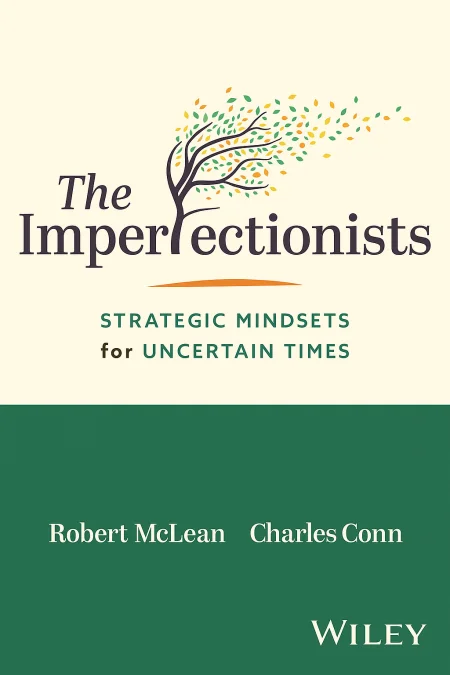
The Imperfectionists
Strategic Mindsets for Uncertain Times
Book Edition Details
Summary
Amidst the relentless tide of change and chaos that defines our current era, "The Imperfectionists" emerges as a beacon for those seeking to navigate uncertainty with agility and insight. Authors Conn and McLean, building on their previous success, invite readers to abandon outdated strategies and embrace a revolutionary mindset. Through the lens of six transformative principles—curiosity, dragonfly vision, active engagement, communal intelligence, the embrace of imperfection, and the power of storytelling—this book charts a course for proactive decision-making in volatile environments. Here, the imperfectionist thrives, not by awaiting stability or making reckless gambles, but by adapting through informed risk-taking and learning from every step. Equip yourself with the strategic prowess to not only survive but excel in a world where uncertainty is the only constant.
Introduction
In an era where disruption has become the norm rather than the exception, organizations across all sectors find themselves navigating uncharted waters with increasing frequency. Traditional strategic planning, built on assumptions of predictable markets and linear growth, proves inadequate when faced with exponential technological change, global pandemics, and radical shifts in consumer behavior. The question that confronts leaders today is not whether uncertainty will impact their organizations, but how they can develop the cognitive frameworks necessary to thrive amidst perpetual ambiguity. The answer lies in cultivating specific mental orientations that transform uncertainty from a paralyzing force into a source of competitive advantage. These strategic mindsets represent a departure from conventional risk-averse thinking, offering instead a framework for intelligent risk-taking and adaptive problem-solving. They challenge the fundamental assumption that certainty is a prerequisite for action, proposing instead that the ability to act effectively under conditions of incomplete information has become the defining capability of successful organizations. This theoretical framework addresses how leaders can systematically develop the intellectual tools necessary to step confidently into uncertainty while avoiding both reckless gambling and paralyzing inaction.
The Six Problem-Solving Mindsets Under Uncertainty
The foundation of effective decision-making in uncertain environments rests upon six interconnected cognitive orientations that collectively form a comprehensive framework for navigating complexity. These mindsets represent a systematic departure from traditional analytical approaches, emphasizing dynamic thinking over static planning and adaptive learning over rigid adherence to predetermined strategies. The first mindset, Ever Curious, transforms uncertainty from a source of anxiety into a catalyst for discovery. This orientation recognizes that in rapidly changing environments, the questions we ask become more valuable than the answers we possess. Curiosity drives the continuous acquisition of new information and challenges existing assumptions, preventing organizations from falling into the trap of pattern recognition when patterns themselves are evolving. Rather than seeking to eliminate uncertainty, the curious mindset embraces it as a signal that new opportunities may be emerging. The Dragonfly Eye mindset introduces the concept of multi-perspective analysis, drawing its name from the compound vision system that allows dragonflies to perceive their environment through thousands of individual lenses simultaneously. This cognitive approach prevents the tunnel vision that often accompanies expertise, encouraging decision-makers to examine challenges from multiple angles before committing to a particular course of action. Like a dragonfly's ability to detect threats and opportunities from all directions, this mindset equips organizations with the perceptual range necessary to identify both emerging risks and hidden possibilities. Occurrent Behavior emphasizes the critical importance of generating new data through controlled experimentation rather than relying solely on historical information or expert opinion. This mindset recognizes that in times of rapid change, past performance becomes an increasingly unreliable predictor of future outcomes. By creating small-scale tests and natural experiments, organizations can gather real-time intelligence about how their environment is evolving, allowing them to make informed decisions based on current realities rather than outdated assumptions.
Building Curiosity and Multi-Perspective Thinking
The cultivation of genuine intellectual curiosity within organizational settings requires a fundamental shift from answer-seeking to question-generating behaviors. Effective curiosity operates as a systematic approach to identifying knowledge gaps and actively working to close them through structured inquiry and experimentation. This process involves creating psychological safety for questioning established practices, allocating time and resources for exploration, and rewarding the discovery of information that challenges conventional wisdom. Multi-perspective thinking emerges from the recognition that complex problems rarely yield to single-lens analysis. The Dragonfly Eye approach involves systematically examining challenges through different conceptual frameworks, stakeholder viewpoints, and temporal horizons. This methodology prevents the cognitive tunnel vision that often accompanies deep expertise, where mastery in one domain can inadvertently blind decision-makers to insights from adjacent fields or alternative approaches. The practical implementation of multi-perspective thinking involves creating structured processes for challenging initial assumptions and deliberately seeking out contrarian viewpoints. Organizations that master this approach often establish formal mechanisms for perspective-taking, such as red team exercises where participants argue against proposed strategies, or structured brainstorming sessions that require exploration of problems from the viewpoint of different stakeholder groups. The power of these combined mindsets becomes evident when organizations face unprecedented challenges that cannot be solved through conventional approaches. By maintaining active curiosity about changing conditions while simultaneously examining problems from multiple angles, leaders can identify innovative solutions that would remain invisible to more narrowly focused analytical approaches. This combination proves particularly valuable when dealing with complex systems where cause and effect relationships are non-linear and conventional wisdom may no longer apply.
Experimentation and Collective Intelligence Strategies
The systematic generation of new knowledge through controlled experimentation represents a cornerstone of effective decision-making under uncertainty. Occurrent Behavior moves beyond theoretical modeling and historical analysis to create real-world tests that reveal how systems actually function under current conditions. This approach recognizes that in rapidly evolving environments, the most reliable source of information about future outcomes comes from carefully designed present-moment experiments rather than extrapolation from past data. Effective experimentation requires balancing the costs of testing against the value of information gained, with particular attention to designing reversible experiments that provide maximum learning at minimal risk. The methodology involves formulating specific hypotheses, creating controlled conditions for testing, and establishing clear metrics for success or failure. Perhaps most importantly, it requires organizational cultures that view failed experiments as valuable sources of information rather than costly mistakes. Collective Intelligence emerges from the recognition that in an era of exponential knowledge growth, no individual or organization can possess all the expertise necessary to solve complex problems. This mindset involves systematically accessing and integrating insights from diverse sources, including crowdsourcing platforms, cross-industry partnerships, and interdisciplinary collaborations. The approach acknowledges that breakthrough solutions often emerge from the intersection of different knowledge domains rather than from deepening expertise within existing silos. The implementation of Collective Intelligence strategies involves creating platforms and processes that can effectively harness distributed knowledge while maintaining quality control and strategic focus. This might include establishing innovation tournaments that attract external problem-solvers, creating partnerships with organizations that possess complementary capabilities, or developing systems that can identify and integrate insights from unexpected sources. The key lies in maintaining openness to external input while developing the organizational capability to synthesize diverse perspectives into coherent action plans.
Imperfectionism and Strategic Communication Methods
Imperfectionism represents a sophisticated approach to risk management that navigates between the extremes of reckless gambling and paralyzing risk aversion. This mindset acknowledges that in uncertain environments, the pursuit of perfect information before taking action often results in missed opportunities or competitive disadvantage. Instead, it emphasizes making informed decisions with incomplete information while building in mechanisms for learning and adjustment as new data becomes available. The practical application of Imperfectionism involves developing organizational capabilities for intelligent risk-taking, including the ability to make reversible decisions quickly, create option value through small initial investments, and build learning systems that can rapidly incorporate new information into strategic planning processes. This approach requires clear frameworks for distinguishing between acceptable and unacceptable risks, with particular attention to protecting against catastrophic downside outcomes while maintaining upside potential. Strategic communication through Show and Tell methodologies recognizes that even the most brilliant insights and well-designed strategies fail to create impact if they cannot be effectively communicated to key stakeholders. This mindset involves moving beyond traditional presentation formats to create compelling narratives that engage both rational and emotional decision-making processes. The approach emphasizes the use of visual storytelling, concrete demonstrations, and value-based messaging to overcome resistance to change and build support for new initiatives. Effective Show and Tell strategies involve understanding the cognitive and emotional frameworks that different audiences use to process information, then crafting messages that resonate with those frameworks while advancing strategic objectives. This might include using metaphors and analogies that make complex concepts accessible, creating visual representations that make abstract ideas concrete, or designing experiences that allow stakeholders to personally experience the benefits of proposed changes. The ultimate goal is to transform understanding into commitment and action.
Summary
The six strategic mindsets for uncertain times form an integrated system for transforming organizational capability in the face of unprecedented change and complexity. True strategic advantage in uncertain environments emerges not from the ability to predict the future, but from developing the cognitive agility to sense emerging patterns, experiment intelligently with new approaches, and adapt rapidly based on real-world feedback. These mindsets represent a fundamental evolution in strategic thinking, moving from planning-based approaches that assume predictability to learning-based approaches that thrive on uncertainty and change, ultimately positioning organizations to not merely survive disruption but to leverage it as a source of sustainable competitive advantage.
Related Books
Download PDF & EPUB
To save this Black List summary for later, download the free PDF and EPUB. You can print it out, or read offline at your convenience.
By Charles Conn
