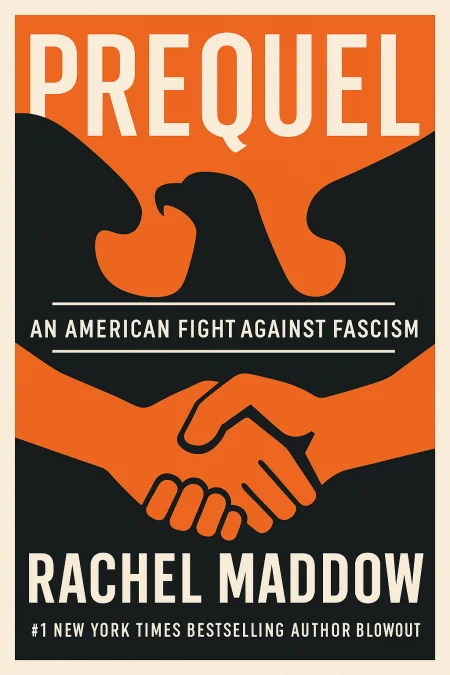
Prequel
An American Fight Against Fascism
Book Edition Details
Summary
In a forgotten chapter of American history, Rachel Maddow unearths a chilling tale of subversion that almost altered the nation’s course. "Prequel" unveils the audacious efforts of a covert network—funded by Nazi sympathizers—determined to forge a sinister alliance during the throes of World War II. At a time when democracy teetered on the brink, a mix of courageous citizens, relentless journalists, and tenacious public servants risked everything to expose a conspiracy aimed at dismantling the very essence of American freedom. With an insidious campaign of disinformation and intimidation, these plotters threatened to undermine democratic institutions from within. As tensions mounted, the justice system waged a fraught battle against these internal enemies, highlighting a dramatic struggle between integrity and intimidation. Maddow’s gripping narrative not only resurrects this near-buried story but also offers a resonant warning—and a beacon of hope—in today’s unsettling political landscape.
Introduction
In the depths of the Great Depression, while Americans struggled with breadlines and bank failures, a more insidious threat was quietly taking root across the nation. This was not the story of foreign armies marching on American soil, but of Nazi agents operating from comfortable offices in Manhattan, of sitting congressmen unknowingly distributing Hitler's propaganda, and of armed militias training in remote camps for the day they would overthrow the government. The period from the 1930s through the 1940s revealed how close America came to succumbing to fascism from within, and how ordinary citizens became the unlikely heroes who saved democracy itself. This forgotten chapter exposes the sophisticated machinery of Nazi infiltration that reached into the highest levels of American government, exploiting the very freedoms that defined democratic society. It illuminates the courage of undercover agents, investigative journalists, and federal prosecutors who risked everything to expose these plots, often working alone when institutions failed to act. For anyone seeking to understand how democracies defend themselves against authoritarian movements, these stories provide both sobering warnings about institutional vulnerability and inspiring examples of citizen resistance. The tactics revealed here remain disturbingly relevant today, offering essential insights for recognizing and countering similar threats in our own era.
Seeds of Subversion: Nazi Networks Take Root (1933-1939)
The Nazi infiltration of America began almost immediately after Hitler's rise to power, taking advantage of a nation reeling from economic collapse and social upheaval. German agents established a sophisticated network of cultural organizations, publishing houses, and training camps across the United States, pouring millions of dollars into operations designed to weaken American resolve and prevent interference with Hitler's European ambitions. The German American Bund emerged as the most visible face of this campaign, conducting massive rallies complete with Nazi symbolism while maintaining the facade of legitimate political activity. Behind the scenes, more dangerous elements were coalescing around charismatic figures who promised simple solutions to complex problems. William Dudley Pelley's Silver Shirts attracted thousands of middle-class Americans with their blend of Christian nationalism and antisemitic conspiracy theories, conducting paramilitary training while stockpiling weapons. George Deatherage's American Nationalist Confederation sought to unite various extremist groups under a single banner, explicitly preparing for "Der Tag" when they would seize power after the 1940 election. The propaganda found receptive audiences among Americans devastated by unemployment and social change. Father Charles Coughlin's radio broadcasts reached thirty million listeners weekly, gradually shifting from economic critique to violent antisemitism. Respected figures like aviator Charles Lindbergh lent their credibility to isolationist causes that served Nazi interests, while business leaders like Henry Ford had already poisoned American discourse with antisemitic publications for years. What made this period so dangerous was how easily fascist ideology penetrated mainstream American institutions. The movements exploited legitimate grievances about economic inequality and social disruption, channeling them toward scapegoating and violence. This established the foundation for a much larger threat that would emerge as war clouds gathered over Europe, demonstrating how democratic societies remain vulnerable to authoritarian exploitation of their own freedoms and divisions.
Congressional Infiltration: The Viereck Propaganda Machine (1939-1941)
As Hitler's armies swept across Europe, the Nazi influence operation in America shifted into unprecedented sophistication and audacity. George Sylvester Viereck, a German agent who had conducted propaganda campaigns during World War I, orchestrated perhaps the most brazen foreign influence campaign in American history. His strategy centered on exploiting the congressional franking privilege, transforming this democratic institution into a vehicle for distributing Nazi propaganda to millions of American homes. Senator Ernest Lundeen of Minnesota became Viereck's primary congressional asset, unknowingly allowing his office to serve as a distribution center for German-authored materials. Speeches written by Nazi agents were inserted into the Congressional Record under Lundeen's name, then reprinted and mailed across the country using taxpayer-funded postage. Representative Hamilton Fish's office similarly became a conduit for propaganda, with staff members actively participating in the distribution scheme while remaining largely unaware of its foreign origins. The operation's scope was staggering in its reach and ambition. Over three million pieces of Nazi propaganda were distributed through congressional offices, reaching American communities with the implicit endorsement of elected officials. Viereck built massive mailing lists targeting teachers, clergy, business leaders, and military personnel, while establishing front organizations like the Make Europe Pay War Debts Committee to provide cover for his activities. The German government invested millions in this effort, recognizing that keeping America out of the war was worth any price. This systematic exploitation of democratic processes revealed fundamental vulnerabilities in American institutions, demonstrating how the very openness that defined democracy could be weaponized against it. The success of Viereck's operation showed how foreign adversaries could manipulate public opinion through trusted channels, blurring the line between legitimate political debate and enemy propaganda. The campaign's effectiveness would soon inspire even more direct challenges to American sovereignty and democratic governance.
Armed Conspiracies: From Rhetoric to Revolutionary Plots (1940-1942)
The transition from propaganda to direct action marked a dangerous escalation in the fascist threat to American democracy. Between 1940 and 1942, law enforcement uncovered multiple conspiracies involving armed groups planning the violent overthrow of the government, representing the logical culmination of years of ideological preparation and foreign encouragement. These plots transformed abstract fascist rhetoric into concrete plans for insurrection, revealing how close America came to experiencing domestic terrorism on an unprecedented scale. The Christian Front conspiracy, centered in New York and inspired by Father Coughlin's increasingly militant rhetoric, exemplified this evolution toward violence. Led by John Cassidy, the group stockpiled weapons and explosives while conducting military training in preparation for what they termed a "Christian revolution." FBI infiltration revealed detailed plans to assassinate prominent Jewish Americans and government officials, seize federal facilities, and establish an authoritarian Christian state. When arrested in January 1940, the seventeen conspirators possessed machine guns, rifles, and homemade bombs. Simultaneously, investigations revealed broader networks of armed fascist cells across the country, with intelligence reports documenting connections between domestic groups and German agents. The Silver Shirts maintained weapons caches and conducted paramilitary training, while various militia groups coordinated plans for synchronized uprisings. This suggested a level of foreign coordination that transformed isolated extremist activities into potential national security threats, with Nazi Germany actively encouraging and supporting armed resistance to American democracy. The exposure of these plots demonstrated both the gravity of the fascist threat and the effectiveness of democratic institutions in responding to it. Federal law enforcement, despite initial skepticism and resource constraints, successfully penetrated these conspiracies and disrupted their operations through patient investigative work and undercover operations. However, the legal proceedings that followed would expose another vulnerability in democratic defense: the difficulty of prosecuting political crimes while maintaining commitment to free speech and due process.
Failed Justice: The Great Sedition Trial Collapses (1943-1946)
The Great Sedition Trial of 1944 represented both the climax and ultimate frustration of America's legal response to domestic fascism. Prosecutor O. John Rogge assembled what appeared to be an airtight case against thirty defendants, including major figures from the fascist underground and their congressional enablers, detailing a vast conspiracy involving Nazi agents, domestic extremists, and elected officials in coordinated efforts to undermine American democracy and military morale. The trial itself became a spectacle of deliberate disruption and legal manipulation that revealed the fundamental challenge of prosecuting political crimes in a democratic system. Defense attorneys employed every conceivable delaying tactic and procedural challenge, while defendants regularly interrupted proceedings with outbursts, Nazi salutes, and coordinated chanting designed to create chaos and prevent the prosecution from presenting evidence. The courtroom atmosphere deteriorated into what observers described as "bedlam," with Judge Edward Eicher struggling to maintain order while respecting defendants' rights. The proceedings dragged on for eight months, consuming enormous resources while generating sympathy for defendants among their supporters. When Judge Eicher died of a heart attack, widely attributed to the stress of managing the chaotic proceedings, the case ended in mistrial. The defendants had successfully exploited the very democratic processes they sought to destroy, demonstrating how commitment to due process could be weaponized by enemies of democracy itself. The aftermath exposed deeper institutional weaknesses in America's response to authoritarian threats. Political pressure from congressional allies of the defendants led to the removal of key prosecutors, while evidence of Nazi infiltration was suppressed to avoid embarrassing prominent Americans. When prosecutor Rogge attempted to make his findings public after traveling to Germany and interviewing captured Nazi officials, he was fired by Attorney General Tom Clark under pressure from implicated politicians and President Truman himself. The decision to abandon further prosecution reflected a broader American tendency to avoid reckoning with uncomfortable truths about democratic vulnerability, leaving unresolved fundamental questions about how democracies should defend themselves against internal enemies.
Summary
The struggle between American fascism and democracy during the 1930s and 1940s reveals a fundamental tension that continues to define democratic societies: the challenge of defending open institutions against those who exploit their openness for authoritarian ends. This historical period demonstrates how economic crisis, social division, and foreign manipulation can combine to create existential threats to democratic governance, while also illuminating the sources of democratic resilience and the critical importance of citizen vigilance in preserving freedom. The lessons from this era offer crucial insights for contemporary democratic defense. The recognition that authoritarian movements rarely emerge fully formed but develop through gradual normalization of extremist rhetoric and systematic exploitation of democratic processes remains painfully relevant today. Foreign influence operations succeed not through crude propaganda but through sophisticated manipulation of existing social divisions and legitimate grievances, a pattern that continues to threaten democratic societies worldwide. Perhaps most importantly, this history reveals that legal and institutional responses to authoritarian threats must balance democratic values with practical necessities of defense, requiring both vigilance and wisdom to avoid destroying democracy in order to save it. These historical insights demand active engagement from citizens committed to democratic values. The preservation of democracy requires not passive faith in institutions but active participation in their defense, informed understanding of authoritarian tactics, and willingness to confront uncomfortable truths about democratic vulnerabilities. The heroes of this story were ordinary Americans who chose to investigate, expose, and resist when their institutions failed to act, demonstrating that the ultimate defense of democracy lies not in any single institution but in the courage and commitment of citizens themselves.
Related Books
Download PDF & EPUB
To save this Black List summary for later, download the free PDF and EPUB. You can print it out, or read offline at your convenience.
By Rachel Maddow
