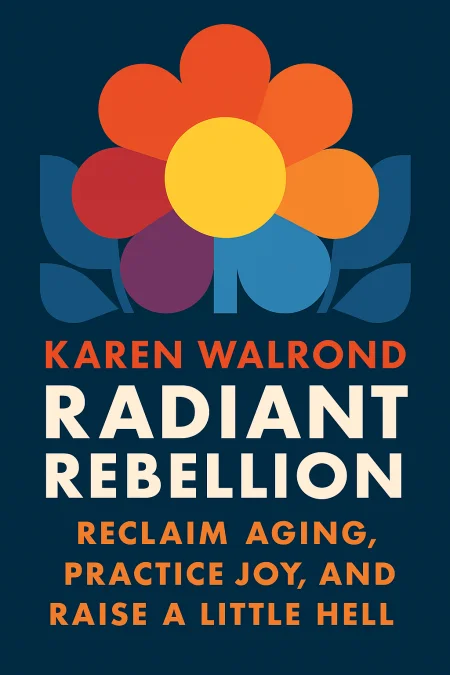
Radiant Rebellion
Reclaim Aging, Practice Joy, and Raise a Little Hell
Book Edition Details
Summary
Age is often shrouded in clichés of decline, but what if it were a vibrant canvas instead? In "Radiant Rebellion," Karen Walrond invites you to challenge the stereotypes and embrace the adventure of growing older. With her characteristic warmth and insight, Walrond embarks on a transformative journey through the landscape of aging—uncovering layers of health, beauty, and spirituality. She dialogues with social thinkers, engages in bold experiments, and redefines her relationship with time. This book is more than a manifesto; it’s a call to arms against internalized ageism and a guide to crafting a future brimming with potential and joy. Are you ready to defy the ordinary and pen your own radiant tale?
Introduction
The bathroom mirror doesn't lie, but sometimes it tells stories we're not ready to hear. Standing there one December evening, Karen caught sight of her reflection and felt a jolt of recognition mixed with surprise. The woman looking back seemed older, more weathered than she remembered. Sixteen months of rebuilding after Hurricane Harvey had left its mark, etching stress and exhaustion into her features in ways that caught her off guard. But instead of surrendering to despair about aging, Karen made a choice that would transform everything she thought she knew about growing older. This is the story of one woman's rebellion against society's narrative that aging equals inevitable decline. Through honest conversations with experts, personal experiments in self-care, and deep reflection on what it truly means to age with purpose, we discover how the fear of growing older has been manufactured by industries that profit from our insecurities. More importantly, we learn how to reclaim the narrative of our later years, transforming them from a season of loss into one of expansion, wisdom, and authentic self-expression. The journey reveals that our attitudes toward aging don't just affect how we feel about ourselves—they literally impact how long and how well we live.
The Mirror Revelation: Confronting Ageism Within and Without
Karen's revelation came not in a moment of vanity, but in a flash of honest recognition. After months of rebuilding her life following Hurricane Harvey, she caught sight of herself and thought, "Good Lord, I've aged." But as she examined her reflection more closely, she realized something profound: what she was seeing wasn't the inevitable march of time, but the visible effects of prolonged stress. Her "pilot light" had gone out, and she could see it written across her features. This moment sparked a year-long commitment to simple self-care practices. Five-minute morning meditations with prayer beads. Hula-hooping to uplifting podcasts in her garage. Drinking more water and practicing daily gratitude. Nothing revolutionary, nothing expensive—just consistent attention to her own well-being. When her friend Laura visited a year later, she immediately noticed the transformation. "Your pilot light is back," she said, and Karen knew exactly what she meant. The experience led Karen to question a more insidious problem: internalized ageism. Through conversations with anti-ageism activist Ashton Applewhite, she discovered how deeply we've absorbed negative messages about aging from childhood. We learn to fear our future selves, to see aging as decline rather than evolution. Even phrases like "I don't feel old" reveal our bias, as if energy, curiosity, and willingness to take chances are the exclusive domain of youth. The truth is more liberating: age can be freeing, offering us the confidence to take risks we were too worried about peer approval to take when we were younger. Recognizing our internalized ageism becomes the first step toward writing a different story about our own aging journey, one where we approach our changing selves with curiosity rather than criticism.
Silver Hair Revolution: Beauty, Authenticity and Professional Courage
At fifty-three, Karen stood in her bathroom with dye-covered hands, suddenly questioning a ritual she'd performed every six weeks for years. What am I doing? she wondered. The decision to stop coloring her hair wasn't born of laziness or surrender, but of curiosity about what it would mean to stop hiding from her natural evolution. In a culture where over seventy percent of American women dye their hair, going gray becomes almost a radical act. The transformation revealed something unexpected about beauty and authenticity. As Karen's salt-and-pepper hair grew out, strangers regularly complimented her striking appearance. But she realized they weren't just admiring her hair color—they were responding to her comfort with it. In a world where women are expected to fight aging at every turn, someone who embraces their natural evolution becomes noteworthy, even inspiring. Working with style activist Stasia Savasuk, Karen discovered that authentic style isn't about following trends or hiding perceived flaws, but about achieving "inside-out congruency." She cleaned out her closet based not on what was fashionable, but on what reflected her values and heritage. The jewel tones that made her feel vibrant. The indigo that connected her to her Caribbean ancestors. The colors and silhouettes that made her think, when looking in the mirror, "There I am." Model and activist Karen Williams, who returned to modeling in her fifties with silver hair, offered another perspective: true beauty emanates from purpose, passion, and love. When we're filled with meaning and moving with intention, it shows in every photograph, every interaction, every moment. The beauty industry may profit from our insecurities, but the most magnetic quality anyone can possess is the confidence to show up as exactly who they are.
Beyond Appearance: Spiritual Practice and Purpose-Driven Living
The foundation of Karen's spiritual exploration was laid in her grandmother's bedroom in Trinidad, surrounded by Sacred Heart statues and the scent of perfume bottles. Her grandmother's advice was simple: "Always pray to Jesus. He will help you." But as Karen grew older, she realized that spiritual practice could be both more personal and more expansive than the religious traditions of her childhood. Through conversations with Lutheran minister Tuhina Verma Rasche, who maintains both Christian and Hindu practices, Karen learned that spiritual traditions don't have to be reconciled to coexist. Tuhina's daily practice includes journaling, mindful walking, and calling on ancestors for guidance. Her approach to taking up space in the world, both physically and spiritually, resonated with Karen's own desire for expansion rather than contraction as she aged. A solo retreat in the Texas woods, complete with a power outage that forced Karen into unexpected meditation, revealed the power of slowing down and connecting with something larger than herself. The simple practice of sitting in silence, breathing deeply, and allowing thoughts to settle brought a peace she hadn't realized she was missing. Research supports what Karen experienced: spiritual practices can significantly impact memory, cognition, and overall mental health as we age. The journey also led Karen to explore her African Caribbean heritage through conversations with Trinidad Orisha practitioner Attillah Springer. What colonizers had labeled as "obeah" and dismissed as dark magic was actually the spiritual practice of her enslaved ancestors, a connection to nature and ancestral wisdom that had been systematically suppressed. Learning to call on her ancestors for guidance, to set daily intentions, and to honor the sacred in everyday moments became part of Karen's expanding spiritual toolkit that grounded her in purpose beyond physical appearance.
Creating Legacy: From Personal Transformation to Collective Impact
When Karen's body began changing in ways that felt unfamiliar, her doctor's response was dismissive: "Welcome to getting older. It happens." The night sweats, stubborn weight, and joint stiffness were simply brushed off as inevitable consequences of being in her late forties. But Karen refused to accept this non-answer, embarking on a deeper investigation into what her body actually needed rather than what it was supposedly losing. Working with neurologist Dr. Reeta Achari, Karen discovered that her "boring" healthy lifestyle had masked significant vitamin deficiencies and concerning trends in her cholesterol and blood sugar. Despite eating well and exercising regularly, her body wasn't getting what it needed to function optimally. Through comprehensive testing and personalized supplementation, combined with a shift toward viewing food as nourishment rather than restriction, Karen experienced a transformation that went far beyond appearance. The revelation extended beyond personal health to collective impact. Karen began sharing her discoveries with friends, family, and eventually a broader audience. Her willingness to challenge medical dismissiveness and demand real answers inspired other women to advocate for their own health needs. What started as personal curiosity evolved into a mission to help others rewrite their aging stories. The most profound shift came when Karen recognized that her accumulated experiences, both challenging and joyful, had equipped her with unique gifts to offer the world. Her journey from hurricane survivor to health advocate to spiritual seeker wasn't just personal growth—it was preparation for a larger purpose. When we approach aging as an opportunity to deepen our impact rather than mourn our youth, we discover that our most powerful and purposeful years may still lie ahead of us.
Summary
Karen's journey from that stressed reflection in her bathroom mirror to a woman comfortable in her evolving skin reveals a profound truth: aging is not something that happens to us, but something we can actively shape through our choices, attitudes, and daily practices. By refusing to accept dismissive medical care, challenging beauty standards that demand we hide our natural evolution, and cultivating spiritual practices that honor our full heritage, we can rewrite the narrative of what it means to grow older with intention and purpose. The research is clear: our attitudes toward aging literally affect our longevity and quality of life. Those with positive views of aging live an average of 7.5 years longer than those with negative perspectives. This isn't about toxic positivity or denying the real challenges that can come with age, but about recognizing that much of what we fear about aging has been manufactured by industries that profit from our insecurities. When we approach our changing bodies with curiosity rather than criticism, when we express our authentic selves rather than trying to appear younger, when we build spiritual practices that ground us in purpose, we discover that aging can be a season of expansion rather than decline. The invitation is not to become a super-ager or to deny the reality of physical changes, but to approach our future selves with the same compassion and possibility we'd offer a dear friend, trusting that our best years may very well be ahead of us.
Related Books
Download PDF & EPUB
To save this Black List summary for later, download the free PDF and EPUB. You can print it out, or read offline at your convenience.
By Karen Walrond
