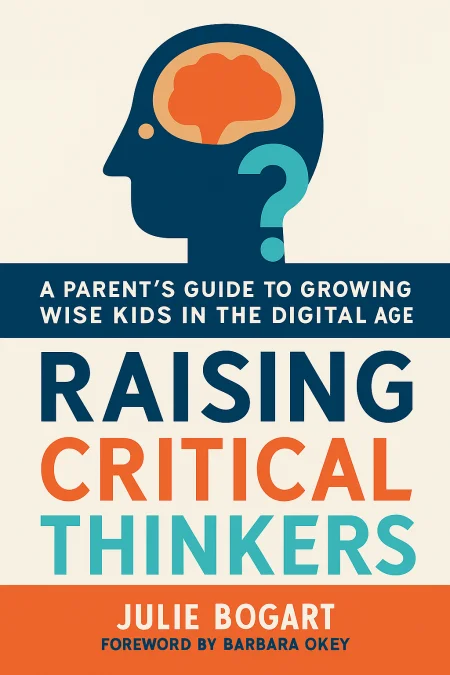
Raising Critical Thinkers
A Parent's Guide to Growing Wise Kids in the Digital Age
byBarbara Oakley, Julie Bogart
Book Edition Details
Summary
In an era where screens bombard young minds with endless streams of data, parents face the daunting task of guiding their children through this digital deluge. Julie Bogart, with over two decades of homeschooling expertise, presents a lifeline for those eager to cultivate discerning, independent thinkers. Her book, "Raising Critical Thinkers," is not just another parenting manual; it’s an invitation to nurture curiosity and empathy in a world that often drowns out both. Through engaging anecdotes and scientifically grounded exercises, Bogart empowers families to explore biases and beliefs with fresh perspectives. This is a toolkit for raising children who don’t just absorb information but transform it into meaningful understanding.
Introduction
How do we prepare young minds to navigate a world where information masquerades as truth and opinions carry the weight of facts? The traditional educational model of memorizing content and regurgitating answers has proven inadequate for developing the sophisticated reasoning skills our complex society demands. What emerges from contemporary educational research is a revolutionary understanding that genuine critical thinking begins not with analyzing external sources, but with examining our own cognitive processes first. This framework introduces self-aware critical thinking as a systematic approach that transforms how children engage with information, form judgments, and make decisions. Rather than simply teaching students to critique others' ideas, this methodology develops their capacity for metacognition—the ability to think about thinking itself. The framework addresses fundamental questions about how identity shapes belief formation, how emotions influence reasoning, and how we can distinguish between observable facts and subjective interpretations. By establishing this foundation of cognitive self-awareness, children develop the intellectual humility and mental flexibility necessary for authentic critical analysis, preparing them to become thoughtful contributors to an interconnected global community.
Self-Aware Critical Thinking: Identity and Cognitive Filters
Self-aware critical thinking represents a fundamental departure from conventional approaches that focus primarily on evaluating external information. This framework recognizes that all reasoning occurs through the lens of personal identity, which functions simultaneously as both a window for viewing the world and a filter that adjusts our perceptions. Understanding this dual nature of identity becomes essential for developing genuine analytical capabilities. The architecture of self-aware thinking operates through multiple interconnected layers that shape how we process information. Our individual perspectives, formed through personal experiences and cultural background, create unique interpretive frameworks that influence what we notice and how we understand it. Our community affiliations provide shared values and collective narratives that help us make sense of complex realities, while our emotional responses and direct experiences create powerful perceptual filters that can either enhance or limit our understanding. Finally, our reasoning systems—the logical frameworks we use to connect ideas and draw conclusions—complete this complex cognitive ecosystem. This multilayered approach reveals itself clearly in everyday situations. When children encounter a familiar story told from an unexpected perspective, such as a fairy tale narrated by the traditional villain, they instinctively recognize the shift because their previous exposure has shaped their expectations. This demonstrates the "mere exposure effect" in action—we tend to trust information that feels familiar while remaining skeptical of perspectives that challenge our established mental models. By helping students recognize these automatic responses, educators can foster greater intellectual flexibility and openness to alternative viewpoints. The practical application of this self-awareness extends beyond academic exercises into real-world decision-making. Students learn to pause before forming judgments, asking themselves what aspects of their identity might be influencing their interpretation. This metacognitive practice doesn't eliminate bias—an impossible goal—but rather acknowledges its presence and accounts for its effects, leading to more nuanced and accurate understanding.
Three Learning Pathways: Reading, Experience, and Encounter
Authentic education transcends the traditional emphasis on textual consumption, encompassing three distinct but complementary modes of learning that progressively deepen understanding and develop critical thinking capacity. This tripartite approach recognizes that while reading provides essential foundational knowledge, it represents only the initial step in a comprehensive educational journey that must include direct experience and meaningful encounters to achieve genuine intellectual development. Reading serves as the most accessible pathway, offering detailed information and exposure to diverse perspectives while maintaining the safety of intellectual distance. Through reading, students can explore complex topics, encounter expert analysis, and develop familiarity with specialized vocabulary and concepts across vast domains of knowledge. However, reading alone can create what might be termed "armchair expertise"—a false sense of understanding where individuals feel qualified to hold strong opinions based solely on textual consumption, without the humbling reality check that comes from practical application. Experience bridges the critical gap between theoretical knowledge and practical understanding by engaging multiple senses and requiring active participation. Direct experiences, such as conducting scientific experiments, learning musical instruments, or practicing artistic techniques, create neural pathways that transform abstract concepts into embodied knowledge. Indirect experiences, including immersive documentaries, historical simulations, and virtual reality environments, provide approximations of realities that cannot be directly accessed. These experiential components reveal the complexity and nuance that reading alone cannot convey, often exposing the limitations of purely theoretical understanding while building the kind of long-term memory connections that enable genuine expertise. Encounters represent the most transformative level of learning, involving direct engagement with people, ideas, or situations that challenge preconceptions and demand authentic response. Unlike the controlled environment of reading or the structured nature of designed experiences, encounters are unpredictable and often uncomfortable, forcing learners to confront the inadequacy of their existing knowledge frameworks. These encounters might involve meaningful relationships with people from different cultural backgrounds, immersive travel experiences that disrupt familiar patterns, or deep engagement with opposing viewpoints that challenge core beliefs. The transformative power of encounter lies in its ability to generate empathy, intellectual humility, and the kind of perspective-shifting insights that cannot be achieved through any other means.
Rhetorical Imagination: Advanced Perspective-Taking Skills
The pinnacle of critical thinking development involves cultivating what can be understood as the rhetorical imagination—a sophisticated cognitive capacity that enables individuals to simultaneously hold multiple perspectives, understand the contextual factors that shape different viewpoints, and navigate the complex interplay between logic, emotion, and identity in human reasoning. This advanced skill represents the culmination of self-aware critical thinking, where students can engage with controversial topics and conflicting evidence while maintaining both intellectual humility and emotional regulation. The rhetorical imagination operates through several interconnected components that work synergistically to create flexible, nuanced thinking. It requires the ability to separate the quality of an argument from one's emotional reaction to its conclusions, allowing students to recognize valid reasoning even when they disagree with the outcomes. This skill involves understanding how different communities and cultures develop their own coherent explanatory frameworks—what might be called "logic stories"—that help groups make sense of complex realities. Additionally, it demands the capacity to recognize how power dynamics, historical context, and systemic factors influence which voices are heard and which perspectives are marginalized in public discourse. This sophisticated approach proves essential when students encounter destabilizing information that challenges their fundamental beliefs or community values. Rather than retreating into defensive positions or dismissing uncomfortable evidence, students with developed rhetorical imagination can sit with uncertainty, explore the implications of new information, and potentially revise their understanding while maintaining their core identity and values. The framework provides tools for managing the psychological discomfort that accompanies genuine learning, helping students understand that intellectual growth often requires temporary periods of confusion and disorientation. The practical application of rhetorical imagination extends far beyond academic settings into the realm of civic participation and democratic engagement. Students who develop these skills become capable of engaging in productive dialogue across difference, contributing to collaborative problem-solving, and maintaining relationships even when fundamental disagreements exist. They understand that complex social issues rarely have simple solutions and that effective responses typically require input from multiple perspectives and expertise from various domains. This capacity for intellectual complexity and emotional maturity represents the ultimate goal of critical thinking education—preparing young people to be thoughtful, engaged citizens capable of contributing to the collective wisdom necessary for addressing humanity's most pressing challenges.
Summary
The essence of developing critical thinkers lies not in teaching students what to think, but in cultivating their capacity for self-aware reasoning that begins with honest examination of their own cognitive processes and identity-based assumptions. This comprehensive framework demonstrates that genuine critical thinking emerges from the integration of reading, experience, and encounter, progressing from basic self-awareness through practical application to the sophisticated rhetorical imagination that enables productive engagement with complexity and difference. By grounding critical thinking education in this foundation of metacognitive awareness and experiential learning, we prepare students not merely to analyze information, but to become wise, empathetic, and intellectually courageous contributors to our shared human endeavor of understanding and improving the world.
Related Books
Download PDF & EPUB
To save this Black List summary for later, download the free PDF and EPUB. You can print it out, or read offline at your convenience.
By Barbara Oakley
