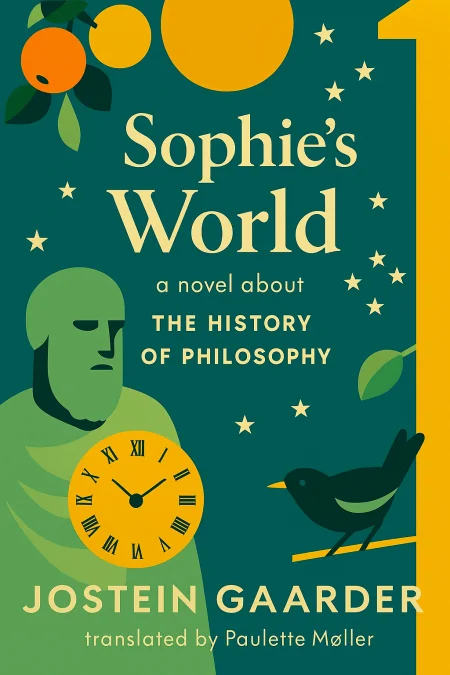
Sophie's World
A Novel about the History of Philosophy
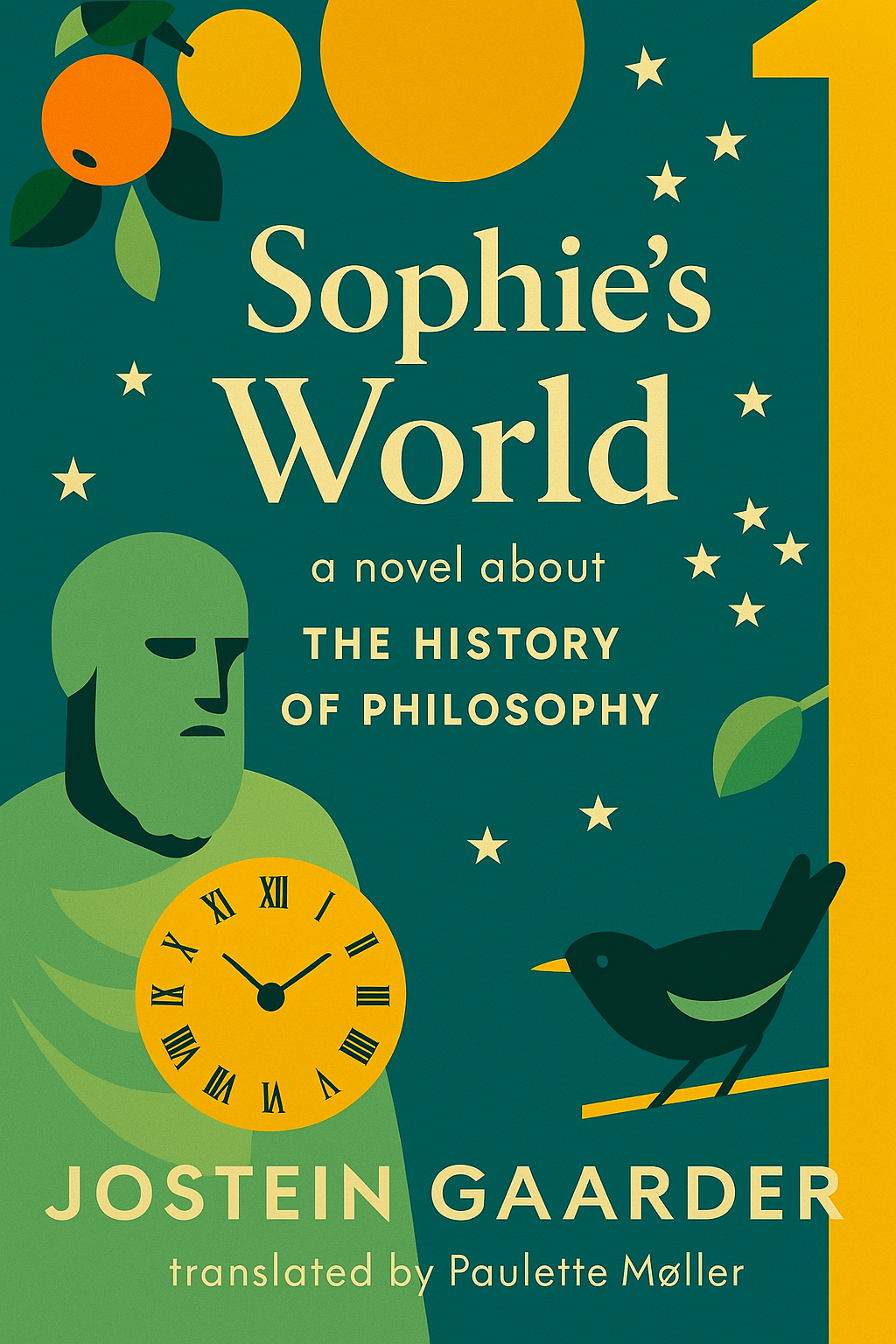
byJostein Gaarder, Paulette Moller
Book Edition Details
Summary
In the quiet corners of a Norwegian village, a curious girl named Sophie stumbles upon an enigma that will reshape her understanding of the universe. With a pair of cryptic notes — "Who are you?" and "Where does the world come from?" — she embarks on a philosophical odyssey that spans the minds of history’s greatest thinkers, from the streets of ancient Athens to the existential musings of 20th-century Europe. As she receives mysterious correspondence meant for someone named Hilde, Sophie is drawn into a labyrinth of ideas and identities, where the boundaries between reality and imagination blur. "Sophie's World" isn’t just a novel; it's a mind-bending exploration of life’s deepest questions, inviting readers to ponder their own place in the cosmos.
Introduction
Picture a fourteen-year-old girl discovering mysterious letters in her mailbox, each containing questions that would forever change how she sees the world: "Who are you?" and "Where does the world come from?" What begins as an ordinary afternoon transforms into an extraordinary journey through twenty-five centuries of human wisdom, where ancient Greek philosophers become as vivid as living neighbors, and the deepest questions about existence unfold through the most captivating of adventures. This remarkable exploration reveals that philosophy isn't confined to dusty academic halls, but lives in the very questions that keep us awake at night, wondering about our purpose and place in the universe. Through the eyes of curiosity and the guidance of a mysterious teacher, we encounter the brilliant minds who dared to question everything we take for granted, from the nature of reality itself to the meaning of love, justice, and truth. The journey demonstrates that the capacity for wonder isn't a luxury reserved for scholars, but a birthright that belongs to anyone brave enough to ask the fundamental questions about existence. As we follow this path of discovery, we find ourselves not merely learning about the history of ideas, but awakening to the profound mystery of our own consciousness and the infinite possibilities that emerge when we dare to think deeply about life, reality, and the extraordinary gift of being human in an endlessly fascinating cosmos.
The Mystery Begins: Ancient Questions and Timeless Wisdom
Sophie Amundsen's world cracked open the moment she found that first unsigned envelope asking the simplest yet most profound question imaginable: "Who are you?" Standing in her garden, surrounded by familiar sights that suddenly seemed strange, she realized she had lived fourteen years without truly considering what lay beneath her name. The mysterious letters multiplied, each carrying questions that seemed to emerge from the very fabric of existence itself, delivered by a golden Labrador named Hermes who appeared and disappeared like a messenger from another realm. The enigmatic philosophy teacher who revealed himself through these letters transported Sophie back to ancient Greece, where the first philosophers dared to seek natural explanations for the world's mysteries. In the bustling agora of Athens, she encountered Socrates, the humble stonecutter's son who claimed to know nothing yet possessed the wisdom to ask questions that exposed how little anyone truly understood about justice, courage, and the good life. His revolutionary method transformed ignorance from a source of shame into the beginning of genuine wisdom. Through Plato's magnificent vision, Sophie discovered a realm of perfect forms existing beyond our imperfect world, where every horse she had ever seen was merely a shadow of the eternal idea of "horse" itself. Like prisoners chained in a cave, mistaking shadows on the wall for reality, most people lived their entire lives without glimpsing the true nature of existence that lay beyond the reach of their senses. These ancient voices whispered across millennia, proving that the fundamental questions of human existence transcend time and culture. The courage of those first philosophers to think beyond accepted wisdom planted seeds that would bloom throughout history, inspiring each generation to continue the eternal quest for understanding and meaning in an endlessly mysterious universe.
From Medieval Faith to Renaissance Reason: Humanity's Awakening
The philosophical journey carried Sophie through the shadowed halls of medieval monasteries, where brilliant thinkers like Augustine wrestled with the relationship between reason and faith, weaving together the wisdom of Athens and Jerusalem into magnificent syntheses that honored both human intellect and divine mystery. Thomas Aquinas emerged as the great bridge-builder, demonstrating how Aristotelian logic could illuminate rather than threaten Christian revelation, creating elaborate philosophical cathedrals of thought that sought to prove God's existence through the very reason He had given to humanity. Then came the Renaissance explosion, bursting upon Europe like spring after an endless winter, declaring that human beings were not merely fallen creatures awaiting salvation but magnificent beings capable of incredible achievements. Leonardo da Vinci embodied this revolutionary spirit, moving seamlessly between dissecting corpses to understand anatomy and designing flying machines that anticipated future possibilities, driven by an insatiable curiosity that recognized no boundaries between art and science, beauty and truth. The scientific revolution transformed humanity's understanding of its place in the cosmos as brave souls like Copernicus dared to suggest that Earth was not the center of the universe, while Galileo peered through his telescope to discover moons orbiting Jupiter, forever changing our perspective on cosmic significance. These pioneers faced persecution for their ideas, yet their commitment to truth over comfortable illusion paved the way for the modern world's emergence from medieval certainty into the bright, challenging light of systematic inquiry. This transformation from medieval faith to Renaissance questioning mirrors every individual's journey from childhood acceptance to adult inquiry, revealing that the courage to question established authority becomes a defining characteristic of human maturity and the endless quest for deeper understanding of ourselves and our place in the vast, wonderful mystery of existence.
Modern Philosophy: Evolution, Consciousness, and the Unconscious Mind
Sophie's education took a dramatic turn as she encountered the revolutionary thinkers who challenged everything humanity thought it knew about knowledge, reality, and human nature itself. Immanuel Kant emerged as the great synthesizer who demonstrated that the mind doesn't passively receive reality but actively shapes our perception of it, revealing that we can never know things as they truly are, only as they appear through the filters of our own consciousness—a limitation that paradoxically becomes the very condition that makes knowledge possible. The story of Darwin's voyage on the Beagle fascinated Sophie as she learned how a young naturalist's careful observations of finches and tortoises would revolutionize humanity's understanding of its place in nature. Darwin's theory of evolution wasn't merely about biology but about recognizing that humans are part of the natural world, subject to the same forces that shape all life on Earth, connected to every living creature through an unbroken chain of descent stretching back billions of years. Freud's exploration of the unconscious mind opened another startling dimension, suggesting that much of human behavior springs from hidden desires and repressed memories lurking beneath the surface of rational thought. This discovery challenged the Enlightenment's faith in reason, revealing that the human psyche contains vast territories unknown to conscious awareness, where dreams, slips of the tongue, and seemingly irrational behaviors provide glimpses into the mysterious depths of mental life. These modern philosophers shared a common thread in their willingness to question comfortable assumptions about human nature and our place in the universe. Whether challenging religious authority, human exceptionalism, or the supremacy of conscious reason, they forced humanity to confront uncomfortable truths while opening new possibilities for understanding the magnificent complexity of existence and consciousness.
Breaking the Fourth Wall: When Fiction Questions Reality Itself
As Sophie's philosophical education neared completion, something extraordinary and deeply unsettling began to unfold around her. She discovered postcards addressed to a girl named Hilde Møller Knag, whose father was apparently writing a philosophy book for her fifteenth birthday—a book that seemed to describe Sophie's own life with impossible accuracy. The boundaries between Sophie's reality and this other story began to blur in ways that challenged everything she thought she knew about existence, identity, and the nature of reality itself. Alberto revealed the shocking truth that transformed their entire world: they were characters in a book being written by Major Albert Knag for his daughter Hilde. This revelation forced Sophie to confront the ultimate philosophical question about the nature of existence—if she was merely a fictional character, did her thoughts, feelings, and experiences have any genuine meaning, or was everything she had learned and felt simply an elaborate illusion created by someone else's imagination? The philosophical garden party became a surreal demonstration of their predicament as reality itself seemed to break down around them, with characters from other stories appearing and the normal rules of existence dissolving into chaos. Yet Sophie and Alberto's determination to escape from the major's control represented the ultimate philosophical rebellion—the assertion of free will against determinism, of meaning against meaninglessness, of consciousness asserting its own reality regardless of its apparent origins. Their successful escape into a parallel reality where they could observe Hilde and her father suggested profound truths about consciousness, existence, and the multiple levels of reality that might coexist simultaneously. Perhaps the questions that matter most aren't about which reality is "true," but about how we choose to live, think, and create meaning within whatever reality we find ourselves inhabiting, recognizing that consciousness itself might be the most mysterious and wonderful phenomenon in any universe.
Summary
Through this extraordinary philosophical adventure, we discover that the capacity for wonder isn't a luxury reserved for professional thinkers but an essential quality that defines our humanity and connects us to the deepest currents of human experience. Every question that has driven humanity's greatest minds—from Socrates' humble admission of ignorance to Darwin's revolutionary insights about our place in nature—lives within each of us, waiting to be awakened by the courage to think deeply about existence, meaning, and the profound mystery of consciousness itself. The most transformative insight from this journey is that philosophy isn't about finding final answers but about learning to ask better questions and maintaining the wonder that makes life infinitely richer than mere survival. When we dare to ask "Who are you?" we begin a journey of self-discovery that can last a lifetime, connecting us to centuries of human wisdom while opening possibilities for growth and understanding that we never imagined possible. The ancient Greeks who first questioned the nature of reality, the medieval scholars who preserved wisdom through dark ages, and the modern thinkers who challenged our deepest assumptions all speak to the same fundamental human need to understand our place in the magnificent mystery of existence. By embracing our capacity for philosophical wonder, by refusing to accept easy answers to life's deepest questions, and by maintaining the courage to think for ourselves while remaining open to wisdom from every source, we can transform our daily existence into an adventure as meaningful and exciting as any that has ever been undertaken. The questions that began this journey—"Who are you?" and "Where does the world come from?"—remain as relevant and urgent today as they were thousands of years ago, inviting each of us to join the eternal conversation about what it means to be human in an endlessly fascinating universe.
Related Books
Download PDF & EPUB
To save this Black List summary for later, download the free PDF and EPUB. You can print it out, or read offline at your convenience.
By Jostein Gaarder
