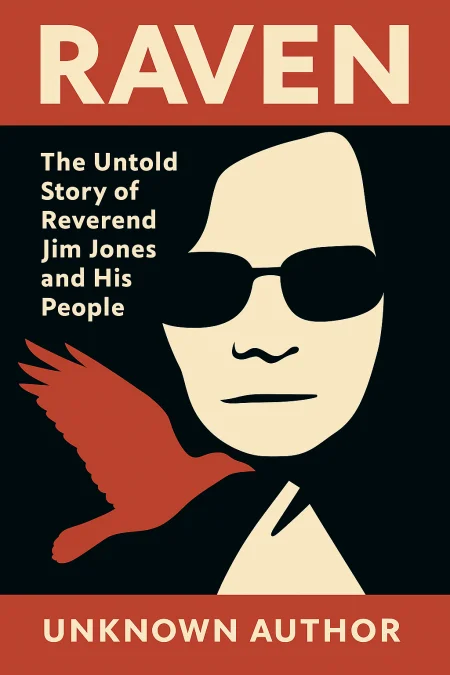
Raven
The Untold Story of the Reverend Jim Jones and His People
Book Edition Details
Summary
In the murky depths of power and devotion, Tim Reiterman's "The Untold Story of Reverend Jim Jones and His People" unveils a chilling tapestry of charisma gone awry. At the heart of Jonestown's devastating tragedy lies a perplexing enigma: how did one man's influence lead 917 souls to their doom? This gripping narrative pulls back the curtain on Jim Jones's enigmatic rise and the fervent loyalty he inspired, only to culminate in unthinkable horror. Reiterman meticulously pieces together the allure and madness that defined the Peoples Temple, offering an unflinching look at the seductive yet perilous dance between faith and fanaticism. Prepare to confront a story as compelling as it is unsettling, where blind devotion meets its darkest hour.
Introduction
On November 18, 1978, in the dense jungles of Guyana, over 900 Americans died in what would become one of the most shocking mass tragedies in modern history. Yet this catastrophe didn't emerge overnight—it was the culmination of three decades of manipulation, idealism corrupted by power, and the dangerous intersection of religion, politics, and unchecked authority in Cold War America. The story of Peoples Temple reveals how a charismatic preacher named Jim Jones transformed from a civil rights advocate in 1950s Indiana into a paranoid dictator who led hundreds of families into the South American wilderness, only to destroy them when his carefully constructed world began to collapse. This extraordinary chronicle illuminates three crucial questions that remain urgently relevant today. First, how do ordinary, well-intentioned people become trapped in systems of absolute control, surrendering their autonomy piece by piece until escape seems impossible? Second, what happens when legitimate social movements are hijacked by manipulative leaders who exploit genuine grievances for personal gain? Finally, how do democratic institutions fail to protect their most vulnerable citizens from predatory organizations that hide behind religious freedom and political influence? Understanding this history is essential for anyone seeking to comprehend how extremist movements develop, how communities can be isolated and controlled, and why vigilance against authoritarian manipulation remains crucial in our fragmented modern world.
From Preacher to Prophet: Early Years and Foundation (1931-1965)
James Warren Jones emerged from the poverty and dysfunction of Depression-era Indiana, shaped by a childhood marked by his father's absence and his mother's grandiose ambitions for her son. Born in 1931 in rural Crete, Jones displayed an early fascination with death, religion, and control that would define his entire life. As a young man practicing sermons to neighborhood children in his family's barn, he discovered his remarkable gift for commanding attention and manipulating emotions—talents that would serve him well in his future career as a religious leader. The seeds of Jones's empire were planted in the 1950s when he established his first church in racially segregated Indianapolis. From the beginning, he demonstrated an uncanny ability to identify and exploit people's deepest vulnerabilities and needs. He preached racial integration at a time when such views were radical in Indiana, attracting both idealistic whites seeking purpose and African Americans desperate for dignity and acceptance. His early followers were drawn by his apparent miracles—staged healings that he privately dismissed as "divine socialism"—and his promise of a community where all would be equal regardless of race or economic status. Jones's genius lay in his understanding that people's spiritual and material needs were inseparable. He established nursing homes for the elderly, provided food and shelter for the poor, and created a sense of family for the isolated and marginalized. His adoption of children of different races, creating what he called a "rainbow family," reinforced his image as a progressive champion of civil rights. Yet even in these early years, troubling patterns emerged that foreshadowed future tragedies. Jones demanded absolute loyalty from his followers, punished dissent through public humiliation, and gradually isolated members from outside influences and relationships. The decision to relocate to California in the mid-1960s revealed Jones's growing paranoia and his skill at manufacturing crises to justify increased control. He convinced his followers that nuclear war was imminent and that only by moving to a safe haven could they survive the coming apocalypse. This manufactured emergency became a template he would use repeatedly throughout his career—creating fear to justify control, promising salvation while tightening his grip on his followers' lives, resources, and autonomy. The westward exodus marked the transformation of Peoples Temple from a small religious community into something far more dangerous and destructive.
Political Ascendancy and Expanding Control: California Years (1965-1977)
The Temple's expansion into California transformed it from a small religious sect into a powerful political force that would influence elections and policy throughout the state. Settling first in the remote town of Ukiah in Mendocino County, Jones expanded his operations to San Francisco and Los Angeles, building a network that would eventually encompass thousands of members and millions of dollars in assets. The California years revealed Jones's sophisticated understanding of American power structures and his ability to use progressive politics as both a shield and a weapon. Jones cultivated relationships with politicians across the liberal establishment, delivering crucial votes and volunteers to candidates who promised to advance civil rights and social justice causes. The Temple's ability to mobilize hundreds of members for rallies, campaigns, and public demonstrations made it an invaluable ally in California's competitive political landscape. Politicians including San Francisco Mayor George Moscone, future Assembly Speaker Willie Brown, and Lieutenant Governor Mervyn Dymally found themselves dependent on Temple support, providing Jones with protection from investigation and access to the corridors of power. Behind the facade of humanitarian work and political activism, however, Jones was constructing an elaborate system of totalitarian control that would have impressed the most ruthless dictators. Members were required to turn over their property and paychecks to the church, work exhausting hours for Temple businesses, and submit to increasingly bizarre forms of discipline and humiliation. Jones used a network of informants to monitor members' loyalty, forced them to sign false confessions to ensure their silence, and gradually severed their connections to family and friends outside the organization. Sexual manipulation became another tool of control, as Jones claimed the right to sleep with members' spouses while forbidding intimate relationships among his followers. The first serious cracks in Jones's carefully constructed facade appeared in the mid-1970s when former members began speaking out about the abuse they had witnessed and experienced. When New West magazine published explosive allegations in 1977 detailing beatings, sexual abuse, financial fraud, and Jones's fake faith healings, the charismatic leader faced his first major crisis. Rather than address these concerns or reform his practices, Jones responded by accelerating his plans for a permanent exodus to South America, where he believed his political connections and geographic isolation would protect him from accountability. The stage was set for the final, tragic act of his deadly drama.
Jungle Paradise to Prison: The Jonestown Experiment (1977-1978)
The establishment of Jonestown in the remote Guyanese jungle represented both the culmination of Jones's utopian vision and the beginning of its horrific transformation into a death camp. Beginning in 1974, Temple members had carved an agricultural settlement from dense rainforest, building dormitories, workshops, schools, and a central pavilion where Jones would deliver his final sermon. The Guyanese government welcomed the project as a model of agricultural development that brought American investment and expertise to an underdeveloped region, while Jones promoted it as a socialist paradise where racism and inequality had been eliminated forever. For many residents, Jonestown initially offered genuine hope and community after lives marked by discrimination and poverty. Elderly African Americans who had faced decades of racism found dignity and purpose in the jungle settlement, while idealistic young people threw themselves into the challenging work of pioneering. The community achieved remarkable agricultural success, producing crops and livestock while maintaining medical facilities, recreational programs, and educational opportunities for children. Jones's propaganda portrayed life in Jonestown as idyllic, a place where his followers could live free from American persecution and build a better world for future generations. Yet beneath this utopian surface, a totalitarian nightmare was rapidly taking shape as Jones's paranoia and drug addiction spiraled out of control. He maintained absolute authority through constant surveillance, exhausting work schedules that left residents too tired to think critically, and the threat of punishment in an underground isolation box known as "the box." Families were deliberately separated to prevent the formation of loyalties that might compete with devotion to Jones, mail was censored to prevent outside contact, and residents were told that defectors would be hunted down and killed by enemies of the Temple. Jones's mental deterioration accelerated in the jungle isolation, leading to increasingly erratic behavior and apocalyptic threats. He conducted regular "White Nights"—rehearsals for mass suicide where followers were forced to drink what they believed was poison as a test of their loyalty to the cause. These exercises served both to condition residents for the final tragedy and to identify potential dissidents who could be drugged or eliminated. As reports of abuse filtered out through the few successful defectors, it became clear that Jones's tropical paradise had become a prison from which escape was virtually impossible, setting the stage for the ultimate catastrophe that would shock the world.
Final Crisis and Mass Tragedy: Congressional Visit and Catastrophe (1978)
The formation of Concerned Relatives in early 1978 marked the beginning of the end for Jones's jungle empire. Led by former Temple attorney Tim Stoen, who was fighting for custody of his son, this group of family members began lobbying government officials and media outlets to investigate conditions in Jonestown. Their persistent advocacy, combined with harrowing reports from defectors like Debbie Layton Blakey, gradually convinced authorities that American citizens might be held against their will in the remote settlement, prompting the first serious government intervention in Temple affairs. Congressman Leo Ryan's decision to visit Jonestown in November 1978 represented everything Jones had spent decades trying to avoid—outside scrutiny of his carefully controlled world. Ryan, known for his hands-on approach to investigating constituent concerns, assembled a delegation that included congressional staff, journalists, and concerned relatives. Despite Jones's desperate attempts to block the visit through political channels, the group arrived at Jonestown on November 17, determined to assess conditions firsthand and offer safe passage to anyone wishing to leave the settlement. The visit initially proceeded according to Jones's carefully orchestrated script, with residents putting on entertainment, serving elaborate meals, and testifying to their happiness in the jungle paradise. However, the facade began cracking when several families quietly approached Ryan's staff requesting help to escape. The defection of even a small number of residents represented a catastrophic failure for Jones, who had built his entire authority on the claim that his followers remained with him voluntarily and that no one wanted to leave his socialist utopia. As the Ryan party prepared to depart with the defectors on November 18, Jones's paranoia reached its breaking point. He had long threatened mass suicide if the community was attacked by outside enemies, and the defections convinced him that his life's work was being destroyed by government persecution. After a Temple member's failed attempt to kill Ryan with a knife, Jones dispatched an armed squad to the nearby airstrip where the congressman's party was boarding planes to return to Georgetown. The massacre that followed claimed the lives of Ryan, three journalists, and one defector, while back in Jonestown, Jones gathered his remaining followers in the central pavilion and convinced them to drink cyanide-laced fruit punch, beginning with the children. Over 900 people died that day in what Jones called "revolutionary suicide" but which was in reality mass murder—the tragic end of a movement that had begun with genuine ideals but had been corrupted by unchecked power and paranoid delusions.
Summary
The tragedy of Peoples Temple illuminates the fundamental tension between humanity's deepest need for belonging and purpose, and our dangerous vulnerability to those who would exploit these needs for personal power. Jones succeeded not because he was uniquely evil, but because he understood how to manipulate basic human desires for community, meaning, and security, gradually transforming noble impulses into instruments of control and destruction. His followers were not weak or gullible people, but ordinary individuals seeking something better than what mainstream society offered—racial equality, economic justice, and spiritual fulfillment—making their exploitation all the more tragic and their deaths all the more senseless. The lessons of Jonestown extend far beyond the specific circumstances of one cult, revealing how the gradual erosion of individual autonomy can lead to complete subjugation, how legitimate social movements can be corrupted by charismatic authoritarians, and how isolation from diverse perspectives can make even the most outrageous demands seem reasonable. The tragedy demonstrates the critical importance of maintaining connections to multiple communities and viewpoints, questioning authority even when it claims to serve our best interests, and recognizing that any leader who demands absolute loyalty while discouraging critical thinking is likely serving their own interests rather than those of their followers. Perhaps most importantly, this history reminds us that the capacity for both great good and terrible evil exists within all human institutions, and that our desire to build a better world must never blind us to the dangers of surrendering our individual judgment and moral autonomy to those who promise easy answers to complex problems.
Related Books
Download PDF & EPUB
To save this Black List summary for later, download the free PDF and EPUB. You can print it out, or read offline at your convenience.
By Unknown Author
