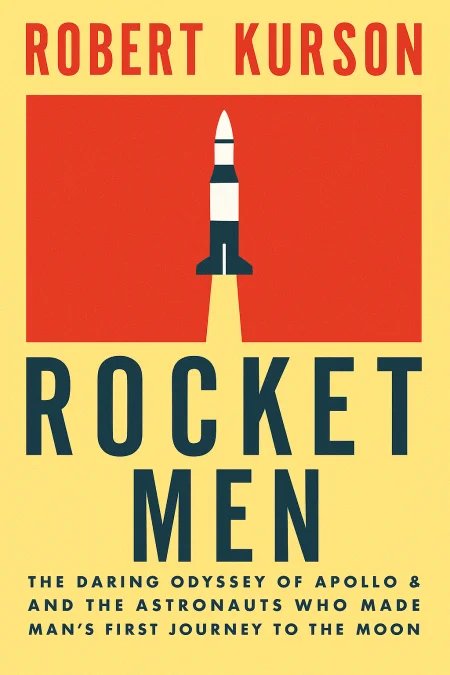
Rocket Men
The Daring Odyssey of Apollo 8 and the Astronauts Who Made Man’s First Journey to the Moon
Book Edition Details
Summary
In a year marred by turmoil and uncertainty, 1968 saw a daring leap into the unknown that captured the world's imagination. "Rocket Men" chronicles the audacious saga of Apollo 8—a mission born from urgency and driven by the fierce competition of the Space Race. With the clock ticking and the Soviet Union looming ever closer, NASA abandoned caution, tasking three intrepid astronauts—Frank Borman, Jim Lovell, and Bill Anders—with a mission that defied conventional wisdom and safety norms. Against a backdrop of societal upheaval, these pioneers and their families braced for a journey that would either redefine human potential or end in catastrophe. Robert Kurson, acclaimed for his storytelling prowess, invites readers into the cockpit, offering a visceral glimpse into the perils and triumphs of a mission that forever changed our place in the cosmos.
Introduction
In the final weeks of 1968, as America burned with riots and despair, three men strapped themselves atop the most powerful machine ever built and aimed for the Moon. This was not merely a space mission—it was a desperate gamble to restore faith in a nation tearing itself apart. The year had witnessed the assassinations of Martin Luther King Jr. and Robert Kennedy, violent protests in Chicago, and endless casualties in Vietnam. Against this backdrop of chaos, NASA conceived an audacious plan that would either triumph spectacularly or fail catastrophically before the eyes of the world. The story reveals how extraordinary leadership emerges in moments of crisis, when conventional wisdom must be abandoned for bold action. It illuminates the delicate balance between calculated risk and reckless ambition, showing how a small group of engineers and astronauts transformed what seemed like certain defeat into humanity's greatest adventure. Through intimate portraits of Frank Borman, Jim Lovell, and Bill Anders, we witness not just technological achievement, but the profound human courage required to leave Earth behind and venture into the cosmic unknown. This narrative speaks to anyone who has faced seemingly impossible challenges, whether in business, politics, or personal life. It demonstrates how vision, determination, and meticulous preparation can overcome even the most daunting obstacles, offering timeless lessons about leadership, teamwork, and the power of human ingenuity when directed toward a noble purpose.
Crisis and Bold Decision: NASA's Desperate Moon Gamble (August-December 1968)
The summer of 1968 found America's space program in crisis. The Soviet Union appeared poised to send cosmonauts around the Moon before year's end, while NASA's lunar module remained hopelessly behind schedule. Technical problems threatened to delay the entire Apollo program, potentially pushing a Moon landing beyond President Kennedy's end-of-decade deadline. In this moment of desperation, a quiet engineer named George Low conceived an idea so audacious it bordered on madness. Low's proposal was elegantly simple yet terrifyingly risky: skip the troubled lunar module entirely and send Apollo 8 directly to the Moon in December. The plan would leapfrog two preparatory missions, relying on an untested Saturn V rocket that had suffered catastrophic problems on its previous flight. When Low presented this scheme to NASA's leadership, the response was immediate and visceral. Administrator James Webb, reached by secure phone in Vienna, exploded with disbelief at the seemingly reckless proposal. Yet beneath Webb's outrage lay recognition of the plan's genius. A successful lunar mission would not only beat the Soviets but provide America with a desperately needed triumph in a year of unrelenting tragedy. The decision crystallized the fundamental tension between safety and ambition that defines all great endeavors. As one NASA official observed, sometimes you have to risk everything to save everything. The approval of Apollo 8's lunar mission represented more than a change in flight plans—it embodied a philosophy of bold leadership in times of crisis. When conventional approaches fail, extraordinary leaders must be willing to abandon incremental progress for transformative leaps. This decision would either vindicate NASA's faith in human ingenuity or destroy the space program entirely, setting the stage for one of history's most dramatic gambles.
First Journey Beyond Earth: Launch to Lunar Orbit (December 21-24)
On the morning of December 21, 1968, three men climbed aboard a machine containing the explosive power of a small atomic bomb. The Saturn V rocket had never flown with humans aboard, yet Frank Borman, Jim Lovell, and Bill Anders trusted their lives to its 7.6 million pounds of thrust. As the countdown reached zero, the rocket's five massive engines ignited in a fury of flame and thunder that shook the ground for miles around Cape Kennedy. The launch itself proved more violent than any simulation had predicted. Inside the command module, the astronauts were battered mercilessly as the rocket clawed its way free from Earth's gravitational embrace. The crew had trained for hundreds of emergencies, but no one had warned them that simply leaving the launch pad would feel like being shaken apart by an angry giant. Eleven minutes after liftoff, Apollo 8 achieved Earth orbit, but the real test lay ahead. The spacecraft needed to reignite its third-stage engine to achieve the tremendous velocity required to escape Earth's gravity—nearly 25,000 miles per hour. This translunar injection burn would either send them toward the Moon or strand them in Earth orbit. When the engine fired successfully over Hawaii, observers saw a brilliant comet streak across the night sky as humanity took its first steps toward another world. The three-day journey to the Moon tested both technology and human endurance in ways never before experienced. Borman fell violently ill, vomiting and suffering diarrhea in the weightless environment, creating a nightmare of floating bodily waste that his crewmates had to capture and clean. The commander's illness raised terrifying questions about unknown effects of deep space travel, yet the decision to continue the mission despite these health concerns exemplified the calculated risks that define all great achievements.
Earthrise and Return: Christmas Eve Triumph That Changed Humanity
As Apollo 8 approached the Moon on Christmas Eve, the three astronauts prepared to become the first humans to witness the lunar far side. When their spacecraft disappeared behind the Moon, all communication with Earth ceased, leaving Borman, Lovell, and Anders utterly alone in the cosmic void. In that moment of profound isolation, they fired their engine to enter lunar orbit—a maneuver that would either capture them around the Moon or send them crashing into its surface. The engine burn worked perfectly, and as Apollo 8 emerged from behind the Moon, the astronauts beheld a sight that would forever change humanity's perspective. Rising above the stark lunar horizon was Earth—a brilliant blue and white marble suspended in the infinite blackness of space. Anders frantically grabbed his camera to capture what would become known as Earthrise, an image that revealed our planet's fragility and beauty as never before seen. On Christmas Eve, as Apollo 8 orbited the Moon, the astronauts delivered a live television broadcast to the largest audience in human history. Nearly one billion people—one-fourth of humanity—listened as Borman, Lovell, and Anders read from the Book of Genesis while showing views of the lunar surface. In a year marked by division and despair, their words offered hope and unity that transcended national boundaries and religious differences. The successful return on December 28, 1968, marked more than the completion of a space mission—it represented America's redemption after its darkest year. The crew's courage and NASA's audacious gamble had paid off spectacularly, proving that even in times of crisis, human ingenuity and determination could achieve the impossible. They had not only saved the space program but offered humanity a new perspective on Earth itself, transforming a year of tragedy into one of triumph and pointing toward a future among the stars.
Summary
The Apollo 8 mission reveals the fundamental tension between safety and ambition that defines all transformative achievements. When conventional approaches fail and time runs short, extraordinary leaders must be willing to abandon incremental progress for bold leaps into the unknown. The decision to send three men to the Moon with only four months of preparation exemplified this principle, showing how calculated risks can yield extraordinary rewards when backed by meticulous planning and unwavering determination. The mission's success offers profound lessons for modern leaders facing seemingly impossible challenges. Crisis often creates opportunity—NASA's technical problems forced the agency to attempt something far more ambitious and ultimately more meaningful than originally planned. Diverse teams united by common purpose can overcome any obstacle, as demonstrated by the collaboration between engineers, astronauts, and mission controllers. Most importantly, the courage to act decisively in uncertain circumstances often separates success from failure. Perhaps most significantly, Apollo 8 demonstrated that humanity's greatest achievements emerge not from comfort and certainty, but from the willingness to venture into the unknown. The image of Earth rising over the lunar horizon forever changed how we see ourselves and our place in the cosmos. In our current age of global challenges and technological transformation, the mission reminds us that bold vision, careful preparation, and unwavering commitment can still move mountains—or carry us to the Moon and safely home again.
Related Books
Download PDF & EPUB
To save this Black List summary for later, download the free PDF and EPUB. You can print it out, or read offline at your convenience.
By Robert Kurson
