
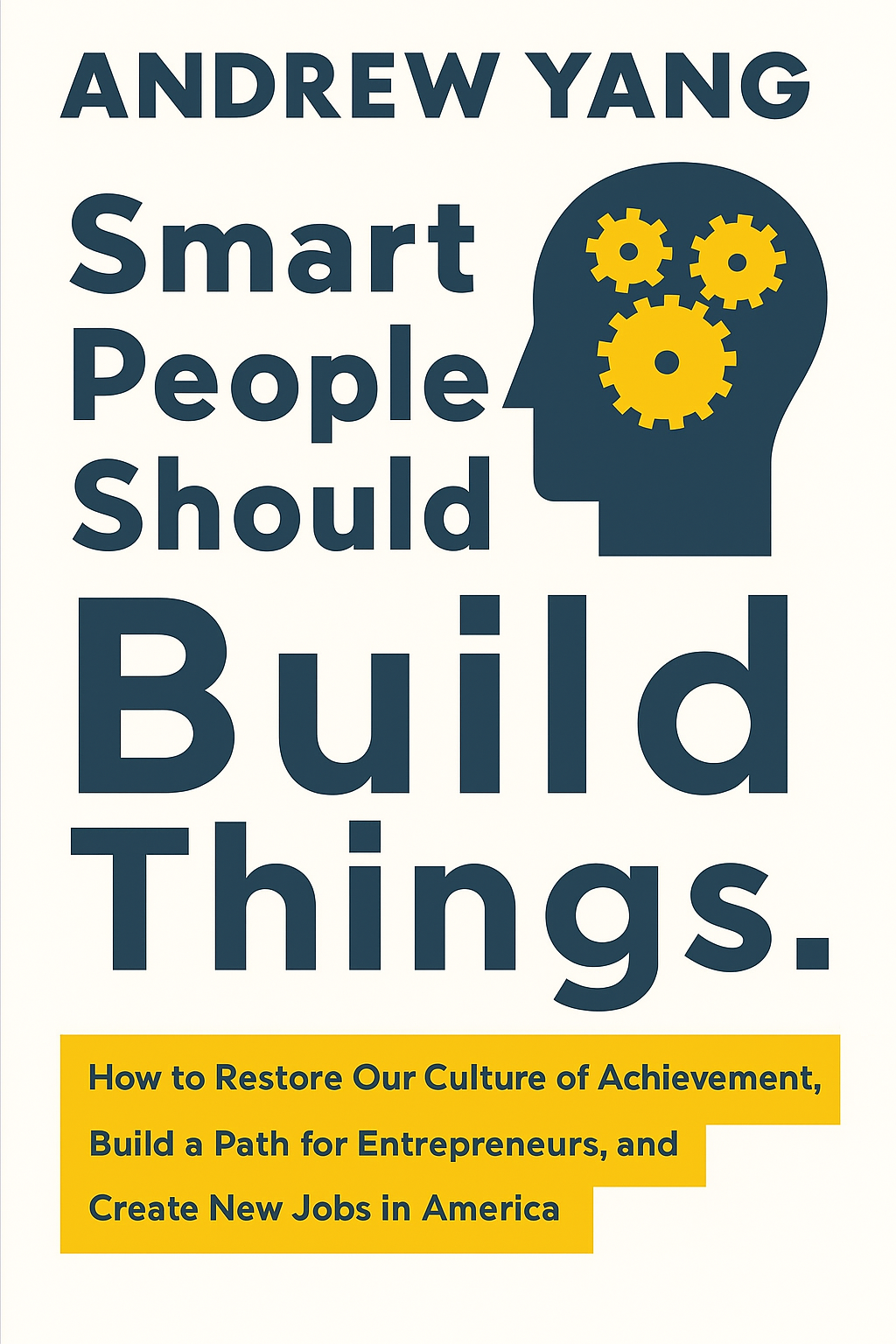
Smart People Should Build Things
How to Restore Our Culture of Achievement, Build a Path for Entrepreneurs, and Create New Jobs in America
Book Edition Details
Summary
What if the brilliance of our brightest minds could be harnessed to create tangible, transformative change? In "Smart People Should Build Things," Andrew Yang, the visionary behind Venture for America, champions a dynamic shift in career aspirations. With razor-sharp insight, Yang critiques a culture that funnels top graduates into well-trodden paths of finance and law, often at the expense of innovation. Instead, he paints a compelling portrait of a future where entrepreneurial spirit thrives, igniting new industries and revitalizing cities. Through personal anecdotes and real-life success stories, Yang maps out a practical blueprint for cultivating a new generation of trailblazers, offering astute advice for policymakers and ambitious job seekers alike. This is more than a book; it’s a clarion call to rethink the essence of success and to build a future worth striving for.
Introduction
America faces a profound misallocation of its most talented graduates. While the country desperately needs innovation and job creation, its brightest minds are systematically funneled into finance, consulting, and law—sectors that, while important, primarily redistribute existing wealth rather than create new value. This troubling trend has accelerated over recent decades as professional service firms deploy sophisticated recruitment machinery on college campuses, offering prestige, high salaries, and clear career paths that make entrepreneurial ventures seem unnecessarily risky by comparison. The fundamental argument presented here challenges the assumption that market forces naturally direct talent to its most productive uses. Instead, powerful institutional incentives have created a system where the very people best equipped to start companies and drive economic growth are instead channeled into roles that extract value from existing enterprises. This represents not just an individual career choice, but a systemic failure with profound implications for national competitiveness and economic dynamism. The analysis proceeds through careful examination of how current recruitment patterns developed, why they persist despite changing economic conditions, and what policy interventions might redirect human capital toward value creation. By combining personal narrative with broader economic analysis, the case emerges for treating talent allocation as a critical policy priority rather than leaving it entirely to market forces that may not serve the broader public interest.
The Talent Allocation Crisis: Where Smart People Go Wrong
Elite universities have become feeder systems for a narrow set of professional service industries. At Harvard, Yale, and Princeton, roughly half of employed graduates enter finance, consulting, or pursue professional school within five years of graduation. This concentration represents a dramatic shift from previous generations and reflects the sophisticated recruitment infrastructure that financial firms and consulting companies have built on college campuses over the past three decades. The mechanics of this channeling process are straightforward but powerful. Investment banks and consulting firms spend millions annually on campus recruitment, offering structured interview processes, generous compensation packages, and the promise of prestigious credentials that will "keep options open." Students facing uncertainty about their futures find these clearly defined pathways appealing, especially when alternatives like joining early-stage companies require navigating ambiguous job markets without established recruitment pipelines. Meanwhile, the startups and growing companies that most need talented early employees lack the resources to compete in this recruitment arms race. A promising biotech company in Baltimore or a software startup in Detroit cannot match Goldman Sachs' ability to wine and dine students, conduct multiple interview rounds, or offer signing bonuses. The result is a systematic disadvantage for precisely those companies that create new jobs and drive innovation. This misallocation has measurable economic consequences. New firms historically account for all net job creation in the American economy, yet the percentage of workers employed by companies less than five years old has declined from over 20 percent in the 1980s to less than 11 percent today. When the country's most capable graduates consistently choose roles in mature industries over positions in emerging companies, this trend toward economic sclerosis accelerates.
Why Building Things Matters More Than Professional Services
The distinction between value creation and value extraction lies at the heart of understanding why talent allocation matters for economic growth. Professional services—while necessary—primarily help existing companies reorganize, access capital, or navigate regulatory requirements. These activities redistribute wealth and improve efficiency but rarely generate entirely new sources of value. In contrast, entrepreneurs and early employees at growing companies create products, services, and business models that expand the overall economic pie. Consider the difference between optimizing a merger transaction and building a company that employs hundreds of people while solving genuine customer problems. Both require intelligence and hard work, but only the latter generates net new economic value. When a pharmaceutical company develops a breakthrough treatment, when a software company creates tools that increase productivity across industries, or when a manufacturer designs more efficient processes, they contribute to genuine wealth creation rather than merely moving existing wealth between parties. The skills developed in professional service environments, while valuable, often translate poorly to the entrepreneurial context. Financial modeling and strategic analysis matter, but building a company requires customer development, team building, product iteration, and operational execution under severe resource constraints. Professional service firms excel at applying established methodologies to well-defined problems, while entrepreneurship demands improvisation, resilience, and the ability to create solutions for problems that may not yet be fully understood. Furthermore, professional service careers socialize young people into consumption patterns and lifestyle expectations that make entrepreneurial risk-taking increasingly difficult over time. The "golden handcuffs" phenomenon describes how high salaries and expensive living habits trap capable individuals in roles they find unfulfilling but financially difficult to leave. This lifecycle effect means that recruiting talent early, before these patterns solidify, becomes crucial for maintaining entrepreneurial dynamism.
Creating a System to Channel Talent Toward Value Creation
Redirecting talent flows requires building alternative infrastructure that can compete with established professional service recruitment. This means creating organized programs that offer talented graduates clear pathways into entrepreneurship, complete with training, mentorship, network effects, and financial support. The Israeli model provides instructive precedent: mandatory military service creates cohort bonds and shared experiences that facilitate later business partnerships and risk-taking. Effective talent redirection programs must address the fundamental uncertainty that deters college graduates from joining early-stage companies. When students cannot easily identify promising startups, evaluate opportunities, or access the networks that facilitate entrepreneurial careers, they naturally default to well-publicized professional service options. Organized fellowship programs can solve these information and access problems while providing the peer community that makes career risk more manageable. The training component proves equally crucial. Most college graduates lack the practical skills needed to contribute meaningfully to early-stage companies from day one. Professional service firms invest heavily in developing these capabilities through formal training programs, while startups typically cannot afford such systematic human capital development. Bridging this gap requires dedicated boot camps that teach everything from financial modeling to customer development to product management before fellows begin their startup roles. Network effects multiply the impact of individual placements. When talented individuals know others pursuing similar paths, entrepreneurship stops feeling like an isolated choice and becomes a viable career track with its own culture and support systems. Alumni of entrepreneurial fellowship programs can eventually start companies that hire subsequent fellows, creating virtuous cycles of job creation and talent development that compound over time.
Policy Solutions for Redirecting Human Capital to Entrepreneurship
Systematic talent reallocation requires policy interventions across multiple levels, from university career services reform to federal student loan programs. Universities should be evaluated partly based on the diversity of career paths their graduates pursue, rather than simply maximizing immediate post-graduation employment rates in high-paying sectors. Career services offices need dedicated staff focused on connecting students with growth companies and entrepreneurial opportunities. Financial incentives can powerfully influence career choices. Student loan forgiveness programs for graduates who join early-stage companies would level the playing field against professional service firms that offer immediate high salaries. Similarly, universities could fund entrepreneurship scholarships that cover living expenses for graduates working at startups during the crucial early years when equity value remains speculative. Professional service firms themselves should reconsider recruitment strategies that create high turnover and employee dissatisfaction. Many consulting firms and investment banks experience annual attrition rates of 20-30 percent, suggesting their broad-based recruitment approach generates significant waste. More targeted hiring focused on genuine long-term fit would reduce the number of talented individuals who enter these fields only to leave after several years of suboptimal performance. Regional economic development strategies should prioritize human capital attraction alongside traditional tax incentives and infrastructure investments. Cities competing for startup ecosystems need programs that bring talented young people to town and connect them with local entrepreneurs. This requires coordination between local universities, economic development agencies, and chambers of commerce to create comprehensive talent pipeline programs rather than ad hoc recruitment efforts.
Summary
The systematic redirection of elite human capital away from value creation represents one of the most pressing but underappreciated challenges facing American economic competitiveness. Market forces alone cannot solve this problem because powerful institutional advantages have tilted the playing field decisively toward professional services recruitment. Addressing talent misallocation requires recognizing it as a legitimate policy priority and building alternative infrastructure that makes entrepreneurial careers as accessible and attractive as traditional professional paths. When the country's most capable graduates consistently choose wealth extraction over wealth creation, everyone suffers from reduced innovation, slower job growth, and diminished economic dynamism.
Related Books
Download PDF & EPUB
To save this Black List summary for later, download the free PDF and EPUB. You can print it out, or read offline at your convenience.
By Andrew Yang
