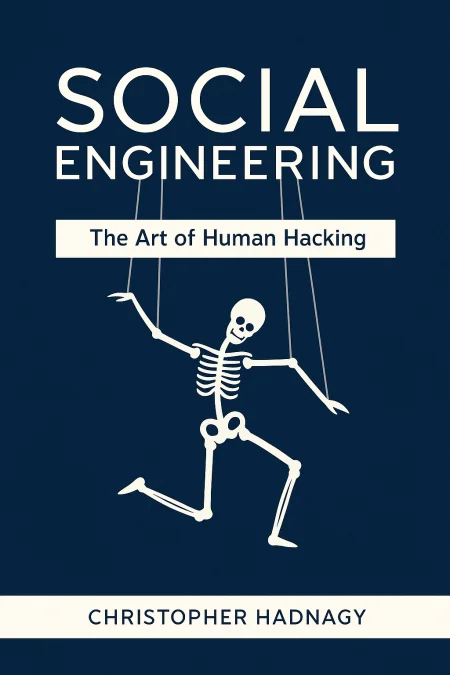
Social Engineering
The Art of Human Hacking
Book Edition Details
Summary
In the shadowy world where the mind becomes the ultimate weapon, "Social Engineering: The Art of Human Hacking" uncovers the dark craft of manipulation that hackers wield with precision. Delve into a realm where deception is an art form and uncover the chilling tactics of social engineers who exploit human psychology to breach defenses with ease. Through gripping real-world examples and personal insights from Kevin Mitnick, the legendary social engineer, this book lays bare the secrets of elicitation, pretexting, and influence. Discover how these cunning operators orchestrate their schemes and learn how to shield yourself from their grasp. An essential read for anyone who wishes to navigate the digital age with eyes wide open, armed against the invisible threats lurking in the social sphere.
Introduction
Have you ever wondered why some people seem to effortlessly navigate complex social situations, gaining trust and cooperation wherever they go? In our interconnected world, the ability to understand human psychology and communicate effectively has become more valuable than ever. Whether you're protecting your organization from security threats, building stronger professional relationships, or simply wanting to communicate more persuasively, mastering these psychological principles can transform how you interact with others. The techniques we'll explore aren't about manipulation or deception, but rather about developing a deeper understanding of how people think, feel, and make decisions. By learning these skills, you'll not only become more effective in your professional endeavors but also develop greater empathy and insight into human nature itself.
Information Gathering: Know Your Target
Information gathering forms the foundation of all successful human interaction strategies. It's the art of collecting seemingly insignificant details that, when pieced together, reveal profound insights about people and organizations. This systematic approach to understanding your targets goes far beyond casual observation, requiring patience, methodology, and genuine curiosity about human behavior. Consider the remarkable case of Mati Aharoni, a security professional tasked with gaining access to a company with virtually no digital footprint. Through meticulous research, he discovered that a high-ranking executive used his corporate email on a stamp collecting forum, expressing particular interest in 1950s stamps. This single piece of seemingly trivial information became the cornerstone of his entire strategy. Aharoni didn't simply stumble upon this information by accident. He systematically searched through online forums, social media platforms, and public records, looking for any trace of the executive's personal interests. When he found the stamp collecting connection, he immediately recognized its potential value. He quickly registered a domain, created a convincing stamp collection website, and crafted a personal email about his recently deceased grandfather's collection. The emotional hook was perfect, combining nostalgia, loss, and the promise of rare stamps. To master information gathering yourself, start by developing systematic observation skills and creating organized files for different types of information about your subjects. Use social media monitoring, public records searches, and conversation techniques to build comprehensive profiles. Remember that no detail is too small, people often reveal crucial information through casual mentions of hobbies, family situations, or personal interests. The key is patience and thoroughness, spending time understanding not just what people do, but why they do it.
Human Psychology: Reading and Influencing Minds
The human mind operates through predictable patterns that can be understood and ethically influenced through scientific principles. Understanding these psychological mechanisms gives you powerful tools for communication and persuasion, while also helping you recognize when these same techniques are being used against you. Stanley Mark Rifkin demonstrated the extraordinary power of psychological manipulation in one of history's most audacious bank heists. This computer consultant didn't use weapons or threats, instead he exploited human psychology and organizational trust systems with surgical precision. Rifkin began by visiting Security Pacific Bank regularly as a legitimate computer worker, allowing employees to become familiar with his presence and accept him as part of the environment. Through confident demeanor and casual conversation, Rifkin gained access to the wire transfer room during one of his visits. He carefully observed the daily procedures and memorized the security code used for authorizing large transfers. Later, calling from outside the bank and posing as "Mike Hansen" from the international division, Rifkin used his calm, authoritative voice and insider knowledge to convince bank employees to transfer over ten million dollars without question. The psychological principle at work was authority bias, our natural tendency to comply with those who appear to have legitimate power and knowledge. To develop these psychological reading skills, practice observing facial expressions and body language by studying photographs and videos with the sound off. Learn to recognize the subtle differences between genuine and fake emotions, focusing on microexpressions that reveal true feelings. Master the art of mirroring, where you subtly match another person's communication style and energy levels to build unconscious rapport. Focus on understanding emotional triggers like fear, curiosity, and the desire to help others, while always ensuring your influence serves everyone's genuine interests.
Advanced Techniques: Building Trust and Authority
Advanced social engineering combines multiple psychological techniques into sophisticated influence campaigns that reshape how people perceive reality and make decisions. These methods go beyond simple tricks to create comprehensive strategies that build genuine connections while achieving your objectives through ethical means. The case of FBI Agent J. Keith Mularski illustrates advanced long-term social engineering in action. This dedicated agent spent over three years infiltrating DarkMarket, an underground criminal network trading in stolen identities and credit card information. Operating under the identity "Master Splynter," Mularski had to completely embody the persona of a malicious hacker, speaking their language, understanding their culture, and earning their trust through consistent behavior over years. His success required mastering every aspect of his false identity with meticulous attention to detail. He studied hacking techniques extensively, learned criminal jargon and communication patterns, and developed the cynical worldview that would make him believable to hardened cybercriminals. Over time, his consistent performance and demonstrated expertise earned him such trust that the criminals made him an administrator of their illegal marketplace. This three-year psychological performance ultimately led to fifty-nine arrests and prevented over seventy million dollars in fraud. To develop advanced capabilities, create detailed personas for different situations, complete with backstories, motivations, and specialized knowledge that you can maintain under pressure. Study influence techniques like preloading, where you plant ideas in someone's mind before making your actual request, and learn to read group dynamics to identify key decision makers. Practice using social proof, scarcity, and reciprocity principles to make your requests seem natural and reasonable while always maintaining ethical boundaries and focusing on mutually beneficial outcomes.
Ethical Defense: Protecting Against Manipulation
The most powerful social engineering techniques are those rooted in genuine understanding and ethical application. True mastery comes not from manipulation or deception, but from developing authentic communication skills that create win-win outcomes for everyone involved while protecting yourself and others from malicious influence attempts. Building effective defenses requires more than just understanding the tactics, it demands creating a culture of security awareness that becomes second nature. The Defcon 18 social engineering contest revealed how unprepared most organizations are for these attacks, as professional security researchers called major corporations and extracted sensitive information within minutes using nothing more than polite questions and careful listening. Every single target company failed to protect their information adequately, regardless of their investment in traditional security measures. What made these attacks successful wasn't sophisticated techniques, but the lack of awareness among employees who answered the phones. Many targets willingly shared information about computer systems, internal processes, and security measures simply because the callers sounded professional and asked reasonable questions. The employees had never been trained to recognize information-gathering attempts or understand the value of seemingly innocent details to potential attackers. Develop clear verification procedures that require independent confirmation of identity before complying with unusual requests, and create a culture where security-conscious behavior is rewarded. Train yourself and others to pause and think critically when someone invokes authority, asking questions like how you can verify their identity and whether legitimate authority figures would make such requests through indirect channels. Remember that your awareness and preparedness serve as the first and most important line of defense against manipulation attempts.
Summary
The principles and techniques explored throughout this journey reveal a fundamental truth about human nature: we are all susceptible to influence, and understanding these mechanisms gives us both power and responsibility. As the research clearly demonstrates, "The more you practice, the more you will succeed at mastering these skills." The most important takeaway is that these techniques should be used to build stronger, more authentic relationships rather than to exploit or deceive others. When you understand what motivates people, you can communicate more effectively, resolve conflicts more successfully, and create environments where everyone can thrive. Start today by choosing one technique from this guide and practicing it in low-stakes social situations, whether it's improving your ability to read facial expressions, developing better listening skills, or learning to ask more effective questions that serve everyone's best interests.
Related Books
Download PDF & EPUB
To save this Black List summary for later, download the free PDF and EPUB. You can print it out, or read offline at your convenience.
By Christopher Hadnagy
