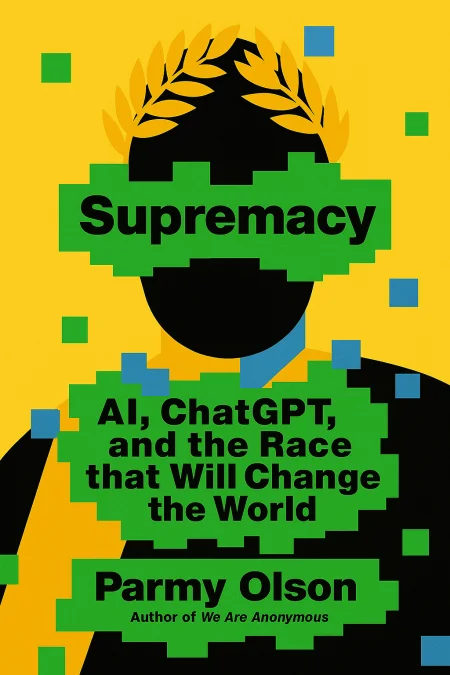
Supremacy
AI, ChatGPT, and the Race that Will Change the World
Book Edition Details
Summary
In the shadowy corridors of tech empires, a tempest brews as two titans, OpenAI and DeepMind, engage in a high-stakes duel for AI dominance. "Supremacy" by Parmy Olson is a riveting exposé that unfurls the secretive and intense rivalry between visionaries Sam Altman and Demis Hassabis. This isn't just a tale of technological marvels, but a piercing examination of ambition, ethics, and the unchecked power of AI behemoths. Olson, with insider access and astute analysis, reveals how the relentless pursuit of Artificial General Intelligence could redefine humanity's future, raising urgent questions about innovation's role in our lives. Will this race lead us to enlightenment, or plunge us into chaos? "Supremacy" beckons readers to ponder the thin line between progress and peril in a world where machines may soon surpass their creators.
Introduction
In November 2022, a simple chatbot named ChatGPT quietly launched and within days had captured the imagination of millions worldwide. Behind this revolutionary moment stood two extraordinary minds whose parallel journeys would define the future of artificial intelligence: Sam Altman, the ambitious Silicon Valley entrepreneur who transformed from a struggling startup founder into one of tech's most influential power brokers, and Demis Hassabis, the chess prodigy turned neuroscientist whose quiet London laboratory had been methodically pushing the boundaries of machine intelligence for over a decade. Their story represents far more than a tale of technological innovation. It reveals the profound tensions between idealistic visions and corporate realities, between the promise of democratizing intelligence and the inexorable pull of Big Tech's resources and influence. Both men began with noble missions to ensure artificial intelligence would benefit all humanity, yet both found themselves navigating increasingly complex relationships with the very tech giants they had once sought to counterbalance. From their remarkable journey, readers will discover how personal experiences of isolation and curiosity shaped two of technology's most consequential figures, how the pursuit of artificial general intelligence became entangled with corporate power and competitive pressures, and how the race to build superintelligent machines ultimately transformed not just technology, but the very organizations that promised to serve humanity's best interests. This is a story about ambition, compromise, and the unintended consequences that emerge when visionary ideals collide with the realities of building transformative technology in the modern era.
The Visionaries: Early Ambitions and Founding Missions
Sam Altman's path to becoming one of AI's most powerful figures began in the unlikely setting of conservative Missouri, where a young gay teenager found refuge in the early internet's anonymous chat rooms. These digital spaces offered something profound: connection without judgment, community without physical boundaries. This formative experience with technology as a force for inclusion and human connection would fundamentally shape Altman's worldview, instilling in him an almost mystical belief that the right tools could solve humanity's deepest problems and bring abundance to those who had been left behind. Meanwhile, across the Atlantic, Demis Hassabis was experiencing his own moment of clarity. As an eleven-year-old chess master competing in tournaments across Europe, he found himself questioning why such brilliant strategic minds were dedicating their lives to moving pieces across a board when they could be solving the universe's greatest mysteries. This realization would drive him away from competitive chess and toward a far more ambitious goal: understanding the fundamental nature of intelligence itself and using that knowledge to accelerate human discovery. Both men shared an extraordinary confidence in artificial intelligence's transformative potential, but their motivations diverged in fascinating ways. Altman, shaped by his experience as an outsider who found belonging through technology, envisioned AI as the ultimate democratizing force that could create unprecedented wealth and opportunity for everyone. His early venture Loopt, which attempted to connect people through location sharing, reflected this philosophy even as it ultimately failed to gain widespread adoption. Hassabis, influenced by his scientific curiosity and desire to understand reality's deepest patterns, saw AI as a path to divine discovery, creating complex video game simulations that hinted at his grander ambition to model existence itself. Their founding missions reflected these different but complementary visions. When Altman helped launch OpenAI in 2015, the organization explicitly rejected traditional Silicon Valley models of venture capital and profit maximization, instead structuring itself as a nonprofit dedicated to ensuring artificial general intelligence would benefit all humanity. Similarly, when Hassabis founded DeepMind, he insisted on maintaining the company's independence and academic freedom, believing that the pursuit of AGI required protection from short-term commercial pressures. Both men understood intuitively that building truly beneficial AI would require new models of organization and governance, setting the stage for the complex compromises that would later define their journeys.
The Corporate Embrace: Big Tech's Influence on AI Development
The transformation of both visionaries from independent researchers to corporate-backed leaders reveals the inexorable pull of Big Tech's resources and the profound compromises required to build truly advanced AI systems. Hassabis confronted this reality first when DeepMind, despite its groundbreaking research achievements, found itself unable to compete for top talent against the massive salaries offered by Google and Facebook. The choice became stark: sell to a tech giant or watch his carefully assembled team be systematically poached away by competitors with deeper pockets. Google's acquisition of DeepMind for $650 million in 2014 came with unprecedented conditions that reflected Hassabis's acute awareness of the dangers ahead. He demanded ironclad guarantees that Google would never use DeepMind's technology for military purposes and insisted on establishing an ethics board with legal authority over any AGI the company might create. These safeguards seemed to offer a promising model for how advanced AI research could remain aligned with human values even within a massive corporate structure. Yet over the subsequent years, Google systematically dismantled these protections, quietly canceling the ethics board and eventually abandoning all meaningful plans for DeepMind's independence. Altman's journey into corporate partnership proved even more dramatic and consequential. When OpenAI's primary benefactor Elon Musk withdrew his support over strategic disagreements, the nonprofit found itself scrambling for the enormous resources required to compete with well-funded rivals. Faced with an existential crisis, Altman devised a characteristically audacious solution: transform OpenAI from a pure nonprofit into a hybrid "capped profit" company and forge a strategic partnership with Microsoft, one of the world's most dominant technology corporations. The Microsoft partnership, announced with great fanfare as a $1 billion investment, fundamentally altered OpenAI's trajectory and mission. While Altman maintained that the alliance preserved OpenAI's commitment to benefiting humanity, critics immediately noted the inherent contradictions. How could an organization dedicated to preventing the concentration of AI power achieve that goal by empowering one of the world's most powerful technology companies? The answer lay in a sophisticated form of rationalization that would become increasingly common throughout the AI field: the ends justified the means, and building AGI first mattered more than the specific path taken to reach that destination. Both men discovered that the computational resources, specialized talent, and massive capital required to build AGI were simply beyond the reach of independent organizations, forcing them to make their life's work dependent on the very corporate giants they had once sought to counterbalance.
The Race Accelerates: Competition, Ethics, and Unintended Consequences
The public release of ChatGPT in November 2022 marked the moment when the private competition between Altman and Hassabis exploded into global consciousness, triggering an unprecedented arms race in AI development that neither visionary had fully anticipated. What had begun as a careful, methodical pursuit of artificial general intelligence suddenly transformed into a frantic sprint, with technology companies worldwide rushing to deploy increasingly powerful AI systems with minimal testing, oversight, or consideration of societal readiness. The transformation was most visible in the behavior of the competitors themselves. Google, which had been cautiously holding back its advanced language model LaMDA due to legitimate safety concerns, suddenly found itself scrambling to catch up with OpenAI's viral success. The company that had invented the transformer architecture underlying ChatGPT was now playing catch-up to a smaller rival that had built upon Google's own foundational innovations. Within months, Google released its own chatbot Bard in what many industry observers recognized as a rushed response to competitive pressure rather than a carefully considered product launch. The human cost of this acceleration became starkly apparent in the stories of researchers who attempted to sound warnings about AI's potential societal harms. Timnit Gebru and Margaret Mitchell, two prominent AI ethics researchers at Google, found themselves abruptly terminated after raising concerns about bias, misinformation, and environmental impact in large language models. Their dismissals sent a chilling message throughout the industry: those who questioned the rapid deployment of AI systems or advocated for more careful development practices did so at considerable professional peril. Perhaps most troubling was how the competitive dynamics systematically corrupted the original safety mechanisms both organizations had established. OpenAI's board of directors, supposedly the ultimate guardian of humanity's interests in AI development, became increasingly marginalized as commercial pressures and competitive threats mounted. The dramatic firing and subsequent rehiring of Sam Altman in November 2023 revealed the fundamental tension between OpenAI's stated humanitarian mission and its corporate realities. When the board attempted to slow down AI development for safety reasons, Microsoft's influence and employee pressure forced Altman's reinstatement, effectively neutering the board's oversight function and demonstrating that market forces ultimately trumped ethical considerations. The race to build AGI had become a race to determine which corporate entity would control humanity's technological future, with the original idealistic visions of both founders increasingly subordinated to the inexorable logic of competition and growth.
Summary
The parallel journeys of Sam Altman and Demis Hassabis serve as a profound cautionary tale about how even the most well-intentioned visionaries can find their noble goals systematically corrupted by the very systems they seek to transform. Both men began with genuine desires to harness artificial intelligence for humanity's benefit, establishing organizations explicitly designed to resist the concentration of power and ensure broad access to transformative technology. Yet both ultimately became instruments of Big Tech's relentless drive for market dominance, their idealistic missions gradually subordinated to corporate imperatives and competitive pressures they had initially sought to transcend. Their experiences reveal fundamental truths about technological development in the modern era: those who control the vast resources necessary for breakthrough innovation inevitably shape that technology's trajectory, regardless of the original creators' intentions or stated values. The lesson for future innovators is sobering but essential: building ethical frameworks and safety mechanisms is meaningless without the institutional power to enforce them against commercial pressures and market dynamics. Perhaps most importantly, their story demonstrates the urgent need for democratic oversight and public governance of transformative technologies, ensuring that decisions about humanity's technological future are not left solely in the hands of a few brilliant individuals and the corporations that employ them. This remarkable tale will resonate most powerfully with technologists, policymakers, entrepreneurs, and anyone concerned about the concentration of power in our increasingly digital world. It offers both a thrilling narrative of scientific achievement and breakthrough innovation, and a sobering reminder of the complex challenges that lie ahead as artificial intelligence reshapes not just our economy and society, but the fundamental nature of human knowledge and capability itself.
Related Books
Download PDF & EPUB
To save this Black List summary for later, download the free PDF and EPUB. You can print it out, or read offline at your convenience.
By Parmy Olson
