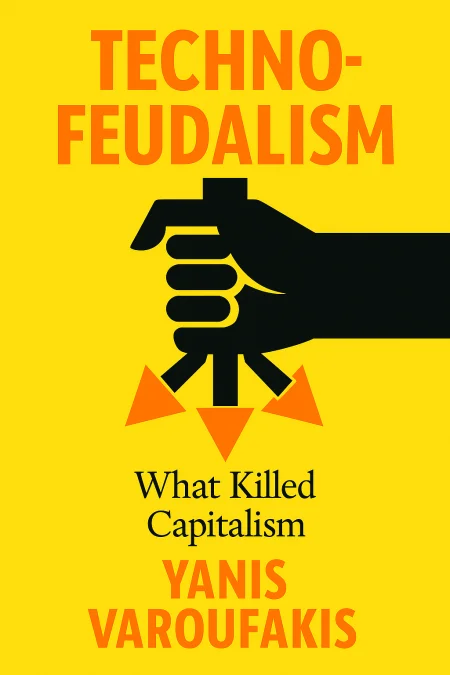
Technofeudalism
What Killed Capitalism
Book Edition Details
Summary
In a world where the pulse of capitalism falters, Yanis Varoufakis exposes the shadowy rise of technofeudalism, a system where Big Tech reigns as the new overlords of society. These digital emperors have seized control, reshaping our realities and rewriting the power dynamics of the globe. Yet, within this dystopian landscape lies a glimmer of rebellion—a chance to reclaim our minds and forge a future free from digital chains. With sharp insights and a visionary gaze, Varoufakis challenges us to confront this epochal shift and arm ourselves for the revolution that beckons. This is not just a book; it's a battle cry for our times.
Introduction
The rise of digital platforms has fundamentally altered the nature of economic power, creating what appears to be a return to feudal-like structures of domination disguised as technological progress. While most observers focus on how technology enhances or disrupts existing capitalist markets, a more radical transformation is occurring beneath the surface. The emergence of cloud-based capital represents not merely an evolution of capitalism but its potential replacement with something qualitatively different—a system where traditional market mechanisms give way to centralized digital fiefdoms controlled by a new class of technological overlords. This analysis employs a historical materialist approach to examine how digital technologies have created novel forms of capital accumulation and social control. By tracing the development of cloud capital through its technological foundations, economic mechanisms, and social implications, we can discern patterns that challenge conventional assumptions about market dynamics and democratic governance. The investigation reveals how seemingly neutral technological innovations have concentrated unprecedented power in the hands of a few platform owners, transforming users into digital serfs who contribute unpaid labor while surrendering autonomy over their data and attention. The examination proceeds through careful analysis of how cloud capital operates differently from traditional industrial capital, why profit has become optional for dominant digital platforms, and how this transformation affects global power relations. Through this systematic approach, we can better understand whether current technological developments represent capitalism's final evolution or the emergence of an entirely new economic system.
The Rise of Cloud Capital and Death of Capitalism
The transformation of internet infrastructure from a commons-based network into privately controlled digital territories marks a decisive break from traditional capitalist development. Unlike previous technological advances that enhanced existing market mechanisms, cloud-based technologies have created entirely new forms of capital that operate according to fundamentally different principles. Cloud capital differs from industrial capital not merely in its immaterial nature, but in its capacity to reproduce itself through unpaid user labor and to extract value without engaging in traditional market competition. This new form of capital exhibits three distinct characteristics that separate it from its predecessors. First, it functions as a produced means of behavioral modification rather than simply a tool for producing commodities. Second, it can accumulate and expand without requiring direct monetary investment from its owners, instead drawing on the unpaid contributions of billions of users who generate content, data, and social connections. Third, it operates through centralized platforms that appear to be markets but actually function as digital fiefdoms where algorithmic control replaces price mechanisms in matching buyers and sellers. The implications of this transformation extend far beyond the technology sector itself. As cloud capital increasingly dominates economic activity, traditional capitalist enterprises find themselves reduced to vassal status, forced to pay tribute to platform owners for access to customers. This represents a fundamental shift in the locus of economic power, from those who own physical means of production to those who control digital means of behavior modification and social coordination. The death of capitalism becomes apparent not through revolutionary upheaval but through the gradual displacement of market mechanisms by algorithmic control systems that concentrate unprecedented power in the hands of platform owners. This process accelerates as more economic activity migrates online and becomes subject to the logic of cloud capital accumulation.
How Digital Platforms Replace Markets with Feudal Control
Digital platforms fundamentally alter the nature of economic exchange by replacing decentralized market mechanisms with centralized algorithmic control. In traditional markets, buyers and sellers interact directly, with prices emerging from their voluntary transactions. Platform-based commerce, however, introduces a powerful intermediary that shapes every aspect of the exchange process while remaining largely invisible to participants. The algorithmic systems that govern platforms like Amazon possess unprecedented power to determine which products users see, how they are presented, and under what terms exchanges occur. This represents a qualitative departure from previous forms of market intermediation. Unlike traditional marketplaces or retail stores, digital platforms can customize the entire shopping environment for each individual user, creating personalized reality bubbles that eliminate the possibility of genuine price comparison or competitive market dynamics. Platform owners leverage this control to extract what can be understood as a form of rent rather than profit. Traditional capitalist profits emerge from competitive advantage in production or innovation, making them vulnerable to market forces. Platform rents, by contrast, flow from control over access to digital infrastructure that has become essential for economic participation. Vendors pay platform fees not because platforms provide superior services, but because they have no alternative means of reaching customers at scale. This feudal-like structure extends beyond mere commercial transactions to encompass the broader digital economy. Users become digital serfs, contributing unpaid labor through their posts, reviews, and data generation while remaining subject to platform rules they cannot influence. The apparent freedom of digital participation masks a deeper form of subjugation to algorithmic systems designed to maximize platform owner wealth and control.
Why 'Technofeudalism' Better Explains Our Economic Reality
The concept of technofeudalism captures essential features of contemporary economic organization that remain invisible when viewed through traditional capitalist frameworks. Unlike capitalism, where power stems from ownership of physical means of production, technofeudalism concentrates power in the hands of those who control digital means of behavioral modification and social coordination. This shift represents more than technological upgrade—it constitutes a fundamental transformation in how economic surplus is generated and extracted. Central banks' monetary policies since 2008 have inadvertently accelerated this transformation by flooding financial markets with liquidity that traditional industrial enterprises could not profitably invest due to weak consumer demand. Cloud capital platforms, however, proved capable of absorbing unlimited amounts of this money to expand their digital infrastructure and user bases without requiring immediate profitability. This created conditions where profit became optional for dominant platforms, allowing them to operate according to feudal rather than capitalist logic. The resulting system exhibits characteristics more reminiscent of feudalism than capitalism. Platform owners extract tribute from both users and commercial vendors while providing digital infrastructure that users cannot easily abandon due to network effects and data lock-in. Traditional capitalist enterprises increasingly find themselves in vassal relationships to platform owners, dependent on algorithmic favor for access to customers and markets. Recognizing this transformation as technofeudalism rather than hyper-capitalism helps explain otherwise puzzling phenomena: why stock markets can rise while economic fundamentals deteriorate, how platforms can dominate markets without traditional competitive advantages, and why democratic institutions seem increasingly powerless to regulate digital monopolies. The feudal analogy illuminates power relationships that capitalist analysis obscures.
Escaping Digital Serfdom Through Democratic Ownership
Resistance to technofeudal domination requires strategies that address the systemic nature of digital platform control rather than treating it as a regulatory or antitrust problem. Traditional approaches to monopoly-breaking prove inadequate because platform power derives not from market share but from control over essential digital infrastructure and user data. Meaningful alternatives must therefore focus on democratizing ownership and control of digital technologies themselves. Democratic ownership of digital platforms would transform the relationship between users and technology from one of subjugation to one of genuine participation. This involves more than worker cooperatives or public ownership—it requires restructuring digital systems so that users retain control over their data, attention, and social connections. Such transformation would eliminate the fundamental asymmetry that allows platform owners to extract value from user activity without reciprocal benefit. The technical foundations for such alternatives already exist in the form of decentralized protocols and peer-to-peer networks that can provide platform functionality without centralized control. The primary obstacles are not technological but political and economic: existing platform monopolies have enormous resources to maintain their dominance, while potential alternatives lack the capital and coordination necessary to challenge established networks effects. Successful resistance strategies must therefore combine technological innovation with political organization that can mobilize both digital platform users and traditional workers affected by platform dominance. This coalition-building approach recognizes that technofeudalism affects not only digital platform users but also the broader working class whose conditions deteriorate as algorithmic management systems extend into traditional workplaces.
Summary
The emergence of cloud capital represents a fundamental transformation in economic organization that transcends traditional capitalist categories and creates new forms of digital feudalism. Through careful analysis of how digital platforms operate, extract value, and concentrate power, we can discern the emergence of technofeudal structures that replace market mechanisms with algorithmic control systems. This transformation has profound implications for democracy, individual autonomy, and economic justice that extend far beyond the technology sector itself. Understanding these changes as technofeudalism rather than hyper-capitalism provides essential insights for developing effective resistance strategies and alternative organizational models that can restore democratic control over digital infrastructure and social coordination technologies.
Related Books
Download PDF & EPUB
To save this Black List summary for later, download the free PDF and EPUB. You can print it out, or read offline at your convenience.
By Yanis Varoufakis
