
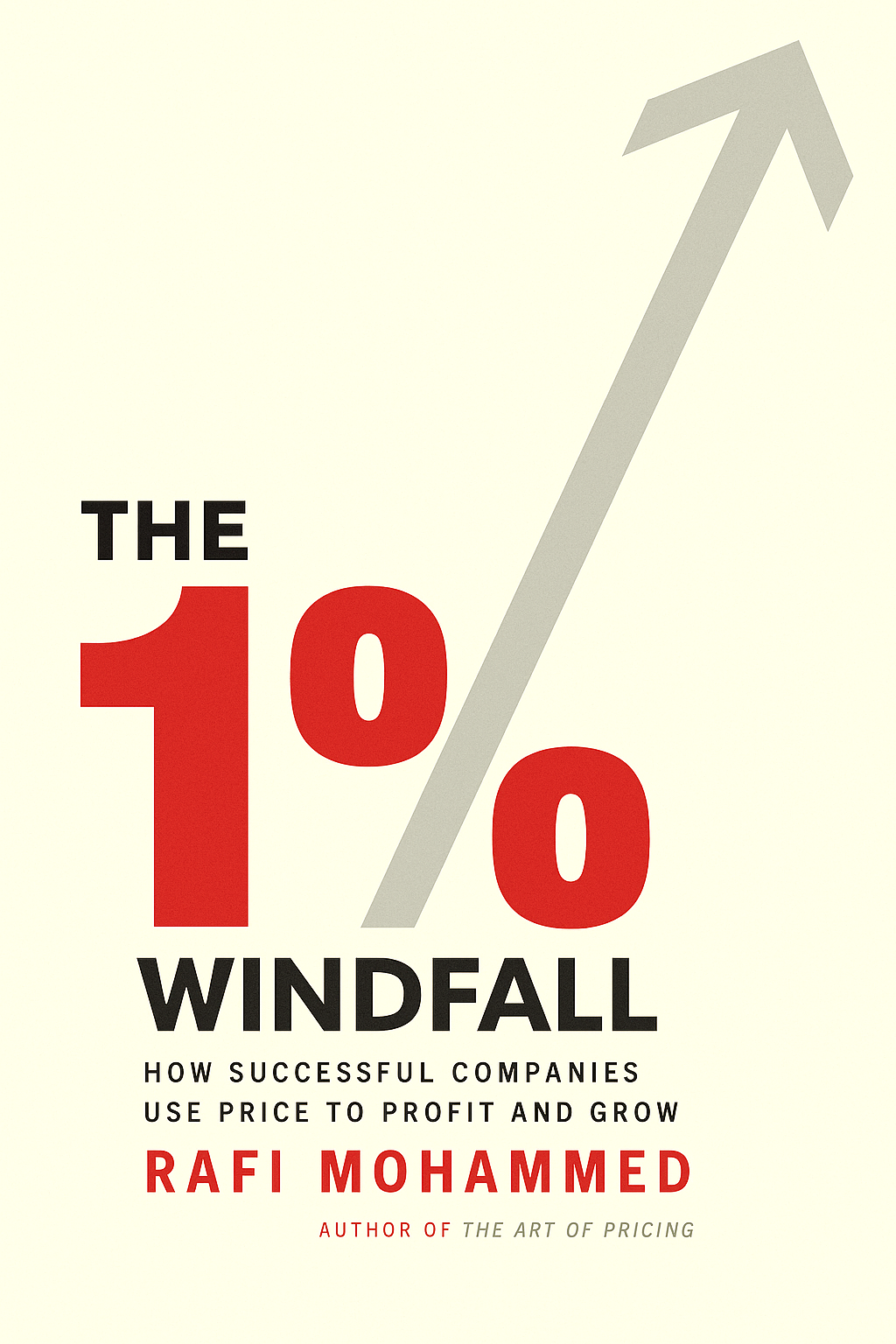
The 1% Windfall
How Successful Companies Use Price to Profit and Grow
Book Edition Details
Summary
When the winds of market change swirl and businesses teeter on the brink, survival hinges on the art of pricing. "The 1% Windfall" is your secret weapon, a revelation in economic strategy that invites companies to wield pricing as a tool for triumph. Crafted by pricing virtuoso Rafi Mohammed, this essential guide unlocks the untapped potential within your price tags, transforming them into levers of profit and growth. Whether navigating the stormy seas of economic downturns or outmaneuvering fierce competitors, this book delivers a robust framework to not just stay afloat but to sail ahead with confidence. Discover the strategic finesse needed to attract and retain the ideal clientele, turning economic adversity into financial opportunity.
Introduction
Most companies invest heavily in product development, marketing, and distribution, yet when it comes to pricing—the mechanism through which businesses capture value for their efforts—they often rely on outdated, arbitrary methods. This fundamental disconnect between sophisticated business operations and simplistic pricing approaches represents one of the most overlooked profit opportunities in modern commerce. This work presents a comprehensive framework for strategic pricing that transcends the conventional "raise or lower prices" mentality. The theoretical foundation rests on value-based pricing principles, which recognize that customer perception of worth, rather than internal cost structures, should drive pricing decisions. The framework introduces systematic approaches to pricing strategy through multiple interconnected methodologies: pick-a-plan strategies that address diverse customer payment preferences, versioning tactics that create product variations for different market segments, and differential pricing mechanisms that capture varying customer valuations. The central thesis challenges businesses to move beyond reactive pricing toward proactive profit optimization. How can organizations systematically identify and capture the maximum value customers place on their offerings? What structural changes enable companies to serve broader markets while maintaining profitability? How do defensive pricing strategies protect margins during economic uncertainty while offensive approaches drive sustainable growth?
Value-Based Pricing: The Foundation of Better Pricing
Value-based pricing represents a fundamental shift from cost-plus methodologies toward customer-centric price determination. This approach recognizes that prices should reflect the worth customers assign to products relative to available alternatives, not merely internal production costs plus desired margins. The theoretical foundation rests on understanding customer decision-making processes and positioning products within competitive landscapes. The framework operates through systematic analysis of next-best alternatives—the competing options customers consider when making purchasing decisions. By identifying these alternatives and understanding how products differentiate themselves through brand strength, quality advantages, unique features, service excellence, purchase convenience, or distinctive design, organizations can establish pricing foundations that capture genuine market value. The methodology encompasses two distinct approaches depending on sales contexts. One-on-one pricing applies when selling individual units to single customers, involving direct customer interaction and negotiation. Multicustomer pricing addresses scenarios where companies set public prices for multiple units across diverse customer bases. This latter approach requires constructing demand curves that reflect varying customer valuations and conducting profit-maximizer analyses to identify optimal price points. Consider how street vendors instinctively apply value-based principles by raising umbrella prices when rain threatens. The cost of umbrellas remains constant, but their value to customers increases dramatically. Similarly, successful companies recognize that customer perception of worth fluctuates based on circumstances, competitive landscapes, and individual needs. This dynamic understanding enables pricing decisions that capture maximum value while maintaining market position and customer satisfaction.
Pick-a-Plan, Versioning, and Differential Pricing Strategies
Pick-a-plan strategies address the reality that customers often desire products but find traditional ownership models unsuitable for their circumstances. This approach recognizes that pricing plans, not just prices, can determine purchase decisions. The theoretical framework categorizes customer constraints into ownership preferences, value uncertainty, price predictability needs, and financial limitations. Ownership alternatives include interval ownership for customers seeking partial rather than complete product control, leasing arrangements for those preferring temporary access, rental models for short-term usage, and subscription-based approaches that provide ongoing access without ownership responsibilities. These options activate dormant customers who found traditional purchase models incompatible with their needs or preferences. Versioning strategies acknowledge that customers have diverse product needs and varying willingness to pay for different attribute combinations. The framework creates product variations through strategic addition or subtraction of features, enabling companies to serve broader market segments while capturing different value levels. Premium versions incorporate enhanced quality, guaranteed access, priority service, improved speed, or comprehensive coverage. Basic versions reduce features, add usage restrictions, unbundle components, or limit availability to off-peak periods. Differential pricing recognizes that identical products can command different prices across customer segments based on varying valuations. Implementation occurs through hurdles that price-sensitive customers must navigate to access discounts, customer characteristics that indicate different value perceptions, adjusted selling characteristics like quantity requirements or bundle configurations, and dynamic selling techniques including negotiation and usage-based pricing. These strategies work synergistically to create comprehensive pricing architectures. Airlines exemplify this integration by offering various booking classes at different price points, multiple payment options including financing, and dynamic pricing based on demand patterns. The result expands market reach while optimizing revenue capture across diverse customer segments.
Creating a Pricing Blossom Strategy Framework
The pricing blossom framework integrates value-based foundations with strategic pricing tactics to create comprehensive profit optimization systems. This theoretical model positions value-based pricing as the central foundation from which multiple strategy branches extend, each containing specific tactical implementations designed to address different customer segments and market conditions. The framework operates through systematic implementation phases beginning with value-based price establishment, followed by identification of applicable pick-a-plan opportunities, development of product versions serving different market segments, and integration of differential pricing mechanisms. Each phase requires careful analysis of customer behaviors, competitive landscapes, and internal capabilities to ensure tactical selections align with market realities and organizational strengths. Implementation considerations include cannibalization analysis to prevent profitable customers from migrating to lower-priced options, market testing to validate pricing assumptions, and competitive response anticipation. The framework emphasizes that not every tactic applies to every product or market situation. Professional services might emphasize financing options and expertise-based versioning, while retailers focus on seasonal pricing variations and loyalty program differentials. The theoretical strength lies in customer self-selection mechanisms that allow individuals to choose pricing options best suited to their needs and valuations. Rather than forcing customers into single price points, the framework creates multiple pathways to purchase, each optimized for different customer segments. This approach maximizes market coverage while enabling companies to capture varying levels of customer value through strategic price discrimination. Consider how successful restaurants implement pricing blossoms through multiple service levels, from casual bar dining to premium private rooms, early-bird specials to chef's table experiences, and group packages to individual meals. Each option serves different customer needs while contributing to overall profitability through strategic value capture across diverse market segments.
Implementation and Culture of Profit
Strategic pricing implementation requires organizational transformation that extends beyond tactical price adjustments to encompass cultural shifts toward profit-oriented thinking. The theoretical framework addresses common pricing myths that undermine profitability, establishes confidence-building mechanisms that support value capture, and creates ongoing practices that sustain pricing excellence over time. Cultural transformation begins with myth elimination, particularly the misconception that prices should reflect costs rather than customer value, that market share necessarily requires price sacrifices, or that discounts today guarantee premium pricing tomorrow. Organizations must develop shared understanding that pricing strategies can simultaneously achieve market leadership and profit maximization through comprehensive customer service rather than universal price reductions. Confidence building involves creating value statements that articulate product differentiation clearly and training employees to communicate these advantages effectively. When staff members understand and believe in their products' unique benefits, they become more comfortable capturing appropriate value through pricing. This confidence proves essential for frontline personnel who directly interact with price-sensitive customers and must justify pricing decisions in real-time situations. Ongoing practices include compensation systems that reward profitability rather than pure volume, competitive intelligence gathering that informs pricing decisions, regular value monitoring that tracks changing market conditions, and pricing roundtables that facilitate knowledge sharing across organizational levels. These mechanisms create sustainable environments where pricing excellence becomes embedded in organizational DNA rather than depending on individual initiative or temporary programs. The implementation framework recognizes that pricing transformation occurs gradually through phased approaches that build capability and confidence over time. Organizations might begin with basic value-based pricing principles before advancing to complex differential pricing schemes or comprehensive versioning strategies. Success depends on maintaining momentum through visible wins and continuous reinforcement of profit-oriented thinking throughout all organizational levels.
Summary
Strategic pricing transcends traditional cost-plus methodologies to become a comprehensive framework for value capture and profit optimization across diverse customer segments and market conditions. The integration of value-based foundations with systematic pick-a-plan, versioning, and differential pricing strategies creates powerful mechanisms for simultaneous market expansion and margin enhancement. This approach recognizes that customer diversity represents opportunity rather than complexity, enabling organizations to serve broader markets while capturing maximum value through strategic price differentiation. The framework's enduring significance lies in its ability to transform pricing from a reactive cost-recovery mechanism into a proactive profit driver that adapts to changing market conditions while maintaining sustainable competitive advantages.
Related Books
Download PDF & EPUB
To save this Black List summary for later, download the free PDF and EPUB. You can print it out, or read offline at your convenience.
By Rafi Mohammed
