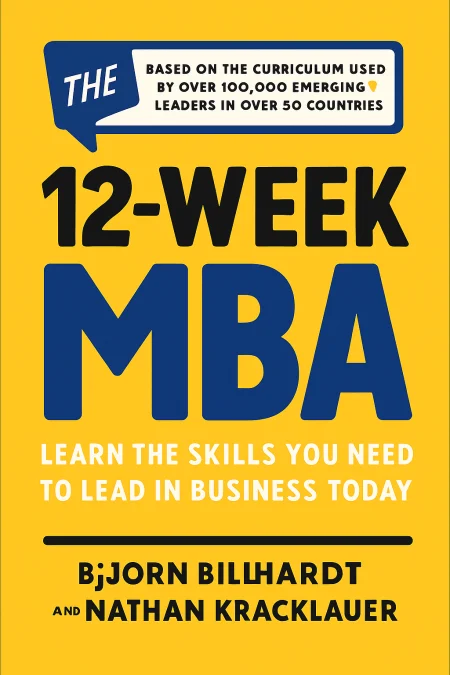
The 12-Week MBA
Learn the Skills You Need to Lead in Business Today
byBjorn Billhardt, Nathan Kracklauer
Book Edition Details
Summary
In a world where traditional education feels like a marathon, "The 12-Week MBA" sprints ahead, reshaping the landscape of business learning. This dynamic guide unpacks the essence of an MBA into a three-month odyssey, drawing wisdom from programs that have propelled over 100,000 professionals to success. Bjorn Billhardt and Nathan Kracklauer, architects of leadership at Abilitie, challenge the conventional with their revolutionary approach: distilling core business acumen into actionable insights. Whether you're steering a multinational or igniting a startup, their philosophy champions the universal toolkit every leader must wield—mastering numbers, galvanizing teams, and creating shareholder value. Say goodbye to the costly confines of a two-year degree; this is the future of business mastery, designed for the visionary in you.
Introduction
Why do some managers create exceptional value while others struggle to make meaningful impact? The answer lies not in complex theories or advanced degrees, but in mastering two fundamental domains that drive all organizational success. Business administration ultimately comes down to understanding numbers and people - the quantitative frameworks that measure value creation and the human dynamics that enable collective achievement. This framework reveals how every business decision involves trade-offs between profitability, growth, and risk, while every organizational outcome depends on building trust and enabling effective decision-making. The intersection of financial literacy and people leadership forms the core competency that separates effective managers from mere functionaries. Rather than pursuing endless specialization, today's leaders need practical mastery of these timeless principles that transcend industry boundaries and technological disruption.
The Numbers: Understanding Financial Value Creation
Financial literacy in business begins with a deceptively simple equation: shareholder value originates from a company's discounted future net cash flows. This principle transforms abstract accounting into a practical framework for every managerial decision. The three drivers of this value creation - profitability, growth, and risk - interact in complex ways that determine whether companies thrive or fail. Profitability represents the fundamental ability to create customer value while consuming fewer resources. This requires driving a wedge between what customers willingly pay and the costs required to deliver that value. Companies achieve this through operational excellence or by enhancing customer value perception, but never through accounting manipulation or wishful thinking. Growth amplifies profitability through scale, but not all growth creates value. Organic growth from satisfied customers differs fundamentally from acquisitive growth that merely rearranges market share. The most sustainable growth comes from understanding market dynamics and customer needs deeply enough to expand both volume and value simultaneously. Risk manifests in investor confidence about future cash flows. Companies with predictable business models and reliable execution earn lower costs of capital, while uncertainty drives up the minimum returns investors demand. Managing risk means making and keeping promises - to customers, employees, suppliers, and shareholders - with unwavering consistency. The interplay between these three drivers explains why successful companies focus obsessively on cash flow, working capital management, and cost structure decisions. Financial statements become tools for understanding these dynamics rather than mere compliance documents, revealing the economic reality behind every operational choice.
The People: Building Trust and Managing Teams
Human collaboration in organizations rests on a foundation more fragile than most leaders recognize: trust between individuals who must coordinate their efforts toward shared goals. This trust emerges from the consistent alignment between expectations set and promises kept. Without this foundation, even the most brilliant strategies fail in execution. Trust building begins with expectation management across three critical areas: relationship dynamics, task specifications, and developmental opportunities. Managers who excel at setting clear, realistic expectations while providing psychological safety for honest communication create the conditions where teams can focus on results rather than relationship maintenance. The feedback process serves as the primary mechanism for maintaining trust while driving performance improvement. Effective feedback balances present results with future capability building, requiring managers to master the delicate art of correction without undermining confidence. This involves specific, timely observations about behavior and impact rather than vague praise or destructive criticism. Understanding individual motivators - achievement, autonomy, mastery, purpose, recognition, security, companionship, and status - enables managers to create environments where people naturally excel. Rather than manipulating these motivators, skilled managers design roles and recognition systems that align individual drives with organizational needs. The ultimate test of people leadership comes during social dilemmas where individual and collective interests diverge. Leaders who can inspire others to contribute discretionary effort toward shared goals create sustainable competitive advantages that purely incentive-based systems cannot match.
Decision-Making: Collective Action and Execution
Organizations succeed or fail based on the quality of their collective decision-making processes, not the brilliance of individual choices. The most critical decisions often involve irreducible uncertainty where outcomes cannot be predicted with confidence. In these situations, process quality becomes more important than analytical sophistication. The three-phase framework of define, deliberate, and execute provides structure for team decision-making. Defining decisions requires identifying which choices truly matter, discovering all viable options, and gathering sufficient information without falling into analysis paralysis. Teams frequently fail by spending too much time on trivial decisions while missing crucial strategic choices entirely. Deliberation mechanisms - consensus, majority rule, and sole decider approaches - each offer distinct advantages depending on the decision type and organizational context. The key lies in establishing legitimate processes that team members accept as binding regardless of their individual preferences. This legitimacy enables alignment even when agreement proves impossible. Execution requires translating decisions into coordinated actions across multiple teams and time horizons. This succeeds only when people understand not just what was decided, but why those choices serve broader organizational purposes. Clear communication channels and accountability structures ensure that downstream decisions remain aligned with original intentions. The most dangerous trap in collective decision-making is the content trap - becoming so focused on the substance of decisions that teams neglect the process by which they make choices. Teams that invest in decision-making procedures consistently outperform those that rely solely on individual expertise or charismatic leadership.
Leadership Responsibility: Creating Sustainable Value
Leadership transcends management through its focus on overcoming social dilemmas - situations where collective benefit requires individuals to subordinate short-term self-interest to long-term shared success. These dilemmas pervade organizational life, from information sharing and resource allocation to innovation investment and quality standards. True leaders enable collective action by building and nurturing belief that everyone commits to common goals. This requires consistent role modeling, clear communication of vision and values, and recognition of cooperative behavior throughout the organization. Leadership behaviors must be visible and authentic rather than performative or manipulative. The responsibility that comes with organizational authority extends beyond personal success to the welfare of all stakeholders affected by business decisions. Managers make choices that impose costs and benefits on employees, customers, suppliers, communities, and future generations. This responsibility cannot be abdicated through appeals to market forces or shareholder primacy. Sustainable value creation demands integration of financial discipline with human development, short-term results with long-term capability building, individual performance with collective achievement. The most effective leaders navigate these tensions through principled decision-making processes that maintain trust while driving results. The ultimate measure of leadership lies not in personal advancement but in the capability and character of the organizations and people left behind. Leaders who focus on developing others while building institutional strength create value that extends far beyond their tenure or immediate sphere of influence.
Summary
Business administration fundamentally involves creating sustainable value through the disciplined integration of financial understanding and human leadership - managing numbers and people with equal sophistication to enable collective achievement that exceeds individual capabilities. This dual competency framework provides the foundation for principled management that serves all stakeholders while building resilient organizations capable of adapting to changing circumstances and creating meaningful impact in an interconnected world.
Related Books
Download PDF & EPUB
To save this Black List summary for later, download the free PDF and EPUB. You can print it out, or read offline at your convenience.
By Bjorn Billhardt
