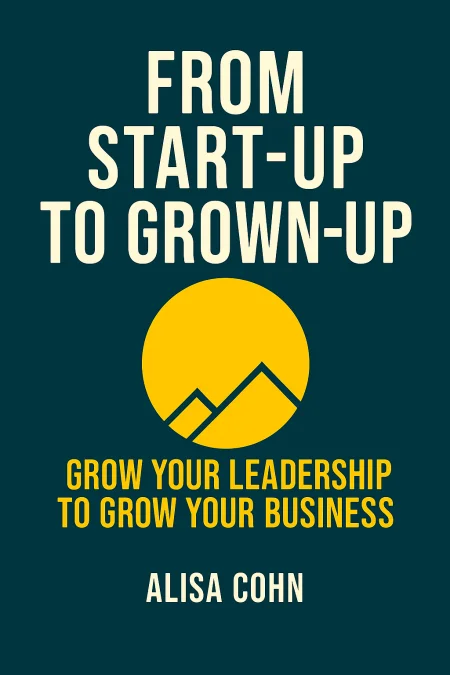
From Start-Up to Grown-Up
Grow Your Leadership to Grow Your Business
Book Edition Details
Summary
In the whirlwind world of start-up ventures, where chaos and uncertainty are the norm, Alisa Cohn's "From Start-Up to Grown-Up" stands as a beacon for founders seeking clarity and growth. This indispensable guide is more than just a manual—it's a transformative journey into the art of self-leadership. Cohn, an acclaimed executive coach, shares her profound insights and real-world strategies that have propelled companies like Etsy and Foursquare to success. Here, she empowers you to harness your personal strengths, tame your inner doubts, and build a cohesive, motivated team. Through relatable anecdotes and practical advice, discover how to foster a company culture that thrives on shared values and forward-thinking vision. Whether you're steering a fledgling start-up or scaling new heights, this book provides the tools you need to evolve alongside your enterprise, ensuring that both you and your company flourish in tandem.
Introduction
The journey from founding a company to leading a thriving enterprise represents one of the most challenging personal transformations in the business world. Many brilliant entrepreneurs who can create groundbreaking products and inspire initial teams find themselves struggling when their companies grow beyond their direct control. The skills that make you successful at launch are not the same ones needed to guide hundreds of employees through complex challenges. This transformation demands more than just learning new business tactics. It requires a fundamental shift in how you see yourself, how you relate to others, and how you approach the daily work of leadership. The path ahead involves mastering three interconnected domains: managing yourself with deeper self-awareness, managing your team with intention and skill, and managing the growing complexity of your organization with systems that scale. Each domain builds upon the others, creating a foundation for sustainable growth and lasting impact.
Managing You: Self-Awareness and Personal Growth
The most important leadership tool you possess is not your strategic mind or your industry expertise, but your capacity for honest self-reflection. Leadership begins with understanding your own patterns, triggers, and blind spots because these invisible forces shape every interaction you have with your team. Consider the story of Tony, who founded a robotics company in Miami. Despite being genuinely likeable and experienced, he repeatedly shut down meetings without realizing it. During one executive session, his COO Holly suggested they develop contingency planning for potential business risks. Tony enthusiastically agreed and launched into a fifteen-minute monologue detailing exactly how they should approach this planning, who should be involved, and how to move forward. When he finished, the room fell silent. Tony was confused because he thought he was being supportive, but his team experienced his passionate response as him taking ownership away from Holly and dismissing their need to contribute. Through coaching, Tony learned that his intentions and his impact were misaligned. He discovered that when he got excited about ideas, his natural leadership style became overwhelmingly directive, leaving no space for others to develop or own solutions. This pattern was consistent across many interactions, creating a team that felt managed rather than empowered. The transformation began when Tony started practicing what coaches call the "pause and inquire" approach. Instead of immediately jumping in with solutions, he learned to ask questions like "What are your thoughts on how we should approach this?" and "What would success look like from your perspective?" This simple shift allowed his team members to think through challenges themselves while still benefiting from his experience and guidance. To develop this kind of self-awareness, start by identifying your natural leadership style across key dimensions: how you express yourself to others, how you handle conflict, your approach to giving feedback, your need for control, and how you respond under stress. Then gather data about how others experience you by asking trusted colleagues for specific examples of when your leadership felt most and least effective. Finally, create a daily practice of reflection where you review key interactions and ask yourself what worked, what didn't, and what you might do differently next time.
Managing Them: Building High-Performance Teams
Once you understand your own leadership patterns, you can turn your attention to the complex art of bringing out the best in others. Great leadership is ultimately about creating conditions where talented people can do their best work while feeling psychologically safe, appropriately challenged, and genuinely valued. The foundation of effective team management is what researchers call psychological safety, which simply means people feel secure enough to take risks, make mistakes, admit confusion, and offer ideas without fear of punishment or humiliation. This concept came alive for Suzanne, who founded a networking company that grew to 600 employees. During a major system outage that threatened their largest customer relationship, Suzanne worked through the night alongside her technical team. Instead of assigning blame when people made mistakes under pressure, she maintained a steady mantra: "We have to fix this problem. We can fix this problem. And we will fix this problem." Her calm, solution-focused approach in crisis created space for her team to think clearly and work collaboratively rather than defensively. One engineer later told her, "You kept the wheels on the bus. It was a very daunting problem with a screaming customer and tight timeline, but you didn't make a single comment about blame. You showed us you had faith in us to deliver, and I think that's why we moved mountains to get it done." This psychological safety must be paired with clear expectations and consistent accountability. The most effective leaders master the balance between supportive and demanding. They invest heavily in positive recognition, celebrating both major victories and small wins, while also having direct conversations when performance falls short of standards. They understand that accountability conversations are not punishment but opportunities to help people succeed. To build this capability, develop a systematic approach to managing your team relationships. Schedule regular one-on-one meetings focused on understanding what motivates each person, what obstacles they face, and how you can better support their success. Practice giving specific positive feedback at least twice as often as constructive feedback. When problems arise, focus your conversations on future solutions rather than past mistakes, and always end by clarifying next steps and follow-up expectations.
Managing the Company: Systems and Operations Excellence
As your company grows beyond the size where you can personally manage every relationship and decision, you must evolve from being the person who does the work to being the person who creates systems that enable others to do great work consistently and efficiently. This transition often proves jarring for founders who built their early success on personal relationships and informal processes. Nathan, who founded an AI startup, experienced this challenge after raising seventeen million dollars. His team had a thoughtful hiring plan, but as they filled roles, each new need seemed reasonable in isolation. The VP of product needed someone for data research, the CTO required two additional engineers for system architecture, and the VP of sales wanted support for operations. Each individual decision made sense, but collectively they burned through far more money than anticipated because they made decisions in isolation rather than within a comprehensive framework. The solution required implementing what successful companies call operational discipline. This means creating dashboards that track your most critical metrics in real-time, establishing clear processes for how decisions get made and communicated, and building systems that give you visibility into project status before problems become crises. Nathan's team learned to use a simple color-coding system: green meant projects were on track, yellow indicated issues with viable solutions, and red signaled problems without clear resolution paths. Most importantly, operational excellence requires great meetings, which many founders resist but which become essential for coordination and alignment. Effective meetings start with clear purpose, include the right participants, and always end with specific commitments about who will do what by when. The weekly executive team meeting becomes your primary tool for ensuring everyone understands priorities, sharing information up and down the organization, and quickly addressing obstacles before they derail progress. Begin building these capabilities by identifying the three to five metrics that best indicate your company's health and progress toward goals. Create a simple dashboard that tracks these metrics weekly and is reviewed in a regular leadership meeting. Establish clear decision-making protocols that specify who has authority for different types of choices and how information flows through your organization. Finally, invest in training yourself and your managers in the fundamental skills of running productive meetings, giving effective feedback, and developing people's careers.
Summary
The transformation from entrepreneur to CEO represents one of the most demanding and rewarding growth journeys in professional life. As one seasoned founder put it, "Leadership is an unnatural act," requiring you to develop capabilities that don't come instinctively but can be learned through deliberate practice and honest self-reflection. The path forward demands that you master the interconnected challenges of self-management, team leadership, and organizational systems. The work begins and ends with you, requiring the courage to examine your own patterns and blind spots while developing the skills to bring out the best in others. Success comes not from having all the answers but from creating conditions where talented people can find solutions together. Your company needs a leader who can adapt and grow as rapidly as the organization itself, someone who understands that building a great business is ultimately about building great relationships and great systems that support those relationships. Start today by scheduling thirty minutes for honest self-reflection about your current leadership patterns, then reach out to three trusted colleagues to ask for specific feedback about how you can become more effective in supporting their success.
Related Books
Download PDF & EPUB
To save this Black List summary for later, download the free PDF and EPUB. You can print it out, or read offline at your convenience.

By Alisa Cohn
