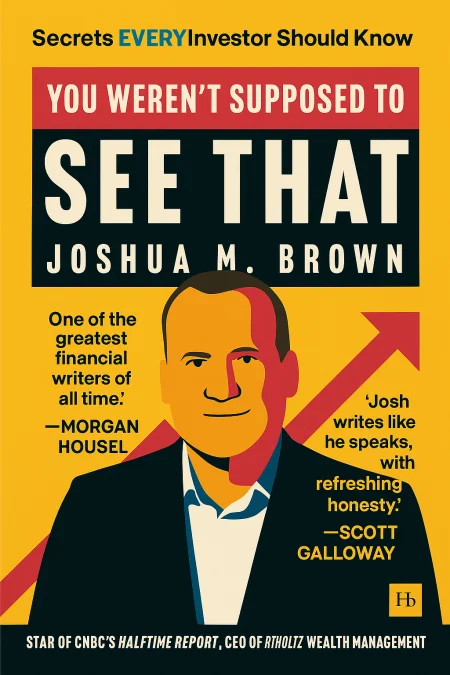
You Weren’t Supposed To See That
Secrets Every Investor Should Know
Book Edition Details
Summary
In a world where financial success often feels like a closely guarded secret, Downtown Josh Brown emerges as the insider willing to unlock the vault. "You Weren’t Supposed to See That" is more than a book—it's your backstage pass to the unvarnished truths of Wall Street. Crafted from over a decade of insights gleaned from The Reformed Broker blog, this collection distills the essence of financial wisdom into revelations that can transform your understanding of investing. Brown, the sharp mind behind CNBC’s Halftime Report, shatters illusions and illuminates the path from novice to savvy investor, guiding readers through the hidden labyrinth of finance. Whether you're an eager newcomer or a seasoned pro, prepare to confront the truths that could change your financial destiny.
Introduction
Wall Street operates behind a veil of complexity and jargon that deliberately obscures its fundamental mechanics from public view. This collection of observations reveals the stark disconnect between the industry's public narratives and its actual functioning, challenging conventional wisdom about how markets, money management, and financial advice truly work. The analysis cuts through decades of institutional mythology to expose how technological disruption, behavioral psychology, and economic incentives have fundamentally reshaped the investment landscape in ways that benefit some participants while disadvantaging others. The exploration employs a practitioner's insider perspective, combining real-world experience with analytical rigor to decode phenomena that academic theory often fails to explain. Rather than accepting surface explanations for market behavior, this examination traces cause-and-effect relationships back to their human origins, revealing how fear, greed, and institutional self-interest drive outcomes that appear rational from the outside but stem from deeply irrational roots. The approach encourages readers to question not just what happens in financial markets, but why it happens, and more importantly, who benefits from maintaining these patterns of behavior and belief.
The Rise of Passive Investing and Market Transformation
The investment industry has undergone a seismic shift that few participants fully comprehend. Over the past two decades, trillions of dollars have migrated from actively managed funds into passive index strategies, fundamentally altering how markets behave. This transformation represents more than a simple preference change; it constitutes a complete rewiring of market mechanics that has created what appears to be a "relentless bid" underneath stock prices. The migration stems from a business model revolution within wealth management itself. Traditional stockbrokers, compensated through commissions and transaction fees, had every incentive to generate portfolio activity. Their successor financial advisors, paid through asset-based fees, discovered that frequent trading undermined rather than enhanced client outcomes. This shift eliminated the economic motivation for portfolio churning and redirected focus toward long-term asset allocation strategies. The mathematical implications prove staggering. When fee-based advisors receive new client assets, they deploy these funds according to predetermined allocation models rather than market timing decisions. Every market decline triggers systematic rebalancing purchases as advisors restore target weightings. This creates persistent buying pressure that operates independently of traditional valuation metrics or economic fundamentals. The aggregate effect transforms market corrections from capitulation events into buying opportunities for a massive, institutionalized investor base. This structural change explains phenomena that perplex traditional market observers: why corrections have become shallower and shorter-lived, why trading volumes have declined despite rising asset values, and why bad news increasingly gets bought rather than sold. The transformation represents perhaps the most significant evolution in market structure since the advent of electronic trading, yet it remains largely invisible to participants who continue analyzing markets through outdated frameworks.
Technology Giants as America's New Economic Gods
A profound shift in collective faith has elevated technology companies to quasi-religious status in American culture. While traditional institutions lose credibility and public trust, corporations like Apple, Amazon, Google, and Tesla have ascended to positions once reserved for government entities and civic organizations. This transformation reflects more than simple investment success; it represents a fundamental reallocation of societal confidence from democratic institutions to corporate entities. The ascension correlates directly with the decline of traditional authority structures. As political institutions become increasingly polarized and ineffective, Americans have transferred their trust to organizations that demonstrate consistent execution and innovation. Technology companies deliver tangible improvements to daily life while government agencies struggle with basic competency. This creates a self-reinforcing cycle where corporate success generates public devotion, which in turn fuels further investment and market capitalization growth. The worship extends beyond rational economic analysis into genuine reverence. Consumers check their smartphones thousands of times daily in ritualistic behavior patterns. Product launches generate excitement typically reserved for religious gatherings. Corporate leaders like Elon Musk and Steve Jobs achieve prophet-like status, with their pronouncements moving markets and shaping public discourse. The companies themselves become objects of devotion rather than mere investment vehicles. This phenomenon explains seemingly irrational market valuations and investor behavior. When companies transcend their role as profit-generating entities to become symbols of progress and hope, traditional valuation metrics become inadequate. Investors buy not just future cash flows but participation in a collective vision of technological salvation. The stock prices reflect this spiritual premium, creating market dynamics that confound analysts focused solely on financial fundamentals.
Human Psychology and Market Volatility Patterns
Modern market volatility stems from psychological forces that differ fundamentally from historical patterns. Traditional fear and greed have evolved into more complex emotional states driven by social media exposure, wealth inequality awareness, and Fear of Missing Out (FOMO) dynamics. These new psychological drivers create market behavior that appears irrational but follows predictable patterns when understood through the lens of human insecurity and envy. The democratization of financial information through social media platforms has created unprecedented exposure to others' investment success and failure. Investors now witness real-time displays of wealth accumulation by peers, celebrities, and strangers, generating emotional responses that drive trading decisions. The traditional fear of losing money has been supplemented by the fear of missing extraordinary gains, while greed has evolved into envy-driven behavior that prioritizes relative rather than absolute performance. These psychological shifts manifest in measurable market phenomena. Speculative bubbles now build faster and with broader participation as social proof accelerates adoption of investment themes. Conversely, market corrections trigger more extreme emotional responses as investors witness their relative standing deteriorate in public forums. The resulting volatility patterns reflect not fundamental economic uncertainty but collective psychological instability amplified by technology. Understanding these psychological underpinnings becomes crucial for investment success in the modern era. Markets increasingly reflect the emotional state of mass psychology rather than rational economic analysis. Successful investors must therefore develop emotional intelligence alongside analytical skills, recognizing that their own psychological responses to market movements often represent precisely the wrong course of action. The discipline to act contrary to these instincts separates successful long-term investors from the crowd that provides liquidity at market extremes.
The Evolution of Financial Advisory Business Models
The financial advisory industry has undergone a complete structural transformation that most observers fail to recognize. What began as a product sales business masquerading as advice has evolved into genuine wealth management, creating profound implications for both practitioners and investors. This evolution explains many puzzling aspects of modern market behavior and industry consolidation patterns. Traditional stockbrokers operated under compensation systems that rewarded transaction volume and product sales rather than client outcomes. They sold mutual funds, insurance products, and individual securities based on commission structures that often aligned poorly with client interests. The regulatory and competitive pressures that emerged following successive market crises forced a migration toward fee-based advisory models where compensation depends on asset growth rather than trading activity. This transformation eliminated the economic incentives for portfolio churning and redirected advisor focus toward long-term client outcomes. Fee-based advisors discovered that low-cost index funds and tax-efficient strategies produced superior results compared to active management and frequent trading. The aggregate effect has been a massive flow of assets from expensive, actively managed products toward cheaper, passive alternatives, fundamentally altering industry economics. The business model shift explains the persistent flows into passive strategies, the decline of active management, and the compression of industry profit margins. It also illuminates why traditional Wall Street firms struggle to adapt to an environment where their historical competitive advantages have become liabilities. The transformation represents a rare instance where regulatory pressure and competitive dynamics aligned to improve outcomes for end investors, though the transition period has created significant disruption for incumbent industry participants.
Summary
The financial industry operates according to hidden dynamics that diverge sharply from public perception and academic theory. Technological disruption, psychological evolution, and business model transformation have combined to create market behavior that appears mysterious but follows logical patterns when underlying causes are properly understood. The passive investing revolution has fundamentally altered market structure, creating persistent buying pressure that supports asset prices independent of traditional valuation concerns. Meanwhile, the elevation of technology companies to quasi-religious status reflects a broader loss of faith in democratic institutions and a corresponding transfer of trust to corporate entities that demonstrate consistent execution. These structural changes interact with evolved psychological drivers to produce market volatility patterns that reflect mass psychology more than economic fundamentals, requiring investors to develop emotional intelligence alongside analytical skills to navigate successfully.
Related Books
Download PDF & EPUB
To save this Black List summary for later, download the free PDF and EPUB. You can print it out, or read offline at your convenience.
By Joshua M. Brown
