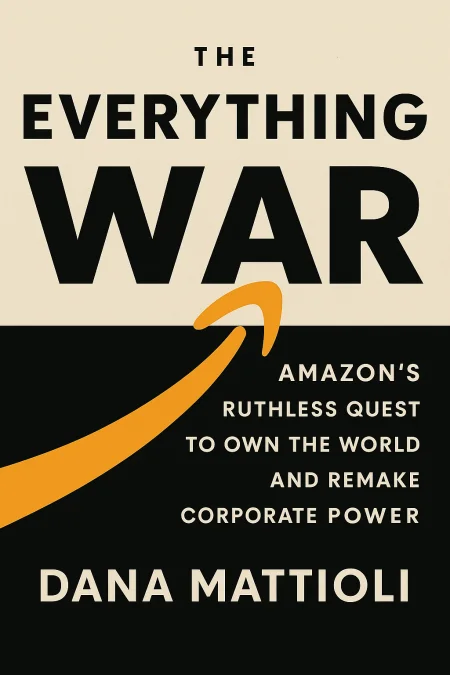
The Everything War
Amazon's Ruthless Quest to Own the World and Remake Corporate Power
Book Edition Details
Summary
In the high-stakes arena of global commerce, Amazon stands as both architect and antagonist, reshaping the world with relentless ambition. Dana Mattioli's "The Everything War" peels back the corporate curtain, revealing the untamed drive behind Amazon's quest for supremacy. This gripping exposé captures the formidable tactics used to dismantle competitors and seize new territories in the digital and physical realms. With a journalist's eye and a storyteller's flair, Mattioli reveals how Amazon's ambitions have indelibly altered the economic landscape, leaving an indomitable mark on society's fabric. Prepare to encounter the unfettered drive that has redefined market boundaries, posing the ultimate question: What price will be paid for one corporation's unyielding quest for world domination?
Introduction
In 1994, when Jeff Bezos left his lucrative Wall Street job to sell books from a garage in Bellevue, Washington, few could have imagined that this modest venture would fundamentally reshape the global economy. What appeared to be a simple story of entrepreneurial success would evolve into something far more complex and consequential: the systematic construction of a digital empire that would challenge the very foundations of competitive capitalism and democratic governance. This transformation reveals three profound lessons about power in the modern era. First, how a company can exploit regulatory gaps and technological shifts to build seemingly insurmountable competitive advantages while maintaining the appearance of customer service. Second, how the concentration of economic power inevitably becomes political power, forcing democratic institutions to grapple with corporate influence that transcends traditional boundaries. Third, how the digital economy's winner-take-all dynamics can create monopolies that operate through entirely new mechanisms, making them nearly invisible to regulatory frameworks designed for an industrial age. This chronicle will resonate with policymakers struggling to regulate technology giants, business leaders navigating an economy dominated by platform monopolies, and citizens concerned about the concentration of power in democratic societies. The rise of Amazon illuminates broader questions about capitalism, competition, and democracy that define our time. Understanding how one company managed to insert itself into virtually every aspect of economic life while avoiding meaningful regulatory constraint offers essential insights into the mechanics of modern corporate power and the urgent need for new approaches to preserving competitive markets in the digital age.
Tax Arbitrage and Foundation Building (1994-2010)
The foundation of Amazon's empire rested not merely on technological innovation, but on the systematic exploitation of America's fragmented tax system. When Bezos chose to locate his company in Washington state, he was implementing a strategy of regulatory arbitrage that would prove more valuable than any algorithm. The 1992 Supreme Court decision in Quill Corp v. North Dakota had created a loophole that mail-order companies could exploit, and Bezos recognized that this precedent would be even more powerful in the digital realm. This tax advantage transformed Amazon from a scrappy startup into a formidable competitor almost overnight. While established retailers like Barnes & Noble and Borders were forced to collect sales taxes on every transaction, Amazon customers enjoyed tax-free shopping in most states. The savings, often approaching ten percent of the purchase price, created an artificial price advantage that had nothing to do with operational efficiency or superior service. Internal documents from this period reveal that Amazon's leadership understood they were building their business model around what was essentially a government subsidy, one that traditional retailers could not access due to their physical presence requirements. The company's early culture reflected this calculated approach to competitive advantage. While Bezos spoke publicly about customer obsession and long-term thinking, privately he was constructing a machine designed to exploit every available loophole while building the scale necessary to survive once those advantages disappeared. Amazon's willingness to operate at losses for years, subsidized by venture capital and public markets, represented a new form of predatory competition that established retailers, bound by traditional financial expectations, could not match. By 2010, Amazon had successfully transformed from a vulnerable startup into a dominant platform, but the foundation of that success remained the tax arbitrage that had given the company crucial breathing room during its formative years. When states eventually began closing these loopholes, Amazon had already achieved the scale and customer loyalty that would make it nearly impossible to dislodge. The lesson was clear: in the digital economy, first-mover advantages combined with regulatory exploitation could create competitive moats that appeared insurmountable.
Platform Expansion and Data Weaponization (2010-2017)
The launch of Amazon Web Services marked the beginning of the company's transformation from retailer to infrastructure provider, but it was the introduction of third-party sellers that would prove most consequential for competition. By opening its platform to millions of small businesses, Amazon created what appeared to be a democratizing force in commerce. The reality was far more sinister: Amazon had constructed the perfect intelligence-gathering operation, one that would provide detailed insights into every successful product and business model in the American economy. The company's approach to partnerships during this period followed a consistent and ruthless pattern. Entrepreneurs and established businesses, desperate for access to Amazon's massive customer base, would share proprietary information about their operations, supply chains, and customer preferences. Amazon's teams would carefully study this data, identify the most promising opportunities, and then either acquire the companies or launch competing products using superior resources and insider knowledge. The Alexa Fund and various partnership programs served as sophisticated scouting operations, allowing Amazon to identify and neutralize emerging threats before they could gain meaningful traction. Internal communications from this era reveal the systematic nature of Amazon's competitive intelligence operations. The company's private label teams regularly accessed individual seller data to identify successful products, then created competing versions using the same factories and similar designs. When sellers complained about this obvious conflict of interest, Amazon's response was to point to the terms of service that sellers had agreed to, terms that gave Amazon broad rights to use seller data for its own purposes. The platform that had promised to empower small businesses was systematically harvesting their innovations and using that intelligence to compete against them. Perhaps most significantly, this period saw Amazon perfect the art of platform leverage. By controlling the marketplace where transactions occurred, the logistics network that fulfilled orders, the advertising system that determined product visibility, and the payment processing that completed sales, Amazon could influence outcomes at every level of the e-commerce ecosystem. Third-party sellers found themselves increasingly dependent on Amazon's services, paying higher fees each year while having little choice but to accept the platform's terms. The company had successfully created what economists call a bottleneck, a position of control that allowed it to extract value from every participant in the digital economy.
Political Awakening and Regulatory Pressure (2017-2021)
The publication of Lina Khan's "Amazon's Antitrust Paradox" in the Yale Law Journal marked a watershed moment in the relationship between Amazon and American democracy. Khan's argument that traditional antitrust thinking was inadequate for addressing platform monopolies resonated far beyond academic circles, providing intellectual ammunition for politicians and activists who had long suspected that Amazon's power posed threats that existing laws could not address. The article's influence demonstrated how ideas could still reshape political discourse, even in an era dominated by corporate lobbying and regulatory capture. The Trump presidency created an unprecedented situation where the world's most powerful company faced a president who viewed it as a personal enemy. Trump's attacks on Amazon, driven partly by his animosity toward the Washington Post and partly by his appeal to small business owners devastated by Amazon's rise, represented a fundamental shift in the relationship between corporate power and political authority. For the first time in its history, Amazon faced an executive branch that was actively hostile to its interests, forcing the company to rapidly develop political capabilities that it had previously neglected. Amazon's response revealed both the company's growing sophistication and its continued tone-deafness in political matters. The hiring of Jay Carney as head of global corporate affairs brought professional political operatives into Amazon's leadership, but their approach often backfired spectacularly. Carney's public questioning of Trump administration officials' patriotism and Bezos's Twitter feuds with the president demonstrated that even the most successful companies could struggle to navigate the intersection of business and politics when their power became too visible to ignore. The period culminated in formal congressional investigations that exposed the extent of Amazon's anticompetitive behavior. Internal documents revealed systematic efforts to copy successful products sold by third-party sellers, use pricing algorithms designed to eliminate competitors, and leverage data gathered through partnerships to identify acquisition targets. The House Judiciary Committee's investigation, led by David Cicilline, produced a comprehensive report that compared Amazon's tactics to those of the robber barons of the Gilded Age, arguing that the company's integrated business model created inherent conflicts of interest that could not be resolved through behavioral remedies alone.
Antitrust Reckoning and Legal Challenge (2021-2023)
The appointment of Lina Khan as chair of the Federal Trade Commission represented the culmination of a decade-long intellectual revolution in antitrust thinking and the beginning of the most serious legal challenge Amazon had ever faced. Khan's elevation from academic critic to the head of the agency responsible for regulating Amazon created a unique historical moment where the architect of modern antitrust criticism of Big Tech was now in position to act on her theories. This appointment signaled that the Biden administration was prepared to fundamentally rethink the relationship between government and corporate power. The FTC's investigation revealed the sophisticated mechanisms through which modern platform monopolies operate. Unlike the crude tactics of nineteenth-century trusts, Amazon's anticompetitive behavior was embedded in algorithms, data systems, and platform rules that appeared neutral but systematically favored Amazon's interests over those of competitors and consumers. The agency's staff spent months analyzing internal Amazon documents, interviewing former employees, and mapping the complex web of relationships that allowed Amazon to maintain its dominance across multiple markets simultaneously. The lawsuit filed in September 2023 marked a historic confrontation between democratic institutions and corporate power. The FTC's complaint detailed how Amazon had used its control over its marketplace to force sellers into using Amazon's logistics services, how it had punished sellers who offered lower prices elsewhere, and how it had systematically copied successful products while using its platform position to promote its own versions. The agency argued that Amazon's practices had inflated costs across the entire e-commerce ecosystem, as sellers were forced to factor Amazon's fees into their pricing everywhere else. Amazon's response to the lawsuit revealed the company's confidence in its legal position while simultaneously exposing the challenges it faced in defending its business model to a skeptical public. The company's arguments that its practices benefited consumers through lower prices and faster delivery invoked the traditional consumer welfare standard that had dominated antitrust thinking for decades. Yet the company's internal documents, quoted extensively in the FTC's complaint, showed that Amazon executives were well aware of the anticompetitive effects of their strategies and had designed systems specifically to maintain the company's market dominance regardless of the impact on competition or innovation.
Summary
The rise of Amazon's empire illuminates the central challenge of our digital age: how democratic societies can harness the benefits of technological innovation while preventing the concentration of power that threatens competitive markets and self-governance. Amazon's transformation from a garage startup to a platform that mediates a significant portion of global commerce represents both the promise and the peril of digital capitalism, demonstrating how patient capital, strategic thinking, and regulatory exploitation can create enormous value while simultaneously undermining the competitive processes that theoretically ensure continued innovation and consumer benefit. The story reveals three critical insights for navigating our technological future. First, traditional regulatory frameworks designed for industrial monopolies are fundamentally inadequate for addressing platform power, which operates through data advantages, network effects, and ecosystem control rather than simple market share. The consumer welfare standard that guided antitrust policy for decades fails to capture the ways that platform monopolies can harm competition while simultaneously offering short-term consumer benefits. Second, the concentration of economic power inevitably becomes political power, as Amazon's conflicts with democratic institutions demonstrate, requiring new approaches to corporate governance that can address the political dimensions of market concentration. Most importantly, the Amazon case illustrates that preserving competitive markets in the digital economy will require constant vigilance and adaptation of democratic institutions. The ongoing legal and regulatory battles over Amazon's business practices represent a test of whether traditional antitrust tools can be adapted to address twenty-first-century monopolies or whether entirely new frameworks for regulating corporate power will be necessary. The resolution of these conflicts will determine whether the digital economy evolves toward greater competition and innovation or further consolidation and control, shaping the economic and political landscape for generations to come.
Related Books
Download PDF & EPUB
To save this Black List summary for later, download the free PDF and EPUB. You can print it out, or read offline at your convenience.
By Dana Mattioli
