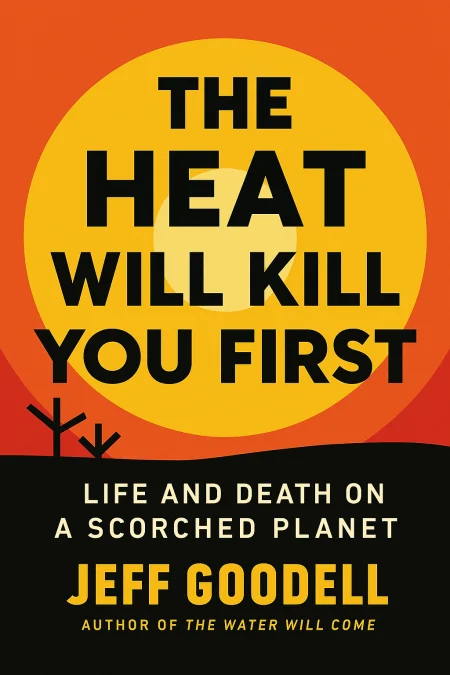
The Heat Will Kill You First
Life and Death on a Scorched Planet
Book Edition Details
Summary
In the crucible of a warming world, where the land smolders and ice turns to water, Jeff Goodell's "The Heat Will Kill You First" unravels the terrifying new normal of climate chaos. With a journalist's keen eye and a storyteller's heart, Goodell plunges into the heart of our planet's fever, where the relentless rise in temperature reveals societal fractures and threatens to reshape our very existence. As heatwaves morph from rare to routine, the once vulnerable become the universal prey. Goodell's incisive narrative weaves cutting-edge science with visceral human stories, warning us of a future where summer days in cities like Chicago and Boston could easily surpass 110°F. This gripping exposé challenges us to confront the existential threat of extreme heat, urging immediate action before it's too late.
Introduction
In the summer of 2021, a heat dome descended upon the Pacific Northwest with unprecedented fury, transforming a region celebrated for its mild climate into a deadly furnace. Temperatures soared to 121 degrees Fahrenheit in British Columbia, melting roads and killing over a billion marine creatures along the coast. This wasn't merely extreme weather—it was a harbinger of humanity's rapidly changing relationship with the fundamental force that has quietly shaped every aspect of our existence: heat itself. This exploration reveals how the invisible force of molecular motion, first understood through an 18th-century cannon-boring experiment, has evolved into the defining challenge of our civilization. We discover how rising temperatures are reshaping everything from ocean currents to human migration patterns, exposing the brutal inequalities that determine who survives when the mercury climbs beyond our evolutionary limits. Through the stories of pioneering scientists, vulnerable workers, and entire communities already living in tomorrow's climate, we witness how heat operates according to physical laws that care nothing for human timelines or political convenience. For anyone seeking to understand how climate change will fundamentally alter human society, this journey through the science and human drama of extreme heat offers essential insights into our species' greatest test. The comfortable assumption that nature maintains its own balance has crumbled, leaving us to confront uncomfortable truths about adaptation, survival, and the future we're creating for generations to come.
Foundations of Heat Science (1797-1950s): From Physics to Climate Discovery
The scientific understanding of heat began with a revolutionary moment in 1797, when Count Rumford transformed a Bavarian cannon-boring workshop into history's most consequential physics laboratory. As horses powered drill bits into brass cannon barrels submerged in water, Rumford observed something extraordinary: the water temperature climbed steadily until it actually boiled. This simple yet profound observation shattered the prevailing theory that heat was an invisible fluid called caloric, proving instead that heat was the vibration of molecules—an inexhaustible expression of energy itself. Rumford's breakthrough laid the foundation for thermodynamics and our modern understanding of how energy transforms from one form to another. His work revealed that heat doesn't flow like a river but spreads like ripples through matter, as faster-moving molecules collide with slower ones, transferring their kinetic energy in an endless dance of molecular motion. This insight would prove crucial centuries later when scientists discovered that greenhouse gases trap heat by vibrating faster when struck by thermal radiation from Earth's surface. Building upon these thermodynamic principles, early climate pioneers including Eunice Newton Foote in 1856 and Svante Arrhenius in 1896 identified the heat-trapping properties of atmospheric gases. Yet these scientists viewed potential warming through an optimistic lens, imagining "more equable and better climates" rather than the catastrophic disruptions we now understand. Their hopeful perspective reflected a profound misunderstanding of how seemingly small temperature changes could trigger massive disruptions in Earth's interconnected systems. This foundational period established heat as a fundamental force governed by immutable physical laws, setting the stage for later discoveries about how human industrial activities could amplify these natural processes to dangerous extremes. The elegant physics of molecular motion would eventually reveal itself as the mechanism driving our planet's greatest crisis.
The Climate Awakening Era (1960s-1990s): Recognition and Early Warnings
By the 1960s, scientists began detecting troubling signals that Earth's climate system was responding to human activities in ways that defied natural variation. Charles David Keeling's meticulous measurements at Mauna Loa Observatory revealed steadily rising atmospheric carbon dioxide levels, creating the now-famous "Keeling Curve" that documented humanity's growing influence on planetary chemistry. Simultaneously, temperature records from around the globe showed warming trends that couldn't be explained by solar cycles, volcanic activity, or other natural factors alone. The pivotal moment arrived in 1988 when NASA scientist James Hansen testified before Congress during a sweltering Washington summer, boldly declaring that "the greenhouse effect has been detected, and it is changing our climate now." Hansen's testimony marked the first time a prominent scientist definitively linked human activities to observable climate changes, transforming global warming from a theoretical future concern into a present reality demanding immediate political attention and action. Hansen focused particularly on heat waves as the most obvious and dangerous manifestation of rising global temperatures. His sophisticated computer models predicted that greenhouse warming would make extreme heat events dramatically more frequent and intense, fundamentally altering the probability distributions that had governed weather patterns for millennia. However, he cautioned that individual extreme events couldn't yet be directly attributed to climate change—a scientific limitation that would persist for decades and complicate public understanding of the crisis. This era established the scientific consensus that human activities were systematically warming the planet, but the full implications remained largely theoretical to most policymakers and the public. The stage was set for a new phase of research that would reveal heat's true power to reshape every aspect of life on Earth, from the deepest ocean currents to the most fundamental biological processes that sustain human civilization.
The Heat Emergency Unfolds (2000s-Present): Deadly Impacts and Attribution Science
The twenty-first century witnessed heat's transformation from a gradual background change into an active, destructive force capable of overwhelming human and natural systems within days or hours. The dramatic collapse of Antarctica's Larsen B ice shelf in 2002 shocked the scientific community by demonstrating how quickly massive ice structures could disintegrate when temperatures crossed critical thresholds, revealing that glaciers were far more responsive to heat than anyone had previously imagined and setting off urgent warnings about accelerating sea-level rise. Marine heat waves emerged as an entirely new category of climate disaster, with phenomena like "the Blob" in the Pacific Ocean killing billions of sea creatures and disrupting entire ecosystems from California to Alaska. These underwater heat waves demonstrated that the ocean, long considered a stable buffer against climate change, was experiencing its own extreme weather events with cascading effects on global weather patterns, commercial fisheries, and coastal communities worldwide. Revolutionary advances in attribution science, pioneered by researchers like Friederike Otto at Oxford University, finally enabled scientists to definitively link individual heat waves to human-caused climate change with unprecedented speed and precision. When the Pacific Northwest heat dome struck in 2021, scientists could declare within days that such an event would have been "virtually impossible" without greenhouse gas emissions, fundamentally transforming public understanding of extreme heat from natural disaster to human-caused catastrophe. The human toll became undeniably clear as heat waves killed thousands across Europe in 2003, claimed outdoor workers like Sebastian Perez in Oregon's agricultural fields, and exposed the brutal inequalities that determine survival when temperatures soar beyond human limits. Heat revealed itself as both a physical force capable of melting roads and power cables and a social force that amplifies existing vulnerabilities, creating what researchers now call "temperature apartheid" between those who can afford life-saving cooling and those who cannot.
Future Scenarios and Civilizational Reckoning: Adaptation or Collapse
As greenhouse gas concentrations continue their relentless climb, climate scientists warn that humanity is rapidly approaching heat thresholds that could fundamentally alter the habitability of vast regions across the globe. Current projections suggest that one to three billion people could be pushed outside the climate conditions that have supported human civilization for the past six thousand years, with some areas becoming too hot for human survival even with perfect health, unlimited water, and access to shade. The cascading effects of extreme heat threaten to overwhelm human adaptive capacity across multiple interconnected systems simultaneously. Agricultural productivity is already declining as staple crops reach their thermal tolerance limits, while accelerating ice sheet melt from Greenland and Antarctica will displace hundreds of millions of coastal residents. The deadly combination of food insecurity, mass climate migration, and competition for diminishing resources could trigger social and political upheavals that dwarf anything in recorded human history. Perhaps most ominously, rising temperatures are accelerating the emergence of new infectious diseases as warming climates expand the geographic ranges of disease-carrying mosquitoes and ticks while forcing wildlife into unprecedented contact with human populations. Scientists estimate that climate change will trigger approximately 15,000 viral spillovers between species in the coming decades, creating ideal conditions for pandemics that could make COVID-19 seem manageable by comparison. Yet this catastrophic future is not inevitable or predetermined by the physics of climate change. The speed and severity of these transformations depend entirely on how quickly humanity can eliminate greenhouse gas emissions and transition to clean energy systems at unprecedented scale. Every fraction of a degree of warming matters enormously for human welfare, making the next decade absolutely crucial for determining whether we face difficult but manageable challenges or complete civilizational collapse. The choice between these radically different futures remains ours to make, but the window for effective action is rapidly closing as heat continues its relentless advance across our planet.
Summary
The central thread weaving through this climate crisis is humanity's Faustian bargain with fossil fuels—trading short-term prosperity and comfort for long-term planetary stability and human survival. What began as Count Rumford's elegant physics experiment revealing the nature of molecular motion has evolved into a global emergency where the fundamental force of heat now threatens the very foundations of human civilization. This historical progression reveals how scientific understanding advanced from curiosity about thermodynamics to urgent warnings about civilizational collapse, while political and economic systems proved tragically slow to respond to exponentially accelerating physical dangers. The overarching pattern is unmistakably clear: heat operates according to immutable physical laws that care nothing for human timelines, political election cycles, or economic convenience. Just as the laws of thermodynamics made Rumford's water boil regardless of observers' expectations or preferences, rising global temperatures will continue reshaping Earth's climate systems according to physics rather than human desires or negotiations. The fundamental lesson from this scientific journey is that we cannot bargain with heat or postpone its effects—we can only choose how much additional heat we create through our continued emissions. Three crucial insights emerge for navigating our rapidly heating future: first, that extreme heat represents an existential threat requiring immediate systemic transformation rather than gradual adaptation strategies; second, that the impacts will be profoundly unequal across society, demanding justice-centered responses that prioritize protecting the most vulnerable populations; and third, that the narrow window for preventing truly catastrophic warming is rapidly closing, making the next decade absolutely decisive for the trajectory of human civilization. The choice between a merely difficult future and an utterly impossible one remains within our collective power, but only if we act with the urgency and scale that the physics of our situation demands.
Related Books
Download PDF & EPUB
To save this Black List summary for later, download the free PDF and EPUB. You can print it out, or read offline at your convenience.
By Jeff Goodell
