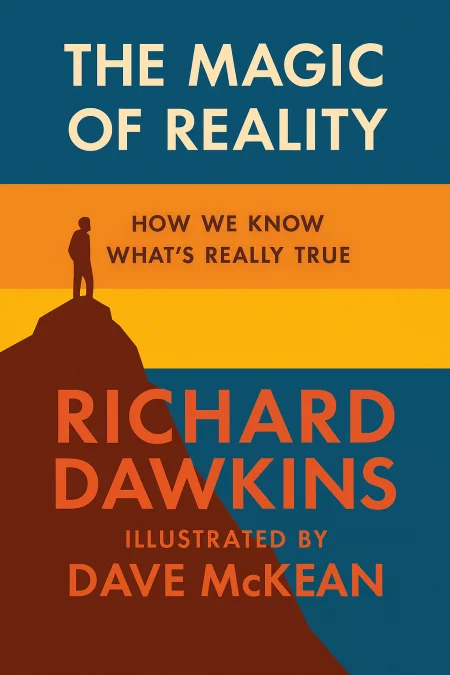
The Magic of Reality
How We Know What’s Really True
byRichard Dawkins, Dave McKean
Book Edition Details
Summary
In a universe where myths once wove tales of gods and monsters, "The Magic of Reality" unveils a tapestry of wonder grounded in the astonishing truths of science. Picture the cosmos as a grand puzzle, each piece a natural phenomenon once shrouded in mystery. From the vibrant arch of a rainbow once thought divine to the trembling earth once blamed on a colossal catfish, Richard Dawkins and the artistic genius of Dave McKean invite readers into a realm where curiosity ignites discovery. This spellbinding guide challenges you to think with the mind of a scientist, unraveling enigmas like the origins of life and the age of the universe with dazzling illustrations and thought-provoking experiments. A celebration of knowledge and imagination, this book isn't just an exploration—it's an invitation to witness the real magic that shapes our world and the cosmos beyond.
Introduction
Have you ever wondered why we see rainbows after a storm, or what makes earthquakes shake the ground beneath our feet? Throughout history, humans have told stories to explain the mysteries around us - tales of gods throwing lightning bolts, giant fish causing tsunamis, or magic turning water into wine. These myths and legends are colorful and fascinating, but they share one crucial limitation: they don't actually help us understand how the world really works. Science offers us something far more powerful and beautiful - the tools to discover the truth about reality itself. Through careful observation, clever experiments, and rigorous testing of ideas, we can uncover the genuine explanations behind nature's most spectacular phenomena. This journey reveals that the real world is far more magical than any myth could ever be. You'll discover how we know what we know about everything from the tiniest atoms to the vastest galaxies, why bad things happen to good people, and whether we might be sharing the universe with alien life. The magic of reality isn't about supernatural spells or divine interventions - it's about the incredible, verifiable truth of how everything actually works.
What Reality Is and How We Know It
Reality is everything that exists, but figuring out what truly exists isn't always straightforward. Our five senses do a reasonable job of showing us rocks, trees, and other everyday objects, but they have serious limitations. We can't see bacteria without microscopes, or distant galaxies without telescopes, or radio waves without special instruments. This is where science becomes essential - it extends our senses through tools and techniques that reveal hidden aspects of reality. Scientists use three main approaches to discover what's real. First, we can detect things directly using our senses, perhaps enhanced by instruments. Second, we can use indirect detection - telescopes show us stars, and fossils reveal ancient life. Third, and most powerfully, we create models of how things might work, then test these models by making predictions and checking if they come true. When Gregor Mendel proposed the existence of "genes" to explain heredity patterns in pea plants, he couldn't see genes directly, but his model made predictions that proved correct when he counted different types of offspring. The key insight is that reality doesn't depend on what we can immediately perceive or what feels intuitive to us. Atoms are mostly empty space, yet solid objects feel solid because of invisible forces between particles. Time itself began with the Big Bang, even though our minds struggle to grasp this concept. The beauty of science lies in its ability to reveal truths that go far beyond common sense, showing us a universe that's both stranger and more wonderful than any mythology could imagine.
The Story of Everything: From Big Bang to Evolution
The universe has an epic biography spanning nearly fourteen billion years, beginning with the Big Bang - not an explosion in space, but the sudden appearance of space and time themselves. In those first moments, everything that would ever exist was compressed into an incomprehensibly tiny point, hotter and denser than anything we can imagine. As the universe expanded and cooled, the first atoms formed, then stars, then galaxies, setting the stage for everything that followed. About four and a half billion years ago, our solar system condensed from a spinning cloud of dust and gas left over from ancient stellar explosions. The heavy elements essential for life - carbon, oxygen, nitrogen, iron - were forged in the nuclear furnaces of dying stars and scattered across space when those stars exploded as supernovas. In a very real sense, we are made of stardust. Earth formed as countless small rocks crashed together, gradually building up mass and generating the heat that still drives plate tectonics today. Life appeared remarkably early in Earth's history, probably in warm pools or deep-sea vents where chemical reactions could become self-sustaining. Once evolution by natural selection got started, it produced an extraordinary tree of life branching into millions of species. Every living thing, from bacteria to blue whales, shares common ancestors and uses the same basic genetic code. We humans are recent arrivals on this ancient planet, connected by unbroken chains of inheritance to the very first life forms. This scientific creation story reveals our deep kinship with all life and our cosmic origins in the hearts of stars.
Natural Phenomena: Rainbows, Earthquakes, and Cosmic Forces
Nature's most dramatic displays - from brilliant rainbows to devastating earthquakes - follow patterns we can understand and predict. A rainbow isn't a physical object you could touch, but rather a beautiful optical illusion created when sunlight hits millions of tiny water droplets. Each droplet acts like a miniature prism, splitting white light into its component colors and reflecting them back to your eyes. The rainbow appears to move as you move because you're seeing light from different droplets, creating a personal light show that exists only from your unique perspective. Earthquakes tell the story of our planet's restless surface, where massive plates of rock drift around like slow-motion bumper cars. These tectonic plates, carrying continents and ocean floors, move at about the speed fingernails grow - imperceptibly slow day by day, but dramatic over geological time. When plates suddenly slip past each other or collide, they release energy that has been building up for decades or centuries. The ground shakes, mountains rise, and new ocean floor spreads outward from underwater ridges. Understanding plate tectonics explains not just earthquakes, but also why we find similar fossils on continents separated by vast oceans. The cosmic forces that shape our universe operate on scales both unimaginably large and impossibly small. Gravity keeps planets in their orbits and holds galaxies together, while electromagnetic forces give atoms their structure and create the northern lights. Nuclear forces power the sun and forge new elements in stellar cores. These same physical laws work everywhere in the universe, from the quantum realm of subatomic particles to the cosmic web of dark matter that scaffolds all visible matter. By studying how these forces interact, we've learned to harness electricity, split atoms, and send spacecraft to other worlds.
Summary
The greatest revelation of science is that reality itself is far more extraordinary than any myth or superstition could ever be. Through careful investigation rather than wishful thinking, we've discovered that we live in an ancient universe filled with wonders beyond imagination - from the quantum dance of particles to the birth and death of stars, from the elegant machinery of living cells to the deep history written in stone and bone. This scientific way of knowing doesn't diminish the magic of existence; it reveals the true magic that surrounds us every moment. How might our understanding of reality continue to evolve as we develop new tools and techniques for exploring the unknown? What other cosmic mysteries await discovery by future generations of scientists and curious minds? The adventure of understanding our universe has only just begun, and every question we answer opens doors to deeper questions about the magnificent reality we inhabit.
Related Books
Download PDF & EPUB
To save this Black List summary for later, download the free PDF and EPUB. You can print it out, or read offline at your convenience.
By Richard Dawkins
