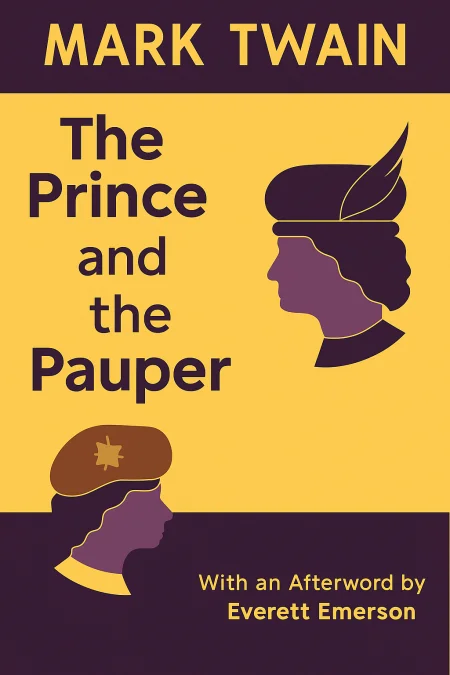
The Prince and the Pauper
A Tale of Two Mirrored Fates
Book Edition Details
Summary
In the bustling heart of 16th-century London, two boys—one a beggar, the other a prince—share more than just a birthdate; they share a face. The regal Edward, Prince of Wales, and the ragged Tom Canty, a street urchin, embark on a daring game of deception when they swap lives, casting each into worlds unknown. Edward, cloaked in poverty, navigates the gritty streets and the raw humanity of the common folk, while Tom grapples with the opulence and peril of court life, perpetually fearing exposure. Their intertwined destinies unravel a vivid tapestry of class, identity, and empathy, offering a timeless critique of society’s stark divides. This narrative is not just a tale of mistaken identities but a powerful exploration of what it means to walk in another's shoes.
Introduction
In the winter of 1877, Mark Twain set aside his rougher American tales to embark on an extraordinary literary experiment. The man who had built his reputation on the boisterous humor of the American frontier suddenly turned his attention to the refined courts of Tudor England, crafting a story that would surprise both critics and admirers alike. This departure from his usual territory represented more than mere creative restlessness—it revealed an author grappling with questions of identity, social justice, and the true nature of nobility that resonated deeply with his own experiences of transformation from Samuel Clemens, the poor boy from Missouri, to Mark Twain, the celebrated author dining with presidents and emperors. The creation of this historical romance illuminates three fascinating dimensions of Twain's artistic evolution. First, we witness his ambitious leap from regional humorist to serious novelist, driven by his desire to prove himself capable of sustained narrative and moral depth. Second, we observe his masterful ability to weave contemporary American social concerns into a distant English setting, using the past as a lens to examine the inequalities of his own era. Finally, we see how this seemingly gentle tale for young readers became a vehicle for Twain's most passionate convictions about human dignity, the corrupting nature of power, and the universal capacity for both cruelty and compassion that defines our shared humanity.
From Missouri Frontier to Literary Ambition
Mark Twain's journey from the muddy streets of Hannibal, Missouri, to the drawing rooms of Hartford's intellectual elite provided him with the perfect foundation for understanding the dramatic contrasts at the heart of his royal tale. Born Samuel Clemens in 1835, he had experienced firsthand the grinding poverty that would later inform his vivid descriptions of Tom Canty's desperate life in Offal Court. His father's financial failures, the family's periodic struggles to afford basic necessities, and young Sam's early entry into the workforce as a printer's apprentice gave him an intimate knowledge of how economic circumstances could shape—or shatter—a person's dreams and dignity. Yet by the time he began writing this novel, Twain had also tasted the intoxicating effects of fame and fortune. His successful books and lecture tours had transformed him from a struggling journalist into a literary celebrity, welcomed in the finest homes and most exclusive clubs. This dramatic personal transformation provided him with unique insights into both sides of the social divide his characters would navigate. Unlike many writers who might romanticize either poverty or privilege, Twain understood the authentic textures of both experiences—the gnawing anxiety of want and the subtle corruptions of comfort. The immediate catalyst for this departure into historical fiction came from his involvement with Hartford's Monday Evening Club, where prominent clergymen and intellectuals like Edwin Parker challenged him to write something more substantial than humor. Parker's gentle but persistent encouragement struck a nerve in Twain, who had long harbored private doubts about being dismissed as merely a comedian rather than a serious artist. The author threw himself into the project with what he described as an interest "that almost amounted to intemperance," finding in the story of switched identities a perfect vehicle for exploring themes that had been simmering in his imagination for years. This period of intensive creative work revealed Twain's remarkable capacity for literary reinvention. Rather than simply grafting his usual comic techniques onto a historical setting, he developed an entirely new narrative voice—one that could handle both the archaic dialogue of Tudor England and the emotional complexity of characters facing profound moral choices. The ease with which he completed the novel, in stark contrast to his ongoing struggles with Huckleberry Finn, suggested that this exploration of identity and social justice had tapped into something fundamental in his artistic vision.
Creating Tudor England in Hartford Connecticut
The transformation of Mark Twain's comfortable Connecticut study into a window onto sixteenth-century London represents one of the most remarkable acts of literary imagination in American letters. Working without the benefit of modern historical research methods or extensive travel to England, Twain nevertheless managed to create a Tudor world that felt both authentic and alive to his readers. His secret lay not in scholarly accuracy but in his profound understanding of human nature and social dynamics, which remained constant across centuries and continents. Twain's approach to historical recreation revealed his genius for finding universal truths within specific circumstances. Rather than becoming bogged down in the minutiae of Tudor customs or attempting to reproduce the exact political intricacies of Edward VI's reign, he focused on the emotional and moral realities that would resonate with readers of any era. His descriptions of the brutal punishments for minor crimes, the callous treatment of the poor, and the arbitrary nature of royal power spoke directly to contemporary American concerns about justice, equality, and the proper relationship between government and citizens. The author's mastery of dialogue proved particularly crucial in bringing his Tudor world to life. By immersing himself in Shakespeare's plays and other period literature, Twain developed an ear for the rhythms and vocabulary of sixteenth-century English that felt natural rather than stilted. His characters speak in a heightened but accessible version of archaic English that maintains the flavor of the period without becoming incomprehensible to modern readers. This linguistic achievement allowed him to create genuine emotional connections between his characters and his audience, making their struggles feel immediate and relevant despite the historical distance. Perhaps most importantly, Twain's Tudor England served as a carefully constructed mirror for his own society. The rigid class distinctions, the casual cruelty toward the powerless, and the way wealth could insulate individuals from the consequences of their actions all had direct parallels in Gilded Age America. By setting his critique of social inequality in the distant past, Twain could address sensitive contemporary issues without directly challenging his readers' comfort zones, while simultaneously suggesting that these problems were not inevitable features of human society but choices that could be changed through greater awareness and compassion.
Critical Reception and Theatrical Legacy
The publication of The Prince and the Pauper in 1881 created a sensation that had as much to do with what the book wasn't as with what it was. Critics and readers accustomed to Mark Twain's boisterous frontier humor found themselves confronting a work of genuine literary sophistication that seemed to emerge from an entirely different writer. This dramatic departure from expectation created a critical response that was simultaneously puzzled, impressed, and occasionally hostile, reflecting the broader tensions in American literary culture between entertainment and artistic respectability. The most perceptive reviewers recognized that Twain had accomplished something more significant than a simple genre switch. They saw in the novel evidence of a mature artistic consciousness capable of sustained narrative development and serious moral reflection. Writers like Joel Chandler Harris praised the work as revealing "the true literary artist" behind the popular entertainer, noting how Twain had refined his natural humor without sacrificing its essential vitality. These critics understood that the book represented not an abandonment of Twain's comedic gifts but their integration into a more complex artistic vision. However, the novel also attracted significant resistance from those who felt Twain had betrayed his authentic American voice by venturing into European historical territory. Some critics accused him of literary pretension, suggesting that his attempt to write a "serious" book had resulted in something forced and unnatural. British reviewers proved particularly harsh, questioning an American's authority to interpret English history and finding his social criticisms presumptuous. These negative responses revealed the narrow expectations that success as a humorist could create, as well as the cultural prejudices that still influenced literary evaluation in the late nineteenth century. The book's adaptation for the theater provided another lens through which to examine its cultural impact. When a stage version premiered in 1889, starring the young actress Elsie Leslie in the dual role of Tom and Edward, it demonstrated the story's strong dramatic potential while also highlighting the challenges of translating Twain's narrative techniques to a different medium. The production's moderate success and subsequent legal controversies over adaptation rights showed how Twain's growing celebrity had made every aspect of his work a matter of public interest. The theatrical experience also revealed how the story's themes of identity and social justice could speak to audiences beyond the reading public, establishing its credentials as a work with broad cultural resonance.
Twain's Transformation from Humorist to Novelist
The completion of The Prince and the Pauper marked a pivotal moment in Mark Twain's artistic evolution, demonstrating his ability to transcend the limitations that critics and readers had unconsciously placed around his work. This transformation went far deeper than a simple expansion of genre—it represented a fundamental shift in how Twain understood his role as a writer and his responsibility to his audience. The success of this experiment gave him the confidence to tackle increasingly complex moral and social themes in his subsequent works, establishing the foundation for masterpieces like The Adventures of Huckleberry Finn. The novel revealed Twain's growing sophistication in handling character development and psychological complexity. Unlike his earlier works, which often relied on episodic adventures and comic situations, The Prince and the Pauper required him to sustain reader interest through gradual character growth and moral education. His portrayal of Tom Canty's evolution from frightened pauper to confident king, and Edward's parallel journey from sheltered prince to compassionate ruler, demonstrated his ability to create believable psychological arcs that served larger thematic purposes. This development of his craft would prove crucial in his later creation of Huckleberry Finn's moral awakening. The book also showcased Twain's emerging mastery of social criticism integrated seamlessly into entertaining narrative. Rather than delivering lectures about inequality and injustice, he allowed readers to experience these issues through the eyes of his protagonists, making abstract social problems immediate and personal. This technique of embedding serious themes within accessible storytelling would become one of his signature strengths, allowing him to reach broader audiences while maintaining his commitment to important social issues. Perhaps most significantly, The Prince and the Pauper established Twain's credentials as a writer whose work could appeal to both children and adults without condescending to either group. His subtitle, "A Tale for Young People of All Ages," proved prophetic in its recognition that the most enduring literature transcends arbitrary age categories by addressing fundamental human concerns. This achievement opened new possibilities for his career, freeing him from the restrictive category of "humorist" and establishing his reputation as a serious artist capable of growth and reinvention. The confidence gained from this success would sustain him through the creative challenges that lay ahead, including the completion of his greatest novel and his continued evolution as one of America's most important literary voices.
Summary
Mark Twain's creation of The Prince and the Pauper represents one of literature's most successful acts of artistic reinvention, proving that genuine creativity thrives when writers dare to venture beyond the boundaries others have established for them. Through his exploration of Tudor England, Twain discovered that the most effective way to address contemporary social problems was often to examine them through the clarifying lens of historical distance, allowing readers to see familiar injustices with fresh eyes and renewed moral urgency. The novel's enduring appeal lies in its fundamental optimism about human nature and social change. Despite its unflinching portrayal of cruelty and inequality, the story ultimately affirms that education, empathy, and moral courage can transform both individuals and societies. Twain's achievement reminds us that the greatest literature serves not merely as entertainment or even as art, but as a catalyst for the kind of moral imagination that makes genuine social progress possible. His example continues to inspire writers to use their craft in service of justice and human dignity, while demonstrating that artistic excellence and social consciousness are not opposing forces but natural partners in the ongoing work of creating a more compassionate world.
Related Books
Download PDF & EPUB
To save this Black List summary for later, download the free PDF and EPUB. You can print it out, or read offline at your convenience.
By Mark Twain
