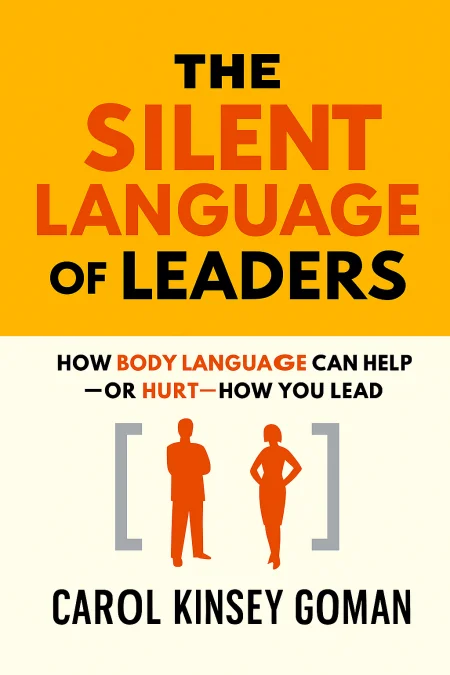
The Silent Language of Leaders
How Body Language Can Help – or Hurt – How You Lead
Book Edition Details
Summary
In the high-stakes world of leadership, words may fail, but your body speaks volumes. "The Silent Language of Leaders" unveils the secret language that transforms presence into power. Carol Kinsey Goman delves into the art of nonverbal communication, revealing how the way you stand, move, and look can redefine your leadership game. Whether you're commanding a boardroom or connecting with a global team, mastering these unspoken signals is your ticket to authenticity and influence. This book empowers leaders to harness the potent, often overlooked, power of body language to motivate, inspire, and effectively navigate diverse cultural landscapes. If you’re ready to transcend conventional leadership boundaries and communicate with unrivaled clarity, this is your essential guide.
Introduction
Imagine walking into a boardroom where the CEO announces, "I'm completely open to your questions," while simultaneously crossing their arms tightly across their chest. Within seconds, the previously engaged audience falls silent, struggling to think of anything to ask. This disconnect between words and body language happens countless times in professional settings, yet most leaders remain oblivious to the powerful messages they're sending through their nonverbal communication. Research reveals that people form judgments about credibility, trustworthiness, and leadership capability within the first seven seconds of meeting someone, long before any carefully crafted words are spoken. The human brain processes nonverbal signals through ancient pathways that evolved for survival, making body language one of the most primitive yet sophisticated forms of communication we possess. Understanding and mastering these silent signals can transform how others perceive your authority, warmth, and authenticity as a leader, ultimately determining whether your message inspires action or falls flat.
Reading the Nonverbal Code: Understanding Body Language Fundamentals
The human brain operates like three interconnected systems working simultaneously to process information. The ancient reptilian brain controls basic survival functions and territorial responses, while the newer cortical brain handles conscious thought and language. Between them sits the limbic brain, our emotional processing center that acts as the primary decoder of nonverbal signals. This evolutionary design explains why body language often feels more "true" than spoken words, as our limbic system reacts to nonverbal cues faster than conscious thought can occur. When someone's words contradict their body language, observers experience a neurological phenomenon similar to hearing nonsensical language. Brain scans show that incongruent messages trigger the same confusion patterns as gibberish, which explains why audiences become uncomfortable when leaders say one thing while their bodies communicate another. This mismatch creates cognitive dissonance that makes listeners instinctively distrust the speaker, regardless of how logical their verbal message might be. The challenge lies in recognizing that body language interpretation happens through the "eye of the beholder." What matters isn't necessarily what you intend to communicate, but how others perceive and react to your nonverbal signals. Cultural backgrounds, personal experiences, and situational contexts all influence how people decode your gestures, postures, and expressions. Understanding these fundamental principles allows leaders to align their physical presence with their intended message, creating the kind of authentic communication that builds trust and inspires action.
Power Signals and Presence: Authority Through Physical Communication
Authority in leadership manifests through specific nonverbal markers that signal confidence, control, and capability. These power cues include maintaining an erect posture, claiming physical space through expanded arm positions, and using purposeful movements that demonstrate command of one's environment. The simple act of standing while others remain seated immediately elevates your perceived status, as height and space occupation are primal indicators of dominance that bypass conscious reasoning. Hand gestures play a particularly crucial role in projecting authority. The "steeple" position, where fingertips touch while palms separate slightly, conveys expertise and certainty about the topic being discussed. Palm-down gestures signal definitiveness and closure, indicating that a decision has been made and is not open for negotiation. Conversely, palm-up movements suggest openness to input but can diminish perceived power if overused. The key lies in matching your gesture style to your message, using authoritative signals when making important decisions while maintaining approachable body language during collaborative discussions. Vocal patterns amplify physical authority signals through tone, pace, and volume variations. Speaking from the diaphragm rather than the throat creates a fuller, more commanding voice that others instinctively respect. Strategic pauses before important points allow your words to carry more weight, while maintaining steady eye contact during crucial moments reinforces your commitment to your message. These authority markers work together to create what researchers call "executive presence," the invisible quality that makes others naturally want to follow your lead.
Building Connection and Trust: Warmth and Collaboration Cues
Warmth signals create the emotional foundation necessary for genuine collaboration and team engagement. These nonverbal behaviors include genuine smiles that engage the muscles around the eyes, leaning slightly forward to show interest, and maintaining appropriate eye contact that demonstrates attention without creating discomfort. The simple act of tilting your head while listening sends a universal signal of curiosity and engagement that encourages others to share more openly. Mirroring behaviors naturally build rapport by creating subconscious feelings of similarity and understanding. When you subtly match another person's posture, gesture frequency, or speaking pace, their mirror neurons fire in patterns that create empathy and connection. This neurological phenomenon explains why successful collaborators often seem to "click" immediately, as their body language synchronizes to create mutual comfort and trust. However, effective mirroring must be subtle and authentic rather than obvious mimicry, which can backfire by making others feel manipulated. Physical space management significantly impacts collaborative success. Standing too close can trigger territorial responses and discomfort, while maintaining too much distance can signal detachment or superiority. The optimal distance for professional collaboration in most Western cultures falls between two and four feet, close enough to demonstrate engagement while respecting personal boundaries. Creating barrier-free environments by removing physical obstacles like laptops, briefcases, or even coffee cups held protectively across the body signals openness and invites authentic exchange of ideas.
Global Leadership Communication: Cultural Body Language Variations
Body language interpretation varies dramatically across cultures, making cultural intelligence essential for effective global leadership. While certain expressions like joy, anger, and surprise appear universally, their intensity, duration, and appropriateness in business contexts differ significantly between societies. High-context cultures like Japan and China rely heavily on nonverbal cues and environmental signals to communicate meaning, while low-context cultures such as Germany and the United States depend more on explicit verbal communication and written documentation. Time perception creates another layer of nonverbal complexity in international business. Cultures that view time as a flowing constant rather than a commodity to be managed interpret punctuality, meeting duration, and scheduling flexibility very differently. In some Latin American and Middle Eastern cultures, arriving thirty minutes late to a meeting shows respect for relationships over rigid scheduling, while Germanic cultures interpret the same behavior as disrespectful and unprofessional. These conflicting interpretations can damage business relationships before any words are exchanged. Personal space, eye contact, and touch protocols vary so dramatically between cultures that well-intentioned gestures can create serious offense. While Americans typically maintain arm's length distance during business conversations, Middle Eastern cultures often stand much closer to demonstrate trust and engagement. Similarly, the direct eye contact that signals honesty in Western cultures can be interpreted as aggressive or disrespectful in many Asian societies. Successful global leaders learn to observe local customs, adapt their nonverbal behavior accordingly, and when uncertain, err on the side of formal respect rather than casual familiarity.
Summary
The most profound insight from studying leadership body language is that authentic communication requires perfect alignment between your internal state, verbal message, and physical presence. When these three elements work in harmony, you create the kind of magnetic leadership presence that naturally inspires trust, confidence, and action in others. This alignment cannot be faked long-term, as your body will inevitably reveal your true feelings and intentions through micro-expressions, posture shifts, and gesture patterns that operate below conscious control. How might you begin observing the nonverbal patterns in your own leadership interactions, and what small adjustments could create more powerful alignment between your intentions and your physical presence? For leaders ready to elevate their influence and effectiveness, mastering the silent language of leadership offers a competitive advantage that transcends cultural boundaries and speaks directly to the human need for authentic connection.
Related Books
Download PDF & EPUB
To save this Black List summary for later, download the free PDF and EPUB. You can print it out, or read offline at your convenience.
By Carol Kinsey Goman
