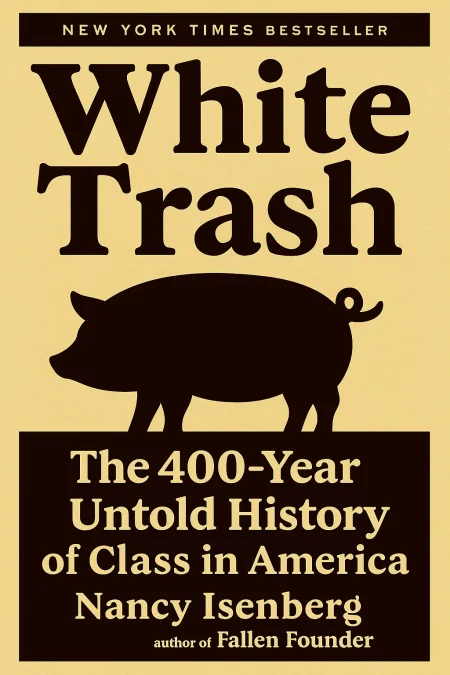
White Trash
The 400-Year Untold History of Class in America
Book Edition Details
Summary
From the shadows of America's past emerges a tale often ignored yet intricately woven into the nation's fabric: the saga of "poor white trash." Nancy Isenberg's riveting exploration sweeps across centuries, unraveling the myths of egalitarianism and exposing the relentless grip of class. From the earliest settlers deemed "waste people" to the stigmatized "clay eaters" of the 1850s, Isenberg peels back the layers of disdain and fascination surrounding America's marginalized poor. With a keen eye on political shifts and societal prejudices, she reveals how these forgotten voices have influenced major historical milestones, from the rise of the Republican Party to the echoes of the Great Society. This provocative account challenges us to confront the uncomfortable truths buried within America's identity, demanding a reevaluation of what it truly means to be classless in a nation defined by division.
Introduction
In the humid tobacco fields of colonial Virginia, a harsh reality was taking shape that would contradict America's most cherished myths for centuries to come. While wealthy planters built grand estates and accumulated vast holdings, a growing population of poor whites found themselves trapped in cycles of debt, poverty, and social contempt. These were not the noble yeoman farmers that would later populate American folklore, but rather the "waste people" whom colonial elites viewed as little more than human refuse to be exploited and discarded. This hidden history reveals how America's class system has always been far more rigid and brutal than our national mythology suggests. From the earliest colonial settlements to modern reality television, the story of America's marginalized white underclass exposes the persistent gap between democratic ideals and social reality. Through centuries of economic upheaval, political transformation, and cultural change, the language used to describe and dismiss the poor has evolved from "waste people" to "crackers" to "white trash," but the underlying contempt and systematic exclusion have remained remarkably consistent. Understanding this forgotten narrative is essential for anyone seeking to comprehend how American society actually functions beneath its egalitarian veneer. The tale illuminates not just the experiences of the poor themselves, but the anxieties, prejudices, and power structures that have shaped the entire American class system. It reveals how those in power have consistently used the specter of "unworthy" populations to justify inequality while maintaining the fiction of equal opportunity, and how scientific theories from eugenics to modern social science have been deployed to legitimize age-old prejudices about human worth and social hierarchy.
Colonial Foundations: Waste People and Social Engineering (1607-1776)
The English colonization of America began not with noble aspirations of freedom, but with a calculated plan to dispose of society's unwanted. Colonial promoters like Richard Hakluyt explicitly envisioned the New World as a giant workhouse where England's "waste people" - vagrants, convicts, and the unemployed poor - could be transformed into economic assets or simply worked to death in the process. This colonial blueprint treated human beings as expendable resources, with mortality rates so staggering that eighty percent of the first six thousand Jamestown colonists died within two decades. The Virginia Company's headright system created immediate incentives to import large numbers of indentured servants, establishing a hierarchy where wealthy planters accumulated both land and human property while the poor remained trapped in cycles of debt and dependency. Even children of dead servants became collateral for their parents' obligations, creating a hereditary underclass that contradicted every myth about American opportunity. The language of waste - describing both unused land and unwanted people - created a vocabulary of dehumanization that justified systematic exploitation. Even the supposedly virtuous Puritans of Massachusetts embraced this exploitative system, with church seating arrangements carefully designed to reflect social hierarchy and Cotton Mather instructing servants that they were merely "animate instruments" of their masters. The Puritan family was not the nuclear unit of modern imagination, but a complex household often including unrelated servants, apprentices, and slaves whose bodies belonged entirely to those who owned their labor. The colonial period established patterns that would endure for centuries, proving that America was never the classless society of later mythology but rather a carefully constructed hierarchy designed to extract maximum value from human misery. Land ownership became the ultimate marker of worth, while the landless were condemned to perpetual wandering and social contempt. These early settlements demonstrated that class divisions, far from being foreign to American soil, were deliberately planted here by colonial planners who saw the New World as a dumping ground for England's human refuse.
Democratic Paradox: From Squatters to Scientific Racism (1776-1920)
As America expanded westward, the colonial underclass evolved into new forms of rural poverty that challenged the young nation's democratic ideals. The "crackers" and "squatters" who populated the frontier were direct descendants of colonial waste people, carrying forward traditions of landlessness and social marginalization. These terms themselves revealed deep contempt - "cracker" suggested empty boasting and crude behavior, while "squatter" implied illegitimate occupation of land, literally sitting in the dirt like lesser peoples. Andrew Jackson's presidency marked a crucial transformation in how Americans understood class and democracy. Though celebrated as the champion of the common man, Jackson himself was a wealthy planter who helped draft voting restrictions while embodying a particular style of masculine aggression that resonated with white male voters. The "cracker democracy" he represented was less about equality than about the right of certain white men to take what they wanted through force, revealing fundamental contradictions in American democratic rhetoric. The Civil War era witnessed an intensification of class consciousness as the language of "breeding" and heredity became central to American social thought. The very term "white trash" gained widespread currency during this period, marking a shift from seeing poverty as circumstantial to viewing it as hereditary. Southern intellectuals like Daniel Hundley developed elaborate theories about poor whites as a distinct and degenerate race, while northern critics pointed to their degraded condition as evidence of slavery's corrupting influence on free labor. The late nineteenth and early twentieth centuries saw the rise of scientific racism and eugenics, which provided new justifications for class inequality. Experts like Charles Davenport argued that poverty was hereditary and that the "unfit" should be prevented from reproducing through institutionalization and sterilization. This pseudo-scientific framework culminated in forced sterilization laws that targeted poor white women as "defective breeders," revealing how deeply embedded assumptions about class and heredity had become in American thought and policy.
Modern Transformations: Eugenics to Reality TV (1920-Present)
The Great Depression temporarily shattered many illusions about American opportunity, as millions of previously respectable citizens found themselves reduced to poverty and dependence. New Deal programs like the Farm Security Administration brought unprecedented attention to rural poverty, with photographers like Walker Evans and Dorothea Lange documenting the lives of tenant farmers and creating new visual vocabularies for understanding American inequality. Yet even these progressive initiatives often reinforced cultural stereotypes about poor whites, portraying them as backward and resistant to modernization. The post-World War II suburban boom created sharper distinctions between the respectable middle class and those left behind in declining rural areas and urban ghettos. The rise of "trailer trash" as a category reflected fears about downward mobility, while television shows like "The Beverly Hillbillies" revealed both fascination with and contempt for rural poverty. These programs allowed middle-class audiences to consume sanitized versions of working-class culture while maintaining comfortable social distance from its realities. The late twentieth century witnessed the emergence of "white trash chic" as poverty became a form of cultural identity that could be claimed and discarded at will. Politicians learned to navigate the complex terrain of class identity in American politics, while the rise of reality television created new forms of voyeuristic entertainment based on the spectacle of poor white dysfunction. Shows like "Here Comes Honey Boo Boo" and "Duck Dynasty" transformed class difference into commodity entertainment, allowing viewers to feel superior while consuming poverty as spectacle. The persistence of this cultural pattern reveals how modern America continues to rely on the systematic marginalization of certain populations to maintain social hierarchies. The language has evolved from colonial concerns about "waste people" to contemporary anxieties about "trailer trash," but the underlying dynamics remain remarkably consistent. Scientific theories have shifted from crude eugenics to sophisticated discussions of cultural pathology and genetic predisposition, yet they serve the same fundamental function of justifying inequality while obscuring its structural causes.
Summary
The long history of America's white underclass reveals the persistent gap between democratic ideals and social reality that has defined the nation from its founding. Despite centuries of rhetoric about equality and opportunity, American society has consistently produced and maintained a class of "waste people" who are blamed for their own poverty while being denied the resources necessary to escape it. This pattern demonstrates that class inequality in America is not an accident or aberration, but rather a structural feature of the economic and political system that has been maintained through evolving but consistent mechanisms of exclusion and control. The myth of universal opportunity has served to legitimize inequality by suggesting that those who fail to rise must be personally deficient, while the reality is that social mobility has always been limited and heavily dependent on factors beyond individual control. From colonial indentured servitude to modern predatory lending, from eugenic sterilization to contemporary mass incarceration, the mechanisms of class control have adapted to changing circumstances while preserving fundamental hierarchies. The persistence of derogatory language and cultural stereotypes reveals how deeply embedded these class divisions have become in American consciousness. Understanding this hidden history is crucial for addressing contemporary problems of inequality and social division. Rather than accepting poverty as the result of individual failings or cultural deficiencies, we must recognize it as the product of specific historical choices and ongoing structural arrangements that can be challenged and changed. This requires moving beyond the comfortable myths of American exceptionalism to confront the uncomfortable realities of how power and privilege have been maintained across generations. Only by acknowledging this history and its continuing influence can we begin to build a more genuinely democratic society that provides real opportunity for all its citizens, regardless of their origins or circumstances.
Related Books
Download PDF & EPUB
To save this Black List summary for later, download the free PDF and EPUB. You can print it out, or read offline at your convenience.
By Nancy Isenberg
