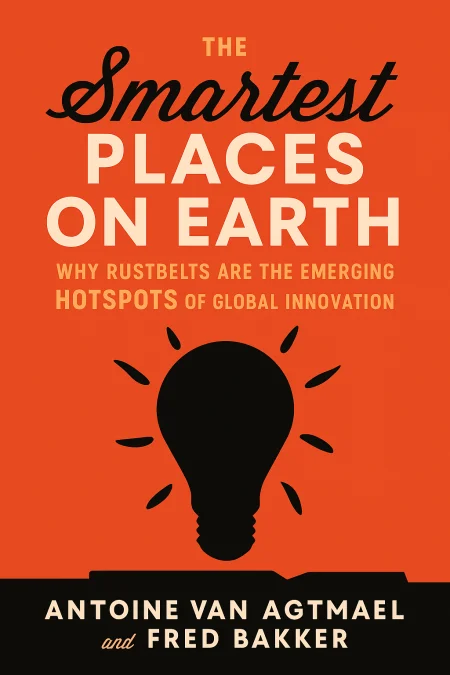
The Smartest Places on Earth
Why Rustbelts Are the Emerging Hotspots of Global Innovation
byAntoine van Agtmael, Fred Bakker
Book Edition Details
Summary
Once-quiet industrial giants like Akron and Eindhoven are now pulsing with the beat of ingenuity, their rusted pasts giving way to vibrant futures. In "The Smartest Places on Earth," Antoine van Agtmael and Fred Bakker reveal a renaissance where forgotten factories and faded assembly lines transform into breeding grounds of innovation. These revitalized "brainbelts" are powered by dynamic synergies among intrepid entrepreneurs, academic pioneers, and visionary public policies. Rejecting the lure of cheap labor, they weave intelligence into every product, from cutting-edge polymers to life-saving medical devices. As these Western hubs reclaim their innovative edge, a new global economy emerges—one that redefines success not by cost, but by brilliance and creativity. Dive into this thrilling narrative where the West rises anew, not as yesterday's powerhouse, but as the vanguard of smart, sustainable industry.
Introduction
In the early 1980s, a peculiar conversation took place in a research facility in Taiwan that would prove prophetic for the global economy. David Ku, chief financial officer of Mediatek, confided to a visitor his growing concern about American competition. "Their R&D is so advanced, so far ahead of ours," he admitted, "They can easily squeeze us." This wasn't the kind of worry Asian manufacturers had expressed for decades. For the first time in generations, the tables were turning. Across the world, in places that had been written off as industrial graveyards, a quiet revolution was brewing. Former steel towns in Pennsylvania, abandoned textile centers in North Carolina, and shuttered electronics hubs in Europe were stirring with new life. These weren't stories of nostalgic revival or futile attempts to resurrect the past. Instead, they represented something entirely unprecedented: the emergence of innovation networks that would fundamentally reshape how we think about economic competition, technological development, and the geography of prosperity. This transformation reveals three critical insights that challenge our assumptions about globalization. First, the era of cheap labor as the ultimate competitive advantage is ending, replaced by an age where smart innovation trumps low costs. Second, the most dynamic centers of this new economy aren't emerging in the obvious places, but in unlikely locations where universities, companies, and communities have learned to share knowledge in revolutionary ways. Third, these changes signal not just an economic shift, but a fundamental reimagining of how societies can organize themselves for prosperity in an interconnected world.
From Rustbelt Decline to Academic-Industry Partnerships (1980s-2000s)
The transformation began in the 1980s, when the foundations of America's industrial heartland were crumbling. Cities like Akron, Ohio, once the tire capital of the world, watched helplessly as factories shuttered and entire industries relocated to countries with cheaper labor. The Quaker Oats silos that had defined Akron's skyline stood empty, symbols of a prosperity that seemed irretrievably lost. Similar scenes played out across the American Midwest and European industrial centers, where decades of manufacturing dominance gave way to what economists euphemistically called "deindustrialization." Yet within this apparent decline lay the seeds of something remarkable. Universities, which had long operated in ivory tower isolation from commercial concerns, found themselves with a new role to play. The Bayh-Dole Act of 1980 in the United States allowed universities to benefit financially from research funded by government grants, fundamentally altering the relationship between academia and industry. Suddenly, professors could become entrepreneurs, and university labs could serve as launching pads for commercial ventures. The deeper catalyst for this shift was necessity itself. As traditional funding sources dried up and competition intensified, neither universities nor corporations could afford to go it alone. Companies discovered that the days of lavishly funded corporate research divisions were ending, while universities realized that research without practical application served neither their communities nor their funding prospects. This mutual vulnerability created unprecedented opportunities for collaboration. What emerged was not merely a series of partnerships, but a fundamentally new approach to innovation. Places like Albany, New York, began attracting global semiconductor companies not through traditional incentives, but by offering something more valuable: the chance to pool resources, share risks, and tackle challenges too complex for any single organization to handle. This collaborative model would prove to be the foundation upon which entire regions would reinvent themselves, transforming from centers of industrial production into hubs of knowledge creation.
The Emergence of Smart Manufacturing and Brainsharing Ecosystems (2000s-2010s)
As the new millennium dawned, a different kind of manufacturing began to emerge from the ashes of the old. This wasn't the return of assembly-line production that politicians promised, but something entirely new: smart manufacturing that merged digital technologies with physical production in ways that made location matter again. The integration of sensors, data analytics, and wireless communication transformed how things were made, creating what industry insiders began calling "smartfactories." The key breakthrough was the recognition that innovation had become too complex for the old model of isolated corporate research. Consider the development of advanced semiconductors, which required expertise spanning materials science, physics, engineering, and manufacturing processes. No single company, regardless of size, possessed all the necessary knowledge. This reality forced the creation of collaborative ecosystems where universities, established corporations, and startup companies worked together in ways that would have been unimaginable just decades earlier. These new arrangements weren't just about sharing costs, but about sharing brainpower itself. In Portland, Oregon, Intel partnered with Oregon Health & Science University to analyze vast amounts of cancer data, combining the chip maker's computational power with the university's medical expertise. Neither organization could have tackled such challenges alone, but together they pushed the boundaries of both personalized medicine and advanced computing. The physical environment of innovation changed as well. The sterile corporate campuses and isolated university labs of the past gave way to vibrant districts where researchers, entrepreneurs, and students worked in close proximity. Old factory buildings were converted into modern research facilities, creating spaces that fostered the informal interactions crucial to breakthrough discoveries. These innovation districts became magnets for talent, offering not just jobs but entire ecosystems of opportunity. Perhaps most importantly, these collaborations began to produce results that vindicated the new model. Advanced materials developed through university-industry partnerships revolutionized everything from aircraft manufacturing to medical devices. The success stories multiplied, creating a powerful demonstration that regions could indeed reinvent themselves not by clinging to their industrial past, but by building on their accumulated knowledge and expertise in entirely new ways.
Geographic Transformation: Silicon Valley's Global Competition (2010s-Present)
By the 2010s, the geographic landscape of innovation was being redrawn in ways that surprised even seasoned observers. While Silicon Valley and Boston remained important centers, a new constellation of innovation hubs emerged in unexpected places. Eindhoven in the Netherlands, once dominated by Philips Electronics, transformed itself into what experts called "the most intelligent region in the world." Dresden, Germany, rose from post-communist industrial decline to become a major center for semiconductor research and production. These new hubs didn't simply copy the Silicon Valley model; they created something different and in many ways superior. Where Silicon Valley celebrated individual genius and winner-take-all competition, these emerging centers emphasized collaboration and shared success. The "lonely hero" model of innovation was giving way to team-based approaches that could tackle more complex challenges more effectively. The competitive advantages these regions developed were substantial and sustainable. Albany's nanotechnology complex brought together global companies like IBM, Intel, and Samsung in ways that would have been legally impossible outside of a university setting. The shared costs and risks made investments possible that no single company could justify, while the collaborative environment accelerated innovation beyond what any isolated effort could achieve. Manufacturing itself was being redefined. The new smart factories bore little resemblance to the automated plants of earlier decades. Advanced robotics, 3D printing, and the Internet of Things created production systems that were simultaneously more flexible and more precise than anything previously imagined. Products could be customized for individual consumers while maintaining the efficiency of mass production. More importantly, these facilities required highly skilled workers and close integration with research activities, making proximity to universities and research centers a competitive necessity. The implications extended far beyond manufacturing. Regions that successfully made the transition found themselves attracting not just companies but entire ecosystems of suppliers, service providers, and supporting industries. The multiplier effects were dramatic: for every high-tech job created, several additional positions emerged in supporting sectors. Communities that had faced demographic decline began experiencing population growth as young professionals were drawn by opportunities that combined meaningful work with affordable living costs.
Future Implications: Technology, Society and Economic Restructuring
The transformation of these regions points toward profound changes in how society organizes itself for prosperity and innovation. The old model of globalization, based primarily on labor cost advantages and standardized mass production, is giving way to something more complex and potentially more equitable. When innovation and customization become the key competitive factors, proximity to knowledge centers becomes more valuable than access to cheap labor. This shift has implications that extend well beyond economics. The collaborative culture that drives these innovation networks tends to reduce extreme inequality and winner-take-all dynamics. Success becomes more broadly shared because innovation requires diverse contributions from many participants. Moreover, the emphasis on solving complex, multidisciplinary challenges naturally directs attention toward society's most pressing problems, from climate change to healthcare to sustainable development. The technological capabilities emerging from these networks promise to address challenges that have long seemed intractable. Smart manufacturing can produce goods locally with minimal environmental impact. Advanced materials can create products that are simultaneously more durable and more recyclable. Precision medicine can provide treatments tailored to individual genetic profiles. Agricultural innovations can produce more food with less resource consumption. Yet realizing this potential will require continued evolution in how these networks operate and how society supports them. Education systems must adapt to prepare workers for careers that will require continuous learning and adaptation. Funding mechanisms must recognize that the most important innovations often emerge from collaborative efforts rather than individual genius. Infrastructure must support the digital connectivity and physical proximity that make collaboration possible. Perhaps most importantly, the success of these innovation networks demonstrates that economic vitality need not be concentrated in a few mega-regions. The knowledge and creativity that drive prosperity can emerge anywhere that people are willing to work together, share resources, and commit to solving meaningful problems. This represents not just an economic opportunity, but a pathway toward more balanced and sustainable development patterns that could benefit communities worldwide.
Summary
The rise of global innovation networks represents a fundamental shift in how economic value is created and where prosperity can flourish. The story that unfolds from the 1980s to today reveals a central paradox: regions that seemed destined for irrelevance discovered new sources of competitive advantage precisely by abandoning the economic models that had originally made them successful. The thread connecting these transformations is the recognition that in an increasingly complex world, collaboration trumps competition, and shared knowledge creates more value than guarded secrets. This historical transformation offers three crucial insights for navigating our current challenges. First, the most sustainable competitive advantages come not from exploiting temporary cost differentials, but from building capabilities that enable continuous innovation and adaptation. Second, the geographic distribution of prosperity is far more malleable than conventional wisdom suggests, but only when communities are willing to reimagine their fundamental approaches to economic development. Third, the collaborative relationships that drive innovation can simultaneously address broader social challenges, suggesting that economic and social progress need not be in tension. For leaders and communities today, these lessons translate into practical imperatives. Invest in the educational institutions and physical infrastructure that enable collaboration across traditional boundaries. Create environments where diverse forms of expertise can intersect and cross-fertilize. Most importantly, recognize that building these innovation networks requires patience and commitment to long-term relationships rather than quick fixes or silver bullets. The regions that successfully navigated this transformation did so not through grand gestures, but through sustained efforts to connect people, share knowledge, and tackle meaningful challenges together.
Related Books
Download PDF & EPUB
To save this Black List summary for later, download the free PDF and EPUB. You can print it out, or read offline at your convenience.
By Antoine van Agtmael
