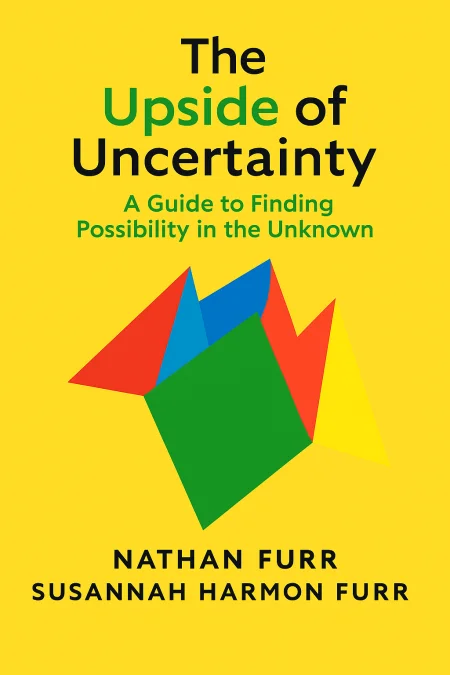
The Upside of Uncertainty
A Guide to Finding Possibility in the Unknown
byNathan Furr, Susannah Harmon Furr
Book Edition Details
Summary
In a world where the only certainty is unpredictability, "The Upside of Uncertainty" by Nathan and Susannah Furr reimagines the unknown not as a barrier but as a canvas for creativity and growth. This transformative guide draws from the wisdom of visionaries across diverse fields, offering you the tools to embrace life's twists with resilience and innovation. Whether you're on the brink of a career shift, launching a groundbreaking idea, or rebuilding after life's setbacks, this book illuminates the path from anxiety to opportunity. Equip yourself with insights that turn fear into fuel and uncertainty into a thrilling adventure of self-discovery and success.
Introduction
Life rarely unfolds according to our carefully laid plans. Whether you're facing a career transition, launching a new venture, navigating relationship changes, or simply feeling stuck in familiar routines, uncertainty seems to lurk around every corner. Yet what if the very thing we've been taught to fear and avoid—uncertainty—is actually the gateway to our greatest possibilities? What if the discomfort of not knowing what comes next is precisely where transformation begins? The most remarkable achievements in human history, from groundbreaking innovations to personal breakthroughs, have emerged not from certainty but from the courage to step into the unknown. Every meaningful relationship, creative endeavor, and life-changing decision requires us to navigate uncharted territory. When we shift our perspective and develop the right tools, uncertainty transforms from an obstacle into an invitation, from a source of anxiety into a wellspring of possibility.
Reframe the Unknown as Your Gateway to Growth
The first step in transforming uncertainty into possibility lies in fundamentally changing how we perceive the unknown. Instead of viewing uncertainty as a threat to be avoided, we can learn to see it as the natural companion of every opportunity worth pursuing. This reframing isn't about naive optimism—it's about recognizing a profound truth that successful innovators and creators have discovered: possibility and uncertainty are inseparable partners. Consider the story of Amy and Michael, an expat family facing a devastating setback when Michael's job was eliminated during the pandemic. With nowhere to live, no employment prospects, and teenage children demanding answers, they found themselves consumed by anxiety and self-doubt. Amy confided to a friend that she felt like a terrible parent, a complete failure. But when her friend helped her reframe their situation, everything shifted. Instead of seeing themselves as victims of circumstance, they began to view their uncertainty as evidence of their courage to wait for what they truly wanted rather than settling for the first available option. This simple shift in perspective—from seeing uncertainty as failure to recognizing it as the price of pursuing meaningful possibilities—transformed their experience entirely. Within months, they had found work that energized them, purchased a home in a vibrant neighborhood, and created opportunities for their children that wouldn't have existed in their previous situation. The uncertainty that had felt overwhelming became the pathway to a life more aligned with their values and dreams. The key to reframing uncertainty lies in remembering your own history of successful navigation through the unknown. Every achievement you're proud of, every meaningful relationship you've built, every skill you've developed—all of these emerged from periods of uncertainty. When you can train yourself to see uncertainty as the shadow cast by approaching possibility, you'll find the courage to lean into the unknown rather than retreat from it.
Build Your Uncertainty Navigation Skills
Preparing for uncertainty isn't about eliminating risk—it's about positioning yourself to thrive when the unexpected arrives. Like a skilled sailor who studies weather patterns and checks their equipment before setting sail, you can develop practices and perspectives that make you more resilient and adaptable when facing the unknown. One of the most powerful preparation strategies involves understanding your personal relationship with different types of risk. Tina Seelig, a Stanford professor, discovered this when she helped a student realize that his reluctance to become an entrepreneur wasn't about lacking courage—it was about being appropriately cautious with financial risk while being naturally comfortable with intellectual and social risks. This insight freed him to pursue academic work that allowed him to take the kinds of risks that energized him while maintaining the financial stability his family needed. Creating what entrepreneurs call "personal real options"—maintaining multiple interests and projects simultaneously—provides another crucial form of preparation. Rather than putting all your energy into one uncertain venture, you can cultivate a portfolio of possibilities. This approach reduces anxiety because you're not dependent on any single outcome, while increasing your chances of success because you're exploring multiple pathways simultaneously. Begin building your own uncertainty navigation skills by identifying the practices, relationships, and resources that consistently restore your sense of stability and confidence. Create what we might call "Dumbo feathers"—people, places, and things that remind you of your capabilities and support your growth. Develop multiple revenue streams or skill sets that could serve you in various possible futures. The goal isn't to control outcomes, but to ensure you have the inner and outer resources to engage uncertainty from a position of strength rather than desperation.
Take Bold Action Despite Incomplete Information
The most crucial moment in any uncertain situation is when you choose to act despite incomplete information. This isn't about reckless decision-making—it's about recognizing that waiting for perfect clarity often means missing the opportunity entirely. The most successful navigators of uncertainty have learned to take thoughtful action based on their values rather than being paralyzed by unknown outcomes. Consider the journey of Sam Yagan, who led Match.com through the creation of Tinder. When his team first attempted to develop new business models, they failed seventeen times in a row. Each failure could have been seen as evidence that they should give up, but Yagan had learned to reframe failure as an essential part of achieving anything worthwhile. He would show his team videos of SpaceX rockets exploding during landing attempts, asking them to consider whether it would be possible to reach Mars without experiencing failures along the way. This perspective shift freed his team to continue experimenting until they discovered the breakthrough that revolutionized online dating. Yagan's approach proved that taking action despite uncertainty requires adopting what researchers call an "attitude of wisdom"—believing in what you know just enough to take action, while doubting what you know just enough to remain open to new information. Start practicing this balance by taking what researchers call "small steps" toward your goals. Rather than trying to plan everything in advance, focus on the next logical action you can take with current information. After each step, pause to assess what you've learned and how it might inform your next move. Develop the habit of asking yourself regularly what the situation is teaching you and how that might change your approach. Most importantly, anchor your actions in your deepest values rather than external measures of success, creating a foundation that remains stable even when everything else feels uncertain.
Sustain Resilience Through Challenges and Setbacks
The journey through uncertainty inevitably includes emotional challenges that can derail even the most well-prepared individuals. Learning to sustain yourself through these difficulties isn't about avoiding negative emotions—it's about developing the emotional hygiene and resilience needed to navigate them without losing sight of your larger purpose. The story of Luca Belpietro illustrates both the devastation that uncertainty can bring and the possibility of recovery. After spending ten years building the financial resources to pursue his childhood dream of creating sustainable ecotourism in Kenya, Luca and his wife Antonella invested everything in building a lodge in the remote Chyulu Hills. They lived in tents for two years, working alongside Maasai tribespeople to create something unprecedented. Just as their vision was becoming reality, a fire destroyed everything they had built. Standing among the smoking ruins, Luca faced a choice that would define the rest of his life. The key to his recovery lay in recognizing that emotions, like weather, come in waves. The devastation he felt was real and necessary—it honored the magnitude of what had been lost. But he also understood that this low point was part of a natural cycle, not a permanent state. By allowing himself to grieve while maintaining connection to his deeper purpose, he found the strength to rebuild. Today, Campi ya Kanzi stands as one of Kenya's most successful examples of community-based conservation, supporting over 300 Maasai families while protecting 280,000 acres of wilderness. Sustaining yourself through uncertainty requires developing consistent practices for caring for your emotional well-being just as you care for your physical health. This includes learning to observe your emotions without being overwhelmed by them, connecting with communities of people who understand your journey, and creating comforts that help you recover from setbacks. Remember that the ability to persist through difficulty is often what separates those who achieve their dreams from those who abandon them.
Summary
The transformation of uncertainty into possibility isn't a destination you reach—it's a way of traveling through life. As you develop these capabilities, you'll find that what once felt overwhelming begins to feel manageable, and what once felt impossible begins to feel inevitable. The uncertainty that surrounds every meaningful possibility will never disappear, but your relationship with it can be completely transformed. Remember the profound truth that philosopher Søren Kierkegaard captured: "there is nothing with which every person is so afraid as getting to know how enormously much he or she is capable of doing and becoming." Your capacity for navigating uncertainty and creating possibility is far greater than you imagine. The only way to discover this capacity is to begin using it. Start where you are, with what you have, today. Choose one small step toward a possibility that calls to you, even if you can't see the entire path ahead. Trust that your ability to navigate uncertainty will grow stronger with each step you take, and that the very act of moving forward will reveal new possibilities you couldn't have imagined from where you started.
Related Books
Download PDF & EPUB
To save this Black List summary for later, download the free PDF and EPUB. You can print it out, or read offline at your convenience.
By Nathan Furr
