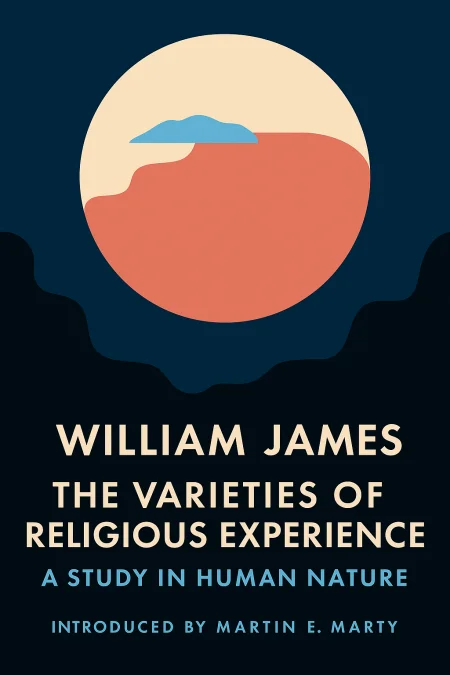
The Varieties of Religious Experience
A Study in Human Nature
byWilliam James, Martin E. Marty
Book Edition Details
Summary
In the early 20th century, William James embarked on a journey through the intricate labyrinth of human spirituality, bringing forth a masterpiece that redefined how we perceive religious experience. "The Varieties of Religious Experience" transcends traditional theological discourse, offering a psychologist's lens on the profound ways individuals connect with the divine in the solitude of their hearts. Here, religion is not confined within church walls but thrives in the vivid tapestry of personal narratives. James weaves together diverse accounts, constructing a rich mosaic that celebrates the pluralistic essence of faith. His exploration reveals that the divine is not a singular entity but a constellation of qualities, each offering a unique mission to those who seek it. This seminal work is an intellectual beacon, advocating for a nuanced respect and tolerance of spiritual diversity that resonates as powerfully today as it did over a century ago.
Introduction
Religious experience represents one of humanity's most enduring yet misunderstood phenomena, persistently dismissed by scientific materialism as delusion while simultaneously generating profound transformations in countless lives. This investigation challenges both religious orthodoxy and reductive scientism by examining religious consciousness as a legitimate psychological phenomenon worthy of empirical study. Rather than debating theological doctrines or institutional claims, the focus shifts to the actual lived experiences of individuals who report encounters with transcendent reality. The empirical approach reveals striking patterns across cultures and centuries: moments of conversion that permanently alter personality structure, mystical states that dissolve ordinary boundaries of consciousness, and sustained transformations that enhance moral capacity and life satisfaction. These phenomena resist easy categorization as either supernatural miracle or pathological symptom, demanding a more nuanced understanding that recognizes their genuine psychological reality while subjecting them to rigorous analysis. The investigation proceeds by examining religious experience through its varieties and effects rather than its metaphysical claims. By studying conversion narratives, mystical testimonies, and the lives of religious exemplars, we can discern the mechanisms through which religious consciousness operates and evaluate its contributions to human flourishing. This approach opens new possibilities for understanding both the depths of human psychology and the practical value of transcendent experience in addressing the fundamental challenges of existence.
Religious Experience as Authentic Psychological Phenomenon
Religious experience emerges as a distinct category of human consciousness characterized by immediate certainty, transformative power, and lasting behavioral change. These experiences possess an undeniable psychological reality that cannot be dismissed through reductive explanations or medical materialism. The attempt to invalidate religious states by identifying their neural correlates commits a fundamental logical error, equivalent to dismissing mathematical truth because it involves brain activity. The significance of any mental state must be judged by its fruits rather than its physiological origins. The phenomenology of religious experience reveals consistent features across diverse cultural contexts: the sense of encountering objective reality beyond ordinary perception, feelings of profound peace and unity, and the conviction that ultimate truth has been revealed. These commonalities suggest that religious consciousness taps into fundamental structures of human psychology rather than representing mere cultural artifacts. The experiences often occur in individuals of exceptional emotional sensitivity and intellectual depth, indicating that religious awareness may require particular psychological refinements rather than representing mental pathology. The transformative effects of religious experience provide compelling evidence for its psychological authenticity. Individuals who undergo profound religious encounters typically exhibit enhanced moral sensitivity, increased capacity for self-sacrifice, and improved ability to cope with suffering. These changes often prove more dramatic and enduring than those achieved through conventional therapeutic interventions. The practical effectiveness of religious transformation in generating sustained behavioral modification demonstrates its genuine causal power in human life. The study of religious experience reveals it as a natural capacity of human consciousness that manifests under specific conditions rather than an anomalous intrusion from supernatural realms. This perspective allows for serious scientific investigation while acknowledging the profound significance these experiences hold for those who undergo them. The psychological reality of religious consciousness demands recognition as legitimate data for understanding the full spectrum of human mental life and its potential for transformation.
Mystical States and the Limits of Rational Knowledge
Mystical experiences represent the most direct and immediate form of religious consciousness, distinguished by four essential characteristics that set them apart from ordinary mental states. These experiences prove ineffable, resisting adequate verbal description despite their profound impact on those who undergo them. They carry a noetic quality, conveying the sense of direct insight into ultimate reality through non-rational means. Their transient nature, typically lasting minutes to hours, contrasts sharply with their permanent effects on personality and worldview. Most significantly, they involve a sense of passivity, as if the individual becomes receptive to forces beyond personal control. The content of mystical states consistently points toward the fundamental unity underlying apparent diversity, the dissolution of subject-object distinctions, and the reconciliation of all contradictions in a higher synthesis. Subjects report experiencing reality as essentially one, with all conflicts and separations revealed as illusory. This unifying vision generates profound feelings of peace, love, and understanding that persist long after the experience itself fades. The authority these states carry for those who experience them proves virtually unshakeable, creating convictions that withstand subsequent rational criticism. Mystical consciousness appears to emerge from the same psychological depths that produce creative insights and inspired activity. The subconscious mind plays a crucial role, with mystical states often arising spontaneously during periods of meditation, emotional crisis, or relaxed attention. This connection suggests that mystical experience represents a natural capacity of human consciousness operating under special conditions rather than supernatural intervention. The phenomenon reveals the provisional nature of ordinary waking consciousness and points toward untapped potentials within human awareness. The epistemological significance of mystical experience lies in its claim to provide knowledge through direct intuition rather than sensory observation or logical reasoning. While such knowledge cannot be verified through conventional scientific methods, its practical fruits in terms of enhanced wisdom, compassion, and effectiveness provide indirect validation. Mystical states suggest that reality possesses dimensions normally hidden from ordinary consciousness and that human awareness can, under certain conditions, transcend its usual limitations to apprehend these deeper truths.
The Pragmatic Test: Evaluating Religion by Its Fruits
The ultimate validation of religious experience lies not in metaphysical demonstration but in its practical consequences for human life and conduct. This pragmatic approach shifts attention from abstract theological debates to concrete psychological and social effects, providing a more reliable basis for assessment than purely theoretical considerations. Religious beliefs and experiences must be judged by the kinds of lives they produce, the values they promote, and their contribution to human flourishing across diverse circumstances and temperaments. Religious consciousness consistently demonstrates its value through the character transformations it generates. Individuals who undergo profound religious experiences typically exhibit increased courage, compassion, and moral sensitivity. They show enhanced capacity for sustained effort toward idealistic goals, greater resilience in facing adversity, and improved ability to transcend narrow self-interest. These changes often prove more dramatic and lasting than those achieved through other means of personal development, suggesting that religious consciousness accesses psychological resources normally dormant in ordinary states of mind. The assessment must acknowledge both the constructive and destructive potentials inherent in religious experience. Religious conviction can produce fanaticism, intolerance, and harmful behavior when combined with intellectual narrowness or psychological instability. The same intensity that generates saintly dedication can fuel persecution and violence under different circumstances. However, these pathological expressions represent distortions rather than essential features of religious consciousness. The healthiest forms of religious life combine deep conviction with intellectual breadth, emotional balance, and practical wisdom. The diversity of religious types indicates that different forms of spiritual experience serve different psychological needs and constitutional requirements. Some individuals require dramatic conversion experiences, while others find fulfillment through gradual development. Some thrive on mystical contemplation, while others prefer active service or intellectual exploration. This variety suggests that religious consciousness represents a fundamental human capacity that manifests differently according to individual temperament and circumstances, requiring multiple valid expressions rather than uniform adherence to single models.
Beyond Philosophy: Experience as the Foundation of Religious Truth
Philosophical theology, despite its impressive systematic achievements, proves inadequate for establishing religious truth through purely rational means. The traditional arguments for divine existence succeed primarily in confirming beliefs already held on experiential grounds rather than generating new conviction in skeptical minds. The persistence of philosophical disagreement about ultimate questions reveals the limitations of abstract reasoning in matters that engage the whole person rather than merely the intellect. The God of philosophical construction bears little resemblance to the living reality encountered in actual religious experience. The fundamental inadequacy of philosophical approaches lies in their attempt to derive living religious conviction from conceptual analysis and logical demonstration. Religious experience involves emotions, will, and practical orientation in ways that purely intellectual methods cannot capture or reproduce. Philosophical systems may achieve logical elegance but often leave the actual phenomena of religious transformation largely untouched. The failure of elaborate metaphysical constructions to achieve widespread acceptance demonstrates their inability to address the concrete needs that drive genuine religious seeking. Religious truth, insofar as it exists, must be grounded in direct experience rather than inferential argument. The immediate certainty characteristic of profound religious encounters provides a foundation that logical demonstration cannot supply. This experiential basis does not render religious claims immune to critical examination, but it does suggest that their validation occurs through lived consequences rather than theoretical proof. The authority of religious experience extends primarily to those who undergo it, creating an asymmetrical epistemological situation that resists universal rational resolution. The proper role of philosophical reflection in religious matters involves critical analysis and conceptual clarification rather than foundational justification. Philosophy can expose contradictions, eliminate beliefs that conflict with well-established knowledge, and help articulate the implications of religious experience for other domains of understanding. However, it cannot create religious conviction where experiential foundation is lacking or provide ultimate validation for claims that transcend the boundaries of rational demonstration. The recognition of these limitations opens space for appreciating religious experience on its own terms while maintaining appropriate critical standards.
Summary
The empirical investigation of religious consciousness reveals it as a natural and valuable dimension of human psychology that transcends the traditional boundaries between subjective experience and objective reality. Religious experiences demonstrate consistent patterns across cultures and individuals, producing measurable transformations in character, conduct, and life satisfaction that justify serious scientific attention. The pragmatic test reveals religious consciousness as among the most powerful forces for personal transformation available to human beings, capable of accessing psychological resources and generating sustained motivation toward idealistic goals in ways that purely rational or therapeutic approaches often cannot match. This understanding suggests that religious experience represents not a primitive superstition destined for elimination but an enduring aspect of human nature that continues to offer unique insights into the depths of consciousness and the possibilities for human flourishing, deserving recognition as legitimate data for understanding the full spectrum of mental life and its transformative potential.
Related Books
Download PDF & EPUB
To save this Black List summary for later, download the free PDF and EPUB. You can print it out, or read offline at your convenience.
By William James
