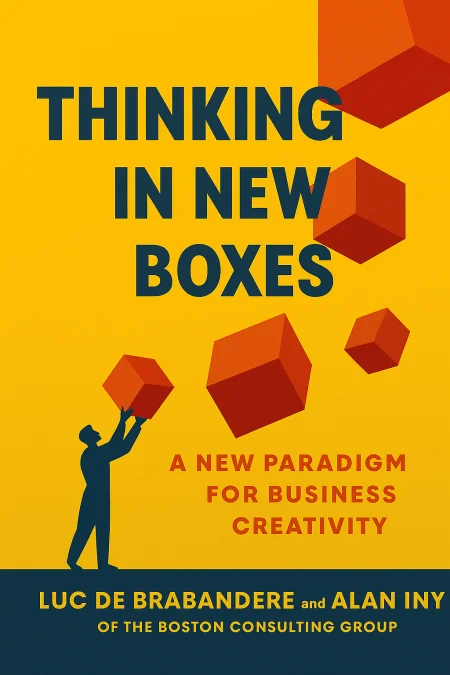
Thinking in New Boxes
A New Paradigm for Business Creativity
Book Edition Details
Summary
BIC's journey from pens to lighters wasn't just an expansion—it was a revelation. Breaking free from the confines of conventional thinking, the masterminds behind "Thinking in New Boxes" invite you to a new frontier of innovation. This isn't about abandoning structure; it's about reinventing it. Luc de Brabandere and Alan Iny offer a groundbreaking approach, urging businesses to dismantle old assumptions and explore limitless possibilities with a clear, structured process. Through riveting examples—from BIC's unexpected leap to Ford's bold moves—this book equips you with the tools to challenge norms, dream big, and transform potential pitfalls into revolutionary triumphs. Perfect for those daring to redefine the rules, this guide promises not just creativity, but creativity that lasts.
Introduction
Why do some individuals and organizations consistently generate breakthrough innovations while others remain trapped in outdated thinking patterns? The challenge lies not in abandoning mental structure entirely, but in understanding how we construct and deploy the cognitive frameworks that shape our perception of reality. This systematic approach to creative thinking introduces a comprehensive methodology that transcends conventional brainstorming techniques by providing disciplined tools for generating, evaluating, and implementing innovative solutions. The framework addresses fundamental questions about how we process information, make decisions under uncertainty, and maintain adaptive capacity in dynamic environments. It explores the delicate balance between creative exploration and practical implementation, the relationship between doubt and discovery, and the ongoing challenge of preventing our most successful innovations from becoming tomorrow's constraints. This theoretical foundation promises to reshape how individuals and organizations approach strategic planning, problem-solving, and leadership development in an increasingly complex world.
Understanding Mental Models and the Theory of Boxes
Mental models function as the invisible architecture of human cognition, serving as simplified representations of complex reality that enable us to process infinite stimuli and navigate our environment effectively. These cognitive structures, conceptualized as "boxes," operate at multiple levels of abstraction, from basic categorization systems that help us distinguish between similar objects to sophisticated paradigms that shape entire worldviews and decision-making processes. The architecture of mental models reveals itself through hierarchical organization, where smaller conceptual boxes fit within larger frameworks. At the foundational level, we create simple groupings and classifications that allow basic navigation of our environment. Moving upward in complexity, we develop stereotypes, assumptions, and belief systems that guide our interactions and choices. At the highest level, we construct comprehensive paradigms that become so deeply embedded in our thinking that we often mistake them for absolute truth rather than provisional constructs. The paradox of mental models lies in their simultaneous power and limitation. Like a dog that continues jumping over a fence that no longer exists, we often persist in using outdated cognitive frameworks long after their usefulness has expired. This phenomenon occurs because our brains naturally gravitate toward familiar patterns, seeking comfort and efficiency in established ways of understanding the world. The challenge becomes recognizing when our current boxes have transformed from useful tools into constraining prisons. Understanding this dynamic provides the foundation for deliberately constructing more effective mental models. The goal is not to eliminate these cognitive structures but to hold them lightly, maintaining awareness of their provisional nature while leveraging their organizational power. This sophisticated relationship with our own thinking processes enables continuous adaptation and prevents the cognitive rigidity that leads to strategic blindness in rapidly changing environments.
The Five-Step Framework for Creative Thinking
The comprehensive framework for systematic creativity consists of five sequential yet iterative steps that guide individuals and organizations through disciplined innovation processes. This methodology balances the psychological freedom required for genuine breakthrough thinking with the analytical rigor necessary to transform insights into actionable strategies and sustainable competitive advantages. The framework begins with doubt, requiring practitioners to question their most fundamental assumptions and beliefs about their situation, industry, or challenge. This foundational step creates the intellectual and emotional space necessary for genuine innovation by loosening attachment to existing mental models. The second step involves rigorous investigation of the external environment, including deep customer insights, competitive intelligence, and megatrend analysis that reveals emerging opportunities and threats. The middle phase orchestrates the delicate dance between divergent and convergent thinking processes. Divergence encourages the generation of numerous creative possibilities without immediate judgment, fostering an environment where unconventional ideas can emerge and develop without premature criticism. Convergence then applies analytical rigor to evaluate these possibilities against practical criteria, selecting the most promising concepts for implementation while maintaining openness to breakthrough innovations. The final step establishes mechanisms for ongoing evaluation and adaptation, recognizing that even the most innovative mental models will eventually require updating or replacement. This creates a sustainable cycle of organizational learning rather than a one-time creative exercise. The framework's iterative nature acknowledges that innovation rarely occurs through single bursts of inspiration but requires multiple cycles of exploration, evaluation, and refinement to achieve meaningful transformation.
From Doubt to Discovery: Breaking Mental Constraints
The journey toward innovative thinking begins with cultivating systematic doubt about existing assumptions, perceptions, and mental models that may have served us well in the past but could be limiting our future potential. This intellectual stance requires both humility and courage, acknowledging that our current understanding may be incomplete while maintaining the confidence necessary for effective action and decision-making. Productive doubt operates at multiple levels of analysis, from questioning specific tactical approaches to examining fundamental beliefs about industry dynamics, customer behavior, or organizational identity. The process involves conducting systematic audits of our beliefs and assumptions, exploring provocative scenarios that challenge conventional wisdom, and deliberately adopting perspectives from outside our normal frame of reference. This creates the mental flexibility necessary for genuine innovation while preventing cognitive entrenchment. The transformation from doubt to discovery requires channeling newly opened minds toward directed investigation of the world around us. This exploration encompasses three critical domains: developing deep customer insight that reveals underlying needs and motivations beyond stated preferences, gathering competitive intelligence that identifies both direct threats and potential disruption from adjacent industries, and conducting megatrend analysis that anticipates future environmental changes and emerging opportunities. Consider how Netflix successfully navigated multiple industry transformations by systematically questioning the sustainability of physical video rental, investigating emerging internet technologies, and continuously reevaluating their business model as streaming capabilities evolved. This approach enabled them to reinvent their value proposition multiple times while competitors remained trapped in outdated assumptions about customer preferences and technological possibilities. The key lies in maintaining disciplined curiosity that transforms uncertainty from a source of anxiety into a wellspring of competitive advantage.
Strategic Vision and Future Scenario Development
Strategic vision represents the culmination of creative thinking applied to organizational direction and long-term planning, requiring leaders to construct compelling mental models of radically different futures while maintaining connection to current realities and capabilities. This process transcends wishful thinking to create actionable narratives that inspire collective effort and coordinate complex organizational transformations across multiple time horizons. The development of strategic vision begins with fundamental shifts in perception about an organization's identity, purpose, and possibilities. This often requires leaders to envision entirely new categories of value creation, such as when Apple transformed from a computer company into a lifestyle brand, or when Amazon evolved from an online bookstore into a comprehensive digital ecosystem. These transformations demanded new mental models that could guide decision-making across unprecedented territories. Scenario planning provides a complementary methodology for exploring multiple possible futures without committing to single predictions or betting organizational survival on specific outcomes. By constructing several plausible but distinct scenarios, organizations can stress-test their strategies against various contingencies while identifying robust approaches that perform well across different conditions. This process combines analytical trend analysis with imaginative storytelling to create vivid narratives that illuminate both opportunities and threats. The power of scenarios lies not in their predictive accuracy but in their ability to expand mental models and prepare organizations for unexpected developments. When Royal Dutch Shell used scenario planning to anticipate oil crises in the 1970s, they gained competitive advantage not because they predicted specific events but because they had mentally rehearsed responses to various disruptions. This preparation enabled faster adaptation when actual crises emerged, demonstrating how strategic vision creates organizational resilience and adaptive capacity in uncertain environments.
Summary
The essence of sustainable creativity lies in recognizing that innovative thinking requires not the abandonment of mental structure but the conscious creation and strategic deployment of new cognitive frameworks that better serve our evolving needs and challenges. This systematic approach to innovation establishes disciplined methodologies for continuous adaptation while maintaining the analytical rigor necessary to transform breakthrough insights into meaningful action and competitive advantage. The framework's enduring significance extends beyond immediate problem-solving to build organizational capabilities for navigating uncertainty, inspiring collective effort, and maintaining relevance in an increasingly dynamic and complex world where the ability to think in new boxes becomes the ultimate source of sustainable differentiation.
Related Books
Download PDF & EPUB
To save this Black List summary for later, download the free PDF and EPUB. You can print it out, or read offline at your convenience.
By Luc de Brabandere
