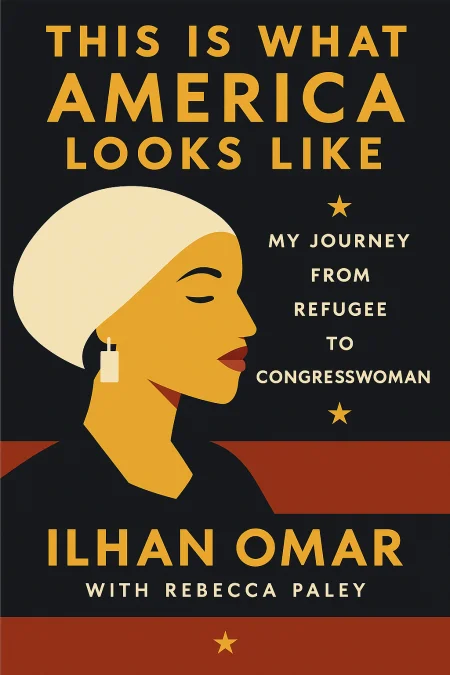
This Is What America Looks Like
My Journey from Refugee to Congresswoman
Book Edition Details
Summary
When the echoes of gunfire shattered her childhood, Ilhan Omar embarked on a path few could imagine, from the chaos of Mogadishu to the heart of American democracy. In "This is What America Looks Like," Omar, a trailblazer in every sense, shares her poignant odyssey of resilience and transformation. At the tender age of twelve, with nothing but hope in her pocket and Somali on her tongue, she dared to dream of belonging in a new world. Through her eyes, we glimpse the relentless drive of an immigrant who defied the odds, reshaped narratives, and made history as a congresswoman. Her memoir is not just a testament to survival but a vivid tapestry of her unwavering belief in America’s potential. This compelling narrative pulses with courage, humor, and an unyielding spirit, offering readers a raw and inspiring portrait of a woman who continues to push boundaries and redefine what it means to be American.
Introduction
From a war-torn refugee camp in Kenya to the marble halls of the United States Congress, Ilhan Omar's story embodies both the promise and the struggles of the American dream. As the first Somali American elected to Congress and one of the first Muslim women to serve in the House of Representatives, Omar has become a symbol of resilience, representation, and the evolving face of American democracy. Her journey from a child fleeing civil war to a fearless political leader who challenges established norms reveals the extraordinary transformation possible within a single lifetime. Omar's path illuminates the complex reality of what it means to be American in the 21st century. Through her experiences, we witness the profound challenges faced by refugees and immigrants seeking belonging in a new homeland, the power of education and community organizing to create change, and the courage required to break barriers in spaces where few who look like you have walked before. Her story offers insights into the nature of democracy itself, showing how one person's unwavering commitment to justice and representation can reshape institutions and inspire others to claim their rightful place in the American narrative. This remarkable journey demonstrates that America's strength lies not in uniformity, but in its capacity to embrace and elevate voices from all corners of the world, transforming them into instruments of progress and hope.
From Somalia to America: A Refugee's Journey
Ilhan Omar's earliest memories are painted with the stark contrasts of privilege lost and survival gained. Born into a well-educated, middle-class family in Mogadishu, Somalia, young Ilhan lived in a compound filled with books, poetry, and spirited political debates among her extended family. Her grandfather, Baba, defied traditional patriarchal norms by treating the girls in the family as equals, instilling in them a sense of worth and capability that would prove invaluable in the trials ahead. The eruption of Somalia's civil war in 1991 shattered this comfortable existence overnight. As bullets flew over their home and militia groups targeted families like theirs, eight-year-old Ilhan witnessed the complete collapse of the world she knew. The family's harrowing escape involved cattle trucks, dangerous border crossings, and the constant threat of violence. The journey that eventually led them to the Utange refugee camp in Kenya was marked by hunger, fear, and the heartbreaking reality that safety often comes at an enormous cost. Life in the refugee camp became a masterclass in resilience and adaptation. For four years, Ilhan navigated the daily challenges of water lines, food distribution, and the ever-present threat of illness and death. The camp was a place where pride and dignity were luxuries few could afford, yet it was also where she learned that survival required both individual strength and collective support. The experience of watching her beloved aunt, Fos, die from malaria while pregnant taught her that nothing in life is permanent, but it also revealed the importance of cherishing human connections. The family's eventual resettlement to Arlington, Virginia, in 1995 marked the beginning of another kind of journey. America, which had been promised as a land of abundance and opportunity, initially appeared through the harsh realities of urban poverty and cultural displacement. Yet even as twelve-year-old Ilhan struggled with the discrepancy between expectation and reality, she began to understand that the America of her dreams was not a destination but an aspiration to be fought for and built.
Finding Voice: Education and Political Awakening
The transition from refugee to American student proved to be one of the most formative periods of Omar's development. Arriving in middle school with only two English phrases, "hello" and "shut up," she faced the dual challenge of mastering a new language while navigating the complex social dynamics of American adolescence. Her natural tendency to fight back against perceived injustices led to frequent conflicts, as she struggled to understand cultural norms while refusing to be intimidated by bullies. Omar's academic journey took an unconventional path. After earning her high school diploma, she initially pursued a two-year business degree at a for-profit institution, working multiple jobs while raising her first child. The limitations of this education, combined with personal struggles and an existential crisis in her mid-twenties, led her to make a bold decision: to leave everything familiar behind and pursue a real college education in North Dakota. This period of self-imposed exile and academic focus became a crucial chapter in her personal growth and intellectual development. At North Dakota State University, Omar discovered her true calling in political science and international studies. Away from family pressures and community expectations, she found the space to explore her own interests and develop her analytical skills. Her academic work included research on democratic governance in Somalia, which not only connected her to her homeland but also deepened her understanding of the challenges and possibilities of representative government. This intellectual foundation would prove essential to her later political career. The combination of her refugee experience, American education, and growing awareness of systemic inequalities created a unique perspective on democracy and representation. Omar began to see politics not as an abstract academic subject but as a practical tool for addressing the real problems faced by marginalized communities. Her work as a nutrition educator for immigrant families further reinforced her belief that effective governance requires deep understanding of constituents' daily struggles and genuine commitment to improving their lives.
Breaking Barriers: From State House to Congress
Omar's entry into electoral politics was both calculated and courageous. Her first major campaign, managing Andrew Johnson's 2013 Minneapolis city council race, taught her the nuts and bolts of political organizing while revealing her natural talents for strategy and coalition-building. However, it was her decision to challenge forty-four-year incumbent Phyllis Kahn for a Minnesota state house seat that truly announced her arrival as a political force to be reckoned with. The 2016 campaign was a baptism by fire that tested every aspect of Omar's character and capabilities. Facing not only an entrenched political establishment but also resistance from within her own Somali community, she endured personal attacks, conspiracy theories, and even physical violence. The night she was assaulted at a caucus meeting became a defining moment, demonstrating both the risks faced by women who challenge power structures and her unwavering commitment to democratic participation. Victory in that race made Omar the first Somali American elected to a state legislature in the United States, but it also thrust her into a national spotlight she hadn't anticipated. As Donald Trump's presidency began with attacks on Muslim Americans and refugees, Omar found herself serving as both a local representative and a symbol of resistance to rising authoritarianism. This dual role required her to master the art of legislative effectiveness while managing the pressures of being a nationally recognized figure. Her rapid ascent to Congress in 2018 represented another leap in scale and responsibility. Running for federal office with just weeks to prepare, Omar had to quickly adapt her grassroots organizing approach to a larger, more diverse constituency. The campaign broke turnout records and demonstrated the hunger for authentic representation among communities that had long felt ignored by traditional politicians. Her victory, alongside that of Rashida Tlaib in Michigan, marked a historic milestone as the first Muslim women elected to Congress.
Redefining Democracy: Vision for America's Future
As a member of Congress, Omar has consistently used her platform to advocate for a more inclusive and representative democracy. Her legislative priorities reflect both her personal journey and her broader vision for America's future. From immigration reform that recognizes the humanity and potential of refugees to criminal justice reforms that address systemic inequalities, her policy agenda is grounded in the belief that American democracy works best when it works for everyone. Omar's approach to governance combines pragmatic coalition-building with principled stands on controversial issues. Her willingness to challenge both Republican policies and Democratic orthodoxies has sometimes generated criticism, but it has also opened space for conversations about topics traditionally considered off-limits in American politics. Her foreign policy positions, in particular, reflect a commitment to applying universal human rights principles consistently, regardless of which countries or interests might be affected. The historic change in House rules that allowed her to wear her hijab on the congressional floor represents more than personal accommodation; it symbolizes the ongoing evolution of American institutions to reflect the country's growing diversity. Omar's presence in Congress has forced these institutions to confront their own assumptions about who belongs in the halls of power and what authentic representation looks like in a pluralistic democracy. Perhaps most significantly, Omar's journey from refugee to congresswoman has redefined what's possible for marginalized communities in America. Her success has inspired countless young people, particularly women of color and immigrants, to see themselves as potential leaders rather than grateful recipients of others' decisions. This transformation of political imagination may prove to be her most lasting contribution to American democracy.
Summary
Ilhan Omar's remarkable journey from Somali refugee to American congresswoman illuminates the transformative power of resilience, education, and unwavering commitment to justice. Her story demonstrates that America's greatest strength lies not in its perfection, but in its capacity for growth and its ability to elevate voices from the margins to the center of power. Through every challenge she has faced, from the trauma of war and displacement to the brutal realities of American politics, Omar has maintained her belief that democracy works best when it includes everyone. Her experience offers two crucial lessons for anyone seeking to create meaningful change. First, that authentic representation requires not just achieving positions of power, but using those positions to amplify the voices and address the needs of those who are typically overlooked. Second, that lasting progress comes from the patient work of building coalitions, changing minds one conversation at a time, and refusing to accept that the status quo is the best we can do. Omar's story will resonate particularly with immigrants, young people, and anyone who has ever felt like an outsider looking for their place in the American story. Her journey proves that with courage, persistence, and unwavering moral clarity, it's possible to not just find your place at the table, but to help build a bigger table where everyone belongs.
Related Books
Download PDF & EPUB
To save this Black List summary for later, download the free PDF and EPUB. You can print it out, or read offline at your convenience.
By Ilhan Omar
