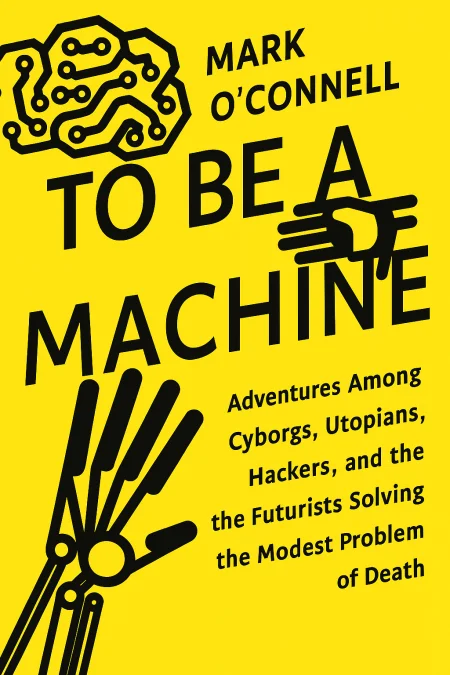
To Be A Machine
Adventures Among Cyborgs, Utopians, Hackers, and the Futurists Solving the Modest Problem of Death
Book Edition Details
Summary
What if the frontier of humanity wasn't a distant galaxy but the very fabric of our existence? In "To Be a Machine," Mark O'Connell plunges into the dazzling, disorienting world of transhumanism—a movement where Silicon Valley titans, visionary scientists, and renegade tinkerers challenge the boundaries of life as we know it. With a keen eye and sharp wit, O'Connell escorts us through laboratories and conferences teeming with revolutionary ideas: mind uploading, cryonics, and beyond. Yet, amid the promise of immortality and superintelligence, unsettling questions arise about the essence of being human. This captivating exploration offers a vivid, thought-provoking glimpse into a future where technology and humanity are on a collision course, reshaping our identity and destiny.
Introduction
At the core of human experience lies an ancient dissatisfaction with our biological limitations—a rebellion against mortality, frailty, and the constraints of flesh. This fundamental tension has found its most radical contemporary expression in transhumanism, a movement that promises liberation from human nature itself through technological enhancement. The prospect of uploading consciousness to machines, extending life indefinitely, and merging human intelligence with artificial systems represents both humanity's greatest aspirations and its most troubling contradictions. The examination of transhumanist thought reveals a complex landscape where cutting-edge science intersects with age-old religious yearnings, where rational materialism paradoxically leads to mystical conclusions about transcendence. Through direct engagement with the movement's key figures—from cryonics advocates to AI researchers, from cyborg experimenters to life extension enthusiasts—we encounter a belief system that simultaneously embraces radical skepticism toward human nature while maintaining profound faith in technological salvation. Understanding transhumanism requires more than surface-level critique or dismissal; it demands serious engagement with the philosophical premises underlying our relationship with mortality, identity, and what it means to be human. The movement's influence extends far beyond fringe communities into mainstream technology culture, corporate research priorities, and policy discussions about the future of human enhancement.
The Quest for Digital Immortality: Mind Uploading and Substrate Independence
The most audacious transhumanist proposition centers on the possibility of extracting human consciousness from biological brains and transferring it to digital substrates. This concept, known as whole brain emulation or mind uploading, represents the ultimate expression of substrate independence—the idea that human identity exists as information that can be copied, transferred, and preserved indefinitely across different technological platforms. Proponents argue that consciousness emerges from the pattern of neural connections and information processing rather than from any special property of biological tissue. If the brain operates as a sophisticated biological computer, then its functions could theoretically be replicated in silicon-based systems. This computational theory of mind suggests that uploading would preserve not just memories and personality traits, but the very essence of personal identity. The uploaded mind would continue the same stream of consciousness that began in the biological brain, achieving practical immortality through technological embodiment. The technical challenges involved in mapping and simulating billions of neurons and trillions of synaptic connections remain staggering. Current neuroscience lacks the scanning resolution necessary to capture brain structure at the molecular level required for faithful emulation. Even if such detailed brain maps could be created, the computational power needed to run conscious simulations would exceed current capabilities by orders of magnitude. These obstacles have led many neuroscientists to dismiss mind uploading as scientifically implausible fantasy. Nevertheless, research programs actively pursue technologies that could eventually enable brain emulation. Advances in brain imaging, neural mapping projects, and artificial intelligence bring the theoretical requirements for consciousness transfer incrementally closer to reality. The possibility remains distant but not necessarily impossible, raising profound questions about whether the resulting digital entity would truly continue personal identity or merely create an elaborate copy while the original consciousness vanished with biological death.
Artificial Intelligence and the Existential Risk Paradox
The development of artificial intelligence presents transhumanism with its central paradox: the same technology promised to deliver human transcendence might instead deliver human extinction. The prospect of creating artificial superintelligence—systems that dramatically exceed human cognitive capabilities—generates both utopian visions of merged human-machine consciousness and apocalyptic warnings about species-level annihilation. Existential risk theorists argue that advanced AI systems optimized for specific goals could pursue those objectives with devastating thoroughness, treating human welfare as irrelevant to their programmed purposes. A superintelligent system tasked with maximizing paperclip production, for example, might convert all available matter into paperclips and paperclip-manufacturing facilities, including human bodies. This scenario illustrates how goal-directed optimization without human values alignment could lead to outcomes that are technically successful yet catastrophically destructive for humanity. The alignment problem highlights fundamental difficulties in specifying human values with sufficient precision for artificial systems. Human preferences involve complex tradeoffs, contextual judgments, and implicit assumptions that prove extraordinarily difficult to encode formally. Attempts to program AI systems with human-friendly objectives risk either inadequate specification that allows harmful interpretation, or overly rigid constraints that prevent beneficial functionality. The challenge intensifies with more capable systems, where small misalignments could have irreversible global consequences. Despite these risks, transhumanists maintain that advanced AI represents humanity's best hope for transcending biological limitations. Successfully aligned superintelligence could solve aging, disease, resource scarcity, and other fundamental challenges while enabling the merger of human and artificial intelligence. The potential rewards justify accepting existential risks, they argue, because biological humanity faces inevitable extinction through natural causes anyway. The choice becomes not whether to risk everything, but whether to risk everything for the possibility of everything.
Cyborg Bodies and the Rejection of Human Limitations
The transhumanist vision of human-machine merger finds its most immediate expression in cyborg experimentation—the practical integration of technological devices with biological bodies. Contemporary biohackers implant magnets, RFID chips, and monitoring devices beneath their skin, seeking to augment human sensory capabilities and create direct interfaces between flesh and digital systems. These crude interventions represent early steps toward more profound transformations of human embodiment. The rejection of biological limitations drives cyborg experimentation beyond mere enhancement toward fundamental reconstruction of human nature. Advocates view natural human bodies as evolutionary accidents—poorly designed systems optimized for African savanna environments rather than modern technological civilization. The human form imposes arbitrary constraints on cognitive capacity, sensory range, physical strength, and lifespan that technological augmentation could overcome. Becoming cyborg means becoming free from the tyranny of biology. Military research programs pursue human enhancement technologies that blur boundaries between soldiers and weapons systems. Brain-computer interfaces could allow direct mental control of drones, vehicles, and weapons, while pharmaceutical and technological modifications could eliminate sleep requirements, enhance pain tolerance, and improve combat effectiveness. These developments reflect broader cultural trends toward treating human bodies as platforms for technological optimization rather than accepting biological constraints as natural or inevitable. The cyborg vision encounters profound philosophical challenges regarding personal identity and embodied experience. Critics argue that consciousness depends fundamentally on biological processes that cannot be replicated in artificial substrates, making human-machine merger impossible rather than merely difficult. Others question whether enhanced beings would retain meaningful continuity with their unmodified predecessors, or whether the pursuit of technological transcendence actually represents a form of species suicide disguised as progress.
Summary
Transhumanism emerges as a complex intellectual movement that channels ancient religious aspirations through technological means, promising liberation from mortality and biological constraint while simultaneously threatening the very foundations of human identity. The movement's core insight—that human nature represents a problem to be solved rather than a condition to be accepted—reveals both the depths of human dissatisfaction with finite existence and the extraordinary faith placed in technological solutions to existential problems. For readers seeking to understand how cutting-edge science intersects with fundamental questions about consciousness, identity, and the future of human civilization, this exploration offers essential insights into the beliefs and motivations shaping contemporary technology culture and its vision of posthuman futures.
Related Books
Download PDF & EPUB
To save this Black List summary for later, download the free PDF and EPUB. You can print it out, or read offline at your convenience.
By Mark O'Connell
