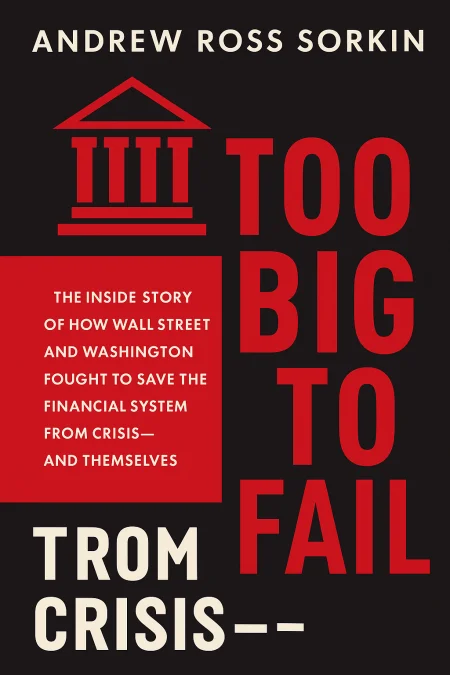
Too Big to Fail
The Inside Story of how Wall Street and Washington Fought to Save the Financial System - and Themselves
Book Edition Details
Summary
In the throes of financial chaos, when giants of Wall Street stood on the brink, Andrew Ross Sorkin unveils a gripping chronicle that reads like a thriller. "Too Big to Fail" takes you behind closed doors and into the clandestine corridors of power where decisions of staggering consequence unfolded. With unparalleled access, Sorkin captures the raw tension and high-stakes gambles of 2008's financial meltdown—a modern odyssey where ego battles ethics, and greed tests governance. From Lehman Brothers’ fall to the urgent whispers of Washington, each page vibrates with the urgency of a crisis that reshaped the global economy. It's a narrative as riveting as it is revealing, offering an insider's look at the dramatic showdown of ambition versus stability.
Introduction
Picture the scene: it's a crisp September morning in 2008, and the most powerful figures on Wall Street are trapped in a windowless conference room at the Federal Reserve Bank of New York, facing an impossible choice. Outside, photographers snap pictures of arriving CEOs, sensing that history is unfolding. Inside, Treasury Secretary Hank Paulson delivers a stark ultimatum: save Lehman Brothers yourselves, or watch the entire financial system collapse. This extraordinary weekend reveals how a perfect storm of hubris, miscalculation, and systemic risk brought the global economy to its knees, transforming the relationship between government and markets forever. The crisis exposes the dangerous myth that sophisticated financial institutions could manage systemic risk through complex mathematical models and diversification strategies. Through intimate conversations and behind-the-scenes maneuvering, we witness how decisions made in boardrooms and government offices reverberated across continents, destroying fortunes and reshaping capitalism itself. The story illuminates the human drama behind economic headlines, showing how fear, pride, and desperation drove the actions of some of the most influential figures in American finance. This account serves anyone seeking to understand how financial crises unfold, how power operates under extreme pressure, and why the decisions of a few can determine the fate of millions. It's essential reading for business professionals, policy makers, and anyone curious about the forces that shape our economic world, offering unprecedented insight into the mechanics of financial crisis management and the lessons that remain painfully relevant today.
Early Warning Signs: Bear Stearns and System Vulnerabilities (2007-March 2008)
The collapse began not with a bang but with a phone call. By early 2008, warning signs were flashing red across the financial landscape, yet few grasped the magnitude of the approaching catastrophe. The roots of the crisis stretched back years, embedded in a culture that rewarded excessive risk-taking while socializing the losses. Investment banks had transformed from partnerships where leaders risked their own capital into publicly traded corporations where executives could gamble with other people's money. Bear Stearns had become the canary in the coal mine, the first major casualty of a crisis that had been building for years. The firm's downfall wasn't sudden—it was the inevitable result of a business model that had become dangerously dependent on short-term funding and complex mortgage securities. When confidence evaporated, Bear discovered what every investment bank fears most: in a business built on trust, once that trust is gone, you have perhaps 72 hours before the lights go out. The rescue orchestrated by Treasury Secretary Hank Paulson and Federal Reserve President Tim Geithner set a precedent that would haunt them for months to come. By arranging government backing for JP Morgan's acquisition, they had crossed a line that had never been crossed before—using taxpayer money to prevent the failure of an investment bank. The decision was made in a frantic weekend of negotiations, with officials convinced that Bear's collapse would trigger a domino effect throughout the financial system. Yet even as they celebrated averting immediate disaster, the architects of Bear's rescue knew they had only bought time. The fundamental problems that had brought down Bear—excessive leverage, toxic assets, and a funding model dependent on market confidence—existed throughout Wall Street. The interconnected nature of modern finance meant that these institutions were not just too big to fail, but too connected to fail, creating a financial system where everyone was swimming in the same pool.
The Lehman Collapse: Government Refusal and Market Panic (September 2008)
By September 2008, Lehman Brothers found itself caught in Bear Stearns' position just six months later. But this time, the government's response would be dramatically different. CEO Dick Fuld, known as "The Gorilla" for his aggressive trading style, had built Lehman into a powerhouse through sheer determination and risk-taking. The firm had survived the 1998 Russian crisis and emerged stronger after 9/11, but Fuld's greatest strength—his willingness to bet big—became his fatal weakness when the mortgage market collapsed. The government's response marked a dramatic shift from its earlier intervention to save Bear Stearns. Treasury Secretary Paulson, stung by criticism that he had become "Mr. Bailout," was determined to draw a line in the sand. When Lehman's executives pleaded for assistance, Paulson's message was unequivocal: there would be no taxpayer money to rescue the investment bank. This decision reflected both political calculation and genuine belief that the market needed to learn that reckless behavior had consequences. Despite frantic weekend negotiations and desperate attempts to find a buyer, Lehman Brothers was allowed to file for bankruptcy on September 15, 2008, becoming the largest corporate failure in American history. The decision to let Lehman fail sent shockwaves through global markets. Within hours, the Dow Jones plummeted, credit markets froze, and panic spread from New York to London to Tokyo. Money market funds, considered among the safest investments, began "breaking the buck"—falling below their $1 share price. The aftermath revealed the interconnectedness of modern finance in stark terms. Lehman's collapse triggered a cascade of failures and near-failures, from AIG to money market funds to European banks that had invested in Lehman's debt. The lesson was brutal but clear: in a globalized financial system, no institution truly fails in isolation. The ripple effects of Lehman's bankruptcy would be felt for years, fundamentally altering how regulators, bankers, and politicians thought about systemic risk.
Emergency Response: AIG Bailout and TARP Implementation (October 2008)
The chaos following Lehman's collapse forced government officials into uncharted territory. Within days of the bankruptcy, it became clear that the hands-off approach that had defined American capitalism for decades was no longer tenable. The crisis demanded intervention on a scale not seen since the 1930s, with officials scrambling to prevent a complete collapse of the financial system. The first major rescue came just one day after Lehman's fall, when the government stepped in to save AIG with an $85 billion loan. The insurance giant had become critically important to the global financial system through its derivatives business, insuring hundreds of billions of dollars in mortgage-related securities. AIG's failure would have triggered payouts and margin calls that could have brought down dozens of other institutions. The irony was stark—the government that had refused to save Lehman was now forced into an even larger bailout to prevent AIG's collapse. Treasury Secretary Paulson, a former Goldman Sachs CEO who had initially resisted government intervention, found himself asking Congress for unprecedented authority. The Troubled Asset Relief Program, initially conceived as a way to buy bad mortgages, quickly evolved into a direct capital injection program. The government was essentially nationalizing parts of the banking system, taking ownership stakes in institutions from Citigroup to Bank of America. These emergency measures represented a fundamental shift in the relationship between government and markets. Officials who had spent their careers believing in the efficiency of free markets were now making decisions about which institutions would survive and which would fail. The interventions worked in the immediate sense—they prevented a complete collapse of the financial system. But they also raised profound questions about moral hazard, fairness, and the role of government in a capitalist economy that would resonate for years to come.
System Transformation: From Investment Banks to Government Control
The crisis didn't just reshape government policy; it fundamentally transformed Wall Street itself. The independent investment bank, a fixture of American finance for decades, essentially ceased to exist. Goldman Sachs and Morgan Stanley, the two remaining major investment banks, converted to bank holding companies in a matter of days, accepting Federal Reserve regulation in exchange for access to government support and deposits. This transformation marked the end of an era. Investment banks had been the swashbucklers of finance, using enormous leverage to generate spectacular returns for their partners and shareholders. They had operated with minimal regulation, funded themselves in short-term markets, and taken risks that would have been unthinkable for traditional commercial banks. The crisis revealed the fundamental instability of this model in a world where confidence could evaporate overnight. The human cost of this transformation was enormous. Lehman's bankruptcy alone eliminated 25,000 jobs, while firms across Wall Street slashed payrolls and shuttered entire divisions. The culture of risk-taking that had defined investment banking gave way to a new emphasis on capital preservation and regulatory compliance. Compensation structures that had created enormous wealth for a relatively small number of people came under intense scrutiny from regulators and the public. Yet the transformation also revealed the resilience of the financial system. New regulations like the Dodd-Frank Act imposed stricter capital requirements and created mechanisms for winding down failing institutions without taxpayer bailouts. Banks rebuilt their balance sheets, reduced their leverage, and developed more stable funding sources. The survivors emerged stronger and more diversified, better positioned to weather future storms. The crisis had been devastating, but it had also forced a long-overdue reckoning with the risks inherent in modern finance.
Summary
The financial crisis of 2008 represents a fundamental clash between two competing visions of capitalism: the free-market ideology that had dominated American economic thinking for decades, and the recognition that some institutions had become so large and interconnected that their failure posed unacceptable risks to society as a whole. This tension between market discipline and systemic stability runs throughout the crisis, from the decision to save Bear Stearns to the choice to let Lehman fail to the massive government interventions that followed. The story offers profound lessons for our current moment. First, complexity and interconnectedness in financial systems can transform individual failures into systemic crises, making it essential to understand and monitor these connections before they become dangerous. Second, the speed of modern finance means that once confidence begins to erode, decision-makers have very little time to respond—preparation and clear thinking are crucial when crisis strikes. Finally, the human element remains paramount in financial markets; despite all the sophisticated models and risk management systems, individual decisions made under extreme pressure ultimately determine outcomes. Perhaps most importantly, the crisis demonstrates that the health of the financial system is not just a concern for bankers and regulators—it affects everyone. When credit markets freeze, businesses cannot operate, jobs disappear, and ordinary families lose their homes and savings. Understanding how these systems work and fail is not just academic curiosity; it's essential knowledge for anyone who wants to navigate and influence the economic forces that shape our world.
Related Books
Download PDF & EPUB
To save this Black List summary for later, download the free PDF and EPUB. You can print it out, or read offline at your convenience.
By Andrew Ross Sorkin
