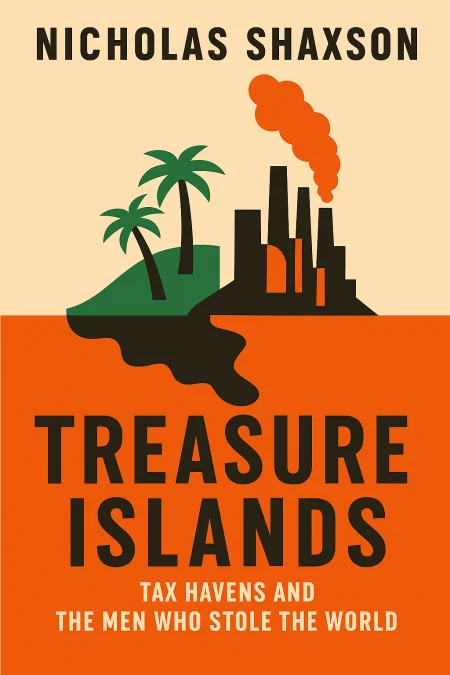
Treasure Islands
Tax Havens and the Men Who Stole the World
Book Edition Details
Summary
Whispers of wealth in shadowed corners shape a narrative both thrilling and chilling in its revelation. "Treasure Islands" lifts the veil on the murky world of offshore tax havens, a clandestine empire where the rich sidestep the rules that bind the rest. Behind closed doors, a massive siphoning of wealth from the world's poorest to its richest unfolds, a quiet heist that outpaces any aid. This isn't just the domain of the notorious; it's a systemic web that corrodes democracies and widens the chasm between classes. With precision and passion, this book dissects the economic rot festering at the heart of global finance, challenging readers to reconsider the very foundations of wealth and power.
Introduction
The global financial system operates through a hidden architecture that most citizens never encounter directly, yet it fundamentally shapes how wealth flows around the world and who ultimately bears the costs of public services. This shadow network of tax havens and secrecy jurisdictions has evolved from scattered island banking centers into a sophisticated system that processes trillions of dollars annually while systematically undermining democratic governance and economic justice. The offshore world represents far more than technical financial arrangements or regulatory gaps—it constitutes a parallel universe where different rules apply to different classes of people, creating what amounts to economic apartheid on a global scale. The evidence reveals how this system has become the primary mechanism through which democratic societies lose control over their economic destinies, enabling unprecedented wealth concentration while hollowing out public institutions from within. Through forensic analysis of financial flows, regulatory capture, and institutional relationships, a compelling case emerges that offshore finance represents one of the most successful counter-revolutions against democratic governance in modern history. The investigation employs a systematic approach to trace how seemingly technical financial arrangements serve broader political purposes, challenging conventional wisdom about globalization, market efficiency, and the relationship between private wealth and public welfare. Understanding this hidden architecture becomes essential for comprehending why democratic institutions have proven increasingly unable to address economic inequality, corporate accountability, and financial instability.
The Hidden Architecture: Britain's Financial Empire and Offshore Networks
The contemporary offshore system operates as a sophisticated web of interconnected jurisdictions with the City of London at its center, representing an evolution of imperial control adapted to modern financial markets. This network consists of three distinct tiers: Crown Dependencies like Jersey and the Isle of Man that maintain constitutional links to Britain while claiming regulatory independence; Overseas Territories including the Cayman Islands and British Virgin Islands where London-appointed governors retain ultimate authority; and former colonies and allied jurisdictions that preserve deep structural ties to British financial interests. Each jurisdiction specializes in particular services while maintaining legal fictions of independence that provide plausible deniability for the coordinating center. The system's architecture enables regulatory arbitrage on an unprecedented scale, allowing financial institutions to fragment their operations across multiple jurisdictions to exploit the most favorable aspects of different legal systems while avoiding less convenient obligations. Trust structures, shell companies, and nominee arrangements create layers of opacity that separate beneficial ownership from legal responsibility, making it nearly impossible for any single authority to trace financial flows or enforce regulations effectively. The complexity serves a deliberate purpose: creating spaces beyond effective government control where wealth can accumulate without democratic oversight or public accountability. The historical development of this network traces back to the dissolution of formal empire, when Britain transformed political dominance into financial influence through carefully maintained relationships with former territories. Rather than losing global reach, the former imperial power created new mechanisms of economic control that proved more durable and profitable than direct political administration. The City of London Corporation, with its unique medieval privileges and governance structure, serves as the coordinating hub for relationships that preserve London's position as a global financial center while providing the infrastructure for worldwide tax avoidance and regulatory escape. The scale of operations through this British-controlled network dwarfs many national economies, with estimates suggesting that over half of global banking assets flow through jurisdictions connected to London. This concentration of financial power enables the system to influence global regulatory standards, resist reform efforts, and maintain the political relationships necessary for continued operation, creating a self-reinforcing cycle that strengthens offshore finance while weakening democratic institutions worldwide.
Corporate Escape Routes: How Multinationals Exploit Regulatory Arbitrage
Multinational corporations have developed increasingly sophisticated strategies to minimize their obligations to any particular society while maximizing their access to public services, infrastructure, and legal protections. These techniques fundamentally rely on the ability to separate legal form from economic substance, creating artificial structures that bear little relationship to actual business operations but serve to shift profits to low-tax jurisdictions while concentrating costs in high-tax countries. Transfer pricing manipulation allows companies to set artificial prices for transactions between their own subsidiaries, effectively moving profits to tax havens while leaving expenses in countries with higher tax rates and better public services. The mechanics of corporate tax avoidance involve complex webs of subsidiaries, licensing arrangements, and financial instruments that exploit differences between national tax codes and treaty networks. Intellectual property licensing has become a particularly favored mechanism, as patents and trademarks can be easily relocated to tax havens while the underlying research, development, and commercialization activities remain in higher-tax jurisdictions with better infrastructure and educated workforces. These arrangements often involve circular structures where subsidiaries lend to each other or license intellectual property in ways that create artificial deductions and income streams designed purely for tax optimization. Double taxation treaties, originally negotiated to prevent the same income from being taxed by multiple countries, have been systematically exploited through treaty shopping to achieve the opposite result: ensuring that profits are taxed nowhere at all. Corporations route transactions through jurisdictions with favorable treaty networks, creating structures where income escapes taxation entirely while the companies continue to benefit from public investments in education, infrastructure, and legal systems. The complexity of these arrangements often exceeds the capacity of national tax authorities to monitor and challenge effectively, creating an asymmetric battle between public oversight and private optimization. The cumulative effect represents a massive transfer of tax burden from mobile capital to immobile factors like labor, consumption, and property ownership. Small businesses and individual taxpayers face proportionally higher effective tax rates while multinational corporations achieve overall tax rates that can approach zero, fundamentally distorting economic incentives and undermining the social contract between business and society. This systematic shift in tax burden contributes to rising inequality while eroding the fiscal capacity of democratic governments to provide public services and invest in long-term economic development.
The Democratic Deficit: Why Tax Competition Undermines National Sovereignty
The proliferation of tax havens has fundamentally altered the relationship between democratic governments and mobile capital, creating a system where policy choices are increasingly constrained by the implicit threat of capital flight to more accommodating jurisdictions. Tax competition between countries creates a race to the bottom that systematically erodes the fiscal capacity of democratic states while empowering unaccountable offshore centers with minimal populations but maximum financial influence. This dynamic represents a profound challenge to democratic sovereignty, as elected governments find their policy options limited by the need to compete for mobile capital that can relocate at the touch of a computer key. The ideology surrounding tax competition presents this process as beneficial market discipline that promotes efficiency and constrains government overreach, but the reality involves a systematic transfer of power from democratic institutions to offshore financial centers that operate with minimal transparency or accountability. Small island jurisdictions with populations measured in thousands can effectively dictate tax and regulatory policy to major democracies with hundreds of millions of citizens, inverting normal principles of democratic representation and creating a system where economic power trumps political legitimacy. The result is structural adjustment imposed through market mechanisms rather than formal conditionality. Regulatory competition operates through similar mechanisms, with offshore centers offering legal frameworks specifically designed to circumvent the regulatory standards that democratic societies have developed to protect consumers, ensure financial stability, and maintain market integrity. Financial institutions can effectively choose their regulators by incorporating in jurisdictions with minimal oversight requirements, creating systemic risks that are socialized across the global financial system while profits remain privatized. This regulatory arbitrage undermines the ability of democratic governments to implement policies reflecting their citizens' preferences regarding financial oversight, environmental protection, and social standards. The cumulative effect of these competitive pressures is a hollowing out of democratic capacity, as governments find themselves unable to implement policies that might trigger capital flight or regulatory arbitrage. Social programs, environmental regulations, financial oversight, and progressive taxation all become subject to the implicit veto of mobile capital, creating a form of market-imposed austerity that operates regardless of electoral outcomes or public preferences. Democratic accountability becomes systematically subordinated to the preferences of capital holders, transforming elected governments into administrators of policies designed to attract and retain mobile wealth rather than serve their citizens' interests.
Defending the Indefensible: Debunking Tax Haven Justifications
Supporters of the offshore system have developed sophisticated ideological arguments to justify arrangements that might otherwise appear as systematic theft from public treasuries worldwide, but these defenses crumble under careful examination of their underlying assumptions and empirical consequences. The most prominent justification centers on tax competition as a beneficial market mechanism that forces governments to compete for mobile capital by offering better services and lower taxes, supposedly constraining government growth while promoting economic efficiency. However, this argument fundamentally misunderstands the nature of government services and the role of taxation in democratic societies, treating public goods as if they were private commodities subject to normal market dynamics. The tax competition argument ignores the reality that governments provide essential services that cannot be efficiently supplied through private markets—national defense, basic research, infrastructure development, education systems, and social insurance programs that require broad participation to function effectively. When governments are forced to compete primarily on tax rates rather than service quality, they must either reduce these essential public investments or shift tax burdens onto less mobile factors like labor and consumption, both of which harm long-term economic development and social cohesion. The supposed efficiency gains from tax competition prove illusory when measured against the broader social costs of reduced public investment and increased inequality. Another common defense portrays offshore finance as protecting legitimate privacy rights and providing refuge from tyrannical governments or unstable political systems, arguing that wealthy individuals need offshore accounts to protect their assets from confiscation or currency devaluation. While this argument contains elements of truth in specific contexts, it systematically ignores the overwhelming evidence that offshore secrecy primarily serves tax evasion, money laundering, and corruption rather than legitimate asset protection. The same secrecy that might protect a political dissident also enables kleptocrats to loot public resources, drug cartels to launder profits, and corporations to avoid taxes that fund essential public services. The efficiency argument proves equally problematic when examined empirically, as offshore finance generally does not create new economic activity but rather shifts existing activity between jurisdictions to minimize tax obligations and regulatory compliance. This jurisdictional arbitrage consumes enormous resources through armies of lawyers, accountants, and financial advisors without producing goods or services that benefit society, representing a massive deadweight loss that reduces overall economic efficiency. The complexity required to maintain offshore structures also creates opacity that undermines market efficiency by making it impossible for investors, regulators, and citizens to understand what companies actually do, where they do it, and what risks they create for the broader financial system.
Summary
The offshore financial system represents the most successful counter-revolution against democratic governance in modern history, having systematically restored the dominance of private wealth over public authority through seemingly technical financial arrangements that obscure their profound political significance. What appears as a collection of small island tax havens actually constitutes a coordinated global infrastructure centered on the City of London that has fundamentally altered the balance of power between capital and democracy, enabling unprecedented wealth concentration while undermining the fiscal capacity and regulatory authority of democratic states. The system's true genius lies not in its complexity but in its invisibility, operating through legal and regulatory mechanisms that fragment accountability across multiple jurisdictions while creating spaces beyond effective democratic control where economic elites can accumulate wealth without corresponding obligations to the societies that enable their success. Understanding this hidden architecture of global power becomes essential for anyone seeking to comprehend why democratic institutions have proven increasingly unable to address the challenges of economic inequality, corporate accountability, and financial instability that define our era, revealing how the restoration of oligarchic power has been achieved through the patient construction of parallel institutions that operate beyond democratic oversight while systematically draining resources from public purposes to private accumulation.
Related Books
Download PDF & EPUB
To save this Black List summary for later, download the free PDF and EPUB. You can print it out, or read offline at your convenience.
By Nicholas Shaxson
