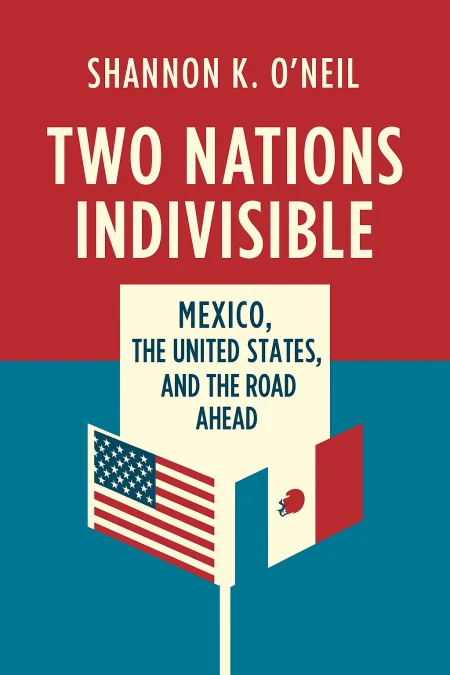
Two Nations Indivisible
Mexico, the United States and the Road Ahead
Book Edition Details
Summary
To many, the narrative of Mexico is clouded by the relentless drumbeat of violence and despair. Yet, beneath this grim facade lies a vibrant nation in the throes of a remarkable metamorphosis. In "Two Nations Indivisible," Shannon K. O'Neil peels back the layers of misconception to reveal a Mexico bustling with economic vigor, democratic strides, and an ascending middle class, intimately intertwined with the fortunes of the United States. O'Neil challenges the prevailing notion of a fractured relationship, urging a shift from antagonism to alliance. As America gazes southward, the stakes are nothing less than the intertwined destinies of two neighbors whose futures are inextricably linked. In this thought-provoking narrative, the call is clear: it's time for America to embrace the burgeoning promise that is modern Mexico.
Introduction
Picture a bustling border crossing where thousands of people pass daily, where families span two nations, and where the economic fortunes of two countries have become so intertwined that what happens in one immediately affects the other. This is the reality of U.S.-Mexico relations today, yet most Americans remain unaware of just how deeply connected our nations have become. This remarkable transformation reveals how two neighbors evolved from distant, often hostile relations to an unprecedented level of integration that touches every aspect of American life. The story that unfolds challenges conventional wisdom about Mexico's role in American prosperity and security. We discover how Mexican immigration has fundamentally reshaped American communities, often revitalizing declining cities and providing essential labor for key industries. We learn how Mexico's transformation from an authoritarian state to a vibrant democracy represents one of the most significant political changes in the Western Hemisphere. Perhaps most surprisingly, we see how Mexico's growing middle class and economic modernization offer tremendous opportunities for American businesses and workers, challenging outdated stereotypes about our southern neighbor. This exploration proves essential for anyone seeking to understand America's future, as demographic trends, economic realities, and security challenges make Mexico's success increasingly vital to American prosperity and stability. The human connections forged through migration, trade, and cultural exchange have created bonds that transcend political rhetoric, demanding new approaches to partnership in an interconnected world.
From Revolutionary Upheaval to Cold War Distance (1910-1988)
The relationship between Mexico and the United States began with territorial ambitions and military conflicts that would shape both nations for generations. When Mexico gained independence in 1821, it controlled vast territories including present-day Texas, California, Arizona, and New Mexico. However, the young Mexican nation struggled with political instability and economic challenges, creating opportunities for American expansion under the banner of manifest destiny. The Texas Revolution of 1836 and the Mexican-American War of 1846-1848 resulted in Mexico losing nearly half its territory to the United States. These traumatic events left deep scars in Mexican national consciousness, creating a narrative of American aggression that would influence Mexican politics for decades. The memory of General Winfield Scott raising the American flag over Mexico City's Chapultepec Castle became a symbol of national humiliation that Mexican leaders would invoke whenever they needed to rally patriotic sentiment against their northern neighbor. Yet beneath the surface of political tensions, economic ties were quietly growing stronger. During the Porfiriato period, American investors poured money into Mexican railroads, mines, and oil fields. The Mexican Revolution brought renewed conflict as the United States repeatedly intervened in Mexican affairs, supporting different factions and even sending troops across the border. The 1938 oil nationalization under President Lázaro Cárdenas represented Mexico's determination to control its own resources, leading to a boycott by American oil companies. World War II marked a turning point as both countries found common cause against fascism. The Bracero Program brought millions of Mexican workers to American farms and factories, creating migration networks that would prove lasting. However, the post-war period saw Mexico adopt a foreign policy of deliberate distance from the United States, as the ruling PRI party used anti-American rhetoric to justify its authoritarian control and inward-looking economic policies. This approach allowed Mexico to maintain political stability while avoiding the Cold War conflicts that engulfed other Latin American nations.
NAFTA Integration and Mexico's Democratic Awakening (1988-2000)
The 1982 debt crisis shattered Mexico's economic model and forced a fundamental reorientation toward the United States. As Mexico embraced market reforms and trade liberalization, the stage was set for NAFTA negotiations. The end of the Cold War removed ideological barriers to closer cooperation, while Mexico's democratization made partnership more palatable to American policymakers. By 1994, the two nations had created the world's most ambitious free trade agreement, permanently linking their economic futures in ways that neither government fully anticipated. The implementation of NAFTA coincided with Mexico's gradual transition from one-party rule to competitive democracy. The 1988 presidential election had already cracked the PRI's monopoly on power, and throughout the 1990s, opposition parties gained ground at local and state levels. The earthquake that struck Mexico City in 1985 had done more than topple buildings; it shattered the myth of PRI competence and opened space for civil society to emerge. As the government fumbled its response to the disaster, ordinary citizens organized rescue efforts, distributed aid, and demanded accountability. Economic integration deepened dramatically during this period, as trade between the two countries quadrupled and investment flows reached unprecedented levels. Mexican companies like Cemex and Bimbo expanded into U.S. markets, while American retailers like Walmart became major employers in Mexico. The growth of cross-border supply chains meant that many products were no longer made in America or made in Mexico but rather made in North America, with components crossing the border multiple times during manufacturing. The historic 2000 election of Vicente Fox marked the first peaceful transfer of power between parties in Mexican history, fulfilling the democratic aspirations of millions of citizens who had struggled for decades against authoritarian rule. Mexico's democratization process revealed both the promise and challenges of political transformation. New institutions like the Federal Electoral Institute ensured clean elections, while freedom of information laws opened government records to public scrutiny. An independent press emerged to challenge official narratives, and civil society organizations proliferated to advocate for various causes.
Middle Class Rise and Security Partnership Challenges (2000-Present)
The victory of Vicente Fox represented everything the old system was not: a former business executive who promised to bring Mexico fully into the modern world. Yet the transition from campaigning to governing proved more difficult than anticipated. Mexico's new democratic institutions, designed to prevent the concentration of power that had characterized the PRI era, also made it difficult to pass major reforms. While Fox succeeded in opening up government to public scrutiny and strengthening civil liberties, many of the structural reforms Mexico needed to boost competitiveness remained stalled. The challenges became even more acute under Fox's successor, Felipe Calderón, who took office in 2006 and immediately declared war on Mexico's powerful drug cartels. The decision to deploy the military against organized crime reflected both the weakness of civilian law enforcement and the growing threat posed by criminal organizations that had grown rich and powerful from the lucrative U.S. drug market. The resulting violence would claim tens of thousands of lives and test Mexico's democratic institutions in ways no one had anticipated. The September 11, 2001 attacks temporarily disrupted the momentum toward closer cooperation, as U.S. security concerns led to border restrictions that slowed trade and travel. The drug war that erupted revealed both the opportunities and challenges of the new relationship. Unlike previous security crises handled unilaterally by the United States, this threat required genuine cooperation. The Merida Initiative represented a new model of partnership, with both countries acknowledging their shared responsibility for the violence. Today's relationship reflects both achievements and limitations of decades of integration. Mexico has emerged as America's second-largest trading partner and a crucial ally in addressing regional challenges from migration to drug trafficking. The rise of Mexico's middle class has created new markets for American goods and services, while Mexican investment in the United States has grown substantially. Millions of Mexican-Americans serve as bridges between the two societies, contributing to American communities while maintaining ties to their ancestral homeland. Despite significant challenges, the underlying forces of integration continue to operate, creating ever-deeper connections that prove difficult for any government to reverse.
Summary
The story of U.S.-Mexico relations reveals a fundamental transformation from conflict to cooperation, driven by the inexorable forces of economic integration, demographic change, and shared challenges that transcend borders. What began as a relationship defined by territorial disputes and mutual suspicion has evolved into unprecedented interdependence that touches every aspect of both societies. The central tension throughout this history has been between the political impulse to maintain distance and control, and the economic and social forces that naturally draw the two nations together. This historical perspective offers crucial insights for contemporary policymakers and citizens. Attempts to wall off or isolate the two countries from each other have consistently failed and often produced unintended consequences that made problems worse rather than better. Mexico's success as a stable, prosperous democracy directly serves American interests, making support for Mexican institutions and civil society a strategic imperative rather than mere altruism. The demographic and economic trends reshaping both countries create opportunities for mutually beneficial cooperation that could strengthen both nations' competitive position in the global economy. The path forward requires abandoning zero-sum thinking in favor of policies that recognize shared interests and mutual dependence. Rather than viewing Mexico as a problem to be contained, Americans should see their southern neighbor as a partner whose success enhances their own prosperity and security. This means supporting comprehensive immigration reform, investing in border infrastructure that facilitates legitimate trade and travel, and working together to address common challenges like organized crime and climate change. The human connections forged over generations cannot be easily severed by enforcement alone, demanding new approaches that honor both nations' sovereignty while acknowledging their inseparable futures.
Related Books
Download PDF & EPUB
To save this Black List summary for later, download the free PDF and EPUB. You can print it out, or read offline at your convenience.
By Shannon K. O'Neil
