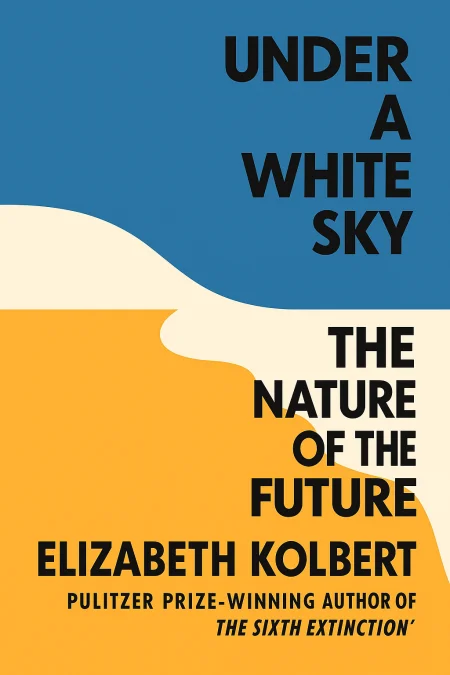
Under a White Sky
The Nature of the Future
Book Edition Details
Summary
What if the same ingenuity that pushed our planet to the brink could also be its saving grace? Elizabeth Kolbert, in her gripping work "Under a White Sky," traverses the thin line between catastrophe and redemption. As humanity's fingerprints mark the dawn of the Anthropocene, Kolbert embarks on a globe-spanning odyssey: from the Mojave Desert's last-stand sanctuary for an endangered fish to the innovative heart of Iceland where carbon emissions solidify into stone. Each stop illuminates the paradox of human intervention—once the villain, now the potential hero. In a world where climate solutions are as audacious as the problems they aim to solve, Kolbert's narrative weaves a tapestry of hope and hubris. By turns thought-provoking and darkly humorous, this book challenges readers to reconsider the dance of destruction and preservation in our quest to engineer a future worth living.
Introduction
Picture this: scientists in Nevada spend their days counting fish in a pool barely larger than your living room, while across the country in Illinois, engineers send thousands of volts through a river to stop invasive carp from swimming upstream. Meanwhile, researchers in Australia are breeding "super corals" designed to survive in increasingly acidic oceans, and in Iceland, machines are literally turning carbon dioxide into stone. These aren't scenes from science fiction—they're glimpses of our current reality, where the line between natural and artificial has become impossibly blurred. We live in the Anthropocene, an age where human influence has become so profound that we've fundamentally altered every system on Earth, from the deepest ocean trenches to the highest reaches of the atmosphere. This transformation has created a peculiar paradox: the very species that caused these massive environmental disruptions now finds itself frantically engineering solutions to problems it created, often discovering that each fix generates new complications. Through extraordinary stories of scientific ambition and environmental crisis, we'll explore how humanity has become both the planet's greatest disruptor and its most desperate caretaker, examining whether our technological prowess can truly repair what we've broken, or if we're simply creating an ever-more-complex web of artificial interventions.
Reversing Rivers and Engineered Ecosystems
The story of Chicago's relationship with water reveals how dramatically humans can reshape nature's most fundamental flows. In the early 1900s, the city faced a deadly crisis: sewage flowing into Lake Michigan, the same lake that supplied drinking water, creating regular outbreaks of cholera and typhoid. The solution was breathtakingly audacious—engineers literally reversed the Chicago River, forcing it to flow backward through a massive canal system, sending the city's waste toward the Mississippi River and the Gulf of Mexico instead of into the Great Lakes. This engineering marvel represented the pinnacle of early 20th-century confidence in humanity's ability to control nature. Yet this triumph of human engineering created unforeseen consequences that ripple through ecosystems today. The reversed river connected two massive drainage systems that had been separate for millions of years—the Great Lakes and the Mississippi River basin. This artificial connection became a highway for invasive species, allowing creatures like Asian carp to threaten the Great Lakes' delicate ecosystems. These remarkable fish, originally imported as a biological solution to control algae and weeds, have become ecological juggernauts, sometimes comprising three-quarters of all fish biomass in invaded waters. Their story illustrates a recurring theme: species introduced to solve one problem often become problems themselves. Today's response to the Asian carp invasion exemplifies our era's approach to environmental management. Engineers have installed electric barriers in the canal, sending thousands of volts through the water to deter fish while allowing boats to pass. Teams of biologists conduct "barrier defense," netting millions of pounds of carp annually. Scientists explore everything from genetic modifications to specialized pheromones to control these aquatic invaders. Each intervention spawns new interventions in an endless cycle of technological solutions to technological problems. The Chicago River's story encapsulates a larger truth about the Anthropocene: we've moved far beyond the point where we can simply "leave nature alone." Instead, we find ourselves managing increasingly complex hybrid systems that are neither fully natural nor entirely artificial. Every major river system, every ecosystem, bears the mark of human intervention, requiring ever-more-sophisticated management to maintain some semblance of ecological balance in a world we've fundamentally altered.
Species Rescue and Genetic Intervention
In the remote Nevada desert, a single species of fish smaller than your thumb has become the focus of one of the most intensive conservation efforts in history. The Devils Hole pupfish lives in just one location on Earth—a water-filled limestone cavern about the size of a small swimming pool. This tiny fish, whose entire habitat could fit in most people's backyards, represents the extreme end of species conservation in the Anthropocene. When groundwater pumping threatened their survival in the 1970s, scientists didn't just protect their habitat—they built an exact replica of their home, complete with artificial lighting systems, computer-controlled water chemistry, and round-the-clock monitoring. The pupfish sanctuary reveals how far we've traveled from traditional conservation. These fish now depend entirely on human intervention for survival, from supplemental feeding to genetic management of their captive population. Their story mirrors that of countless other species worldwide—from California condors to black-footed ferrets—that exist only because of intensive human support. We've created what might be called "Stockholm species," creatures so dependent on their human rescuers that they cannot survive without constant technological intervention. This dependency has pushed conservation science into uncharted territory. Researchers now routinely employ techniques that would have been pure science fiction just decades ago: genetic engineering to create disease-resistant species, assisted evolution to help organisms adapt to rapidly changing environments, and even synthetic biology to resurrect lost genetic diversity. In Australia, scientists are developing "super corals" designed to withstand ocean acidification and warming temperatures by breeding heat-tolerant varieties and engineering their symbiotic algae for greater resilience. Perhaps most dramatically, new genetic tools like CRISPR are enabling scientists to create "gene drives"—genetic modifications that spread automatically through wild populations. Researchers are developing gene-drive mosquitoes that could eliminate malaria-carrying species, gene-drive mice that could clear invasive rodents from islands, and gene-drive toads that could reduce the impact of Australia's cane toad invasion. These technologies represent a fundamental shift from protecting nature as we found it to actively redesigning it for survival in a human-dominated world. The question is no longer whether we should intervene in natural systems, but how extensively we're willing to engineer them to preserve what we value.
Climate Engineering and Atmospheric Control
The atmosphere itself has become humanity's most ambitious engineering project, though largely by accident. Since the Industrial Revolution, we've altered the chemical composition of the air so dramatically that climate scientists can measure our influence in ice cores and tree rings around the world. Now, faced with the consequences of this inadvertent geoengineering, some researchers are proposing we take conscious control of the planet's climate systems through technologies that sound like science fiction but may soon become necessity. Solar geoengineering represents perhaps the most audacious proposal: deliberately injecting reflective particles into the upper atmosphere to block incoming sunlight and cool the planet. The inspiration comes from volcanoes, which have cooled Earth's climate throughout history by hurling sulfur compounds into the stratosphere. Mount Tambora's 1815 eruption, for instance, caused global cooling so severe that 1816 became known as the "year without a summer." Scientists propose using aircraft to spray particles like calcium carbonate or even microscopic diamonds into the stratosphere, essentially creating artificial volcanic winters to counteract global warming. Meanwhile, other researchers are working on removing carbon dioxide directly from the atmosphere using massive machines that function like industrial-scale trees. These direct air capture facilities use chemical processes to pull CO2 from ambient air, then either bury it underground where it mineralizes into rock, or sell it to industries that can use the gas. In Iceland, one such facility has been turning atmospheric carbon dioxide into stone for several years, though the scale remains tiny compared to global emissions. Scaling up these technologies would require industrial efforts comparable to rebuilding the world's entire energy system. The allure of these planetary-scale interventions lies in their potential speed and scope. While reducing emissions requires transforming human civilization—no small task—geoengineering technologies could theoretically cool the planet or remove carbon within years rather than decades. However, they also represent a profound philosophical shift: accepting that humans have become the planet's thermostat operators, permanently responsible for maintaining Earth's climate systems. Once we begin deliberately manipulating the atmosphere, stopping could trigger rapid, catastrophic warming as all the previously masked heat accumulates at once. We would be committing ourselves and all future generations to actively managing the planet's climate systems forever, turning Earth into a kind of life-support system that requires constant technological maintenance.
Summary
The central revelation of our environmental age is both humbling and terrifying: we have become nature's unwitting controllers, and there may be no way back to a world that manages itself. Every intervention we make to fix environmental problems seems to generate new complications requiring further intervention, creating an ever-expanding web of technological dependencies that extends from the smallest desert pools to the planet's entire atmosphere. We find ourselves in the strange position of engineering artificial rivers, breeding designer corals, and contemplating the deliberate manipulation of sunlight itself—all in service of preserving something we can no longer honestly call "natural." This reality raises profound questions about the kind of world we want to inhabit and leave to future generations: Should we embrace our role as planetary gardeners and engineer Earth's systems with increasing sophistication, or is there still hope for stepping back from the controls and allowing natural processes to reassert themselves? Perhaps most importantly, how do we make these momentous decisions wisely when every choice seems to lead deeper into a maze of unintended consequences, and the stakes could not be higher for all life on Earth?
Related Books
Download PDF & EPUB
To save this Black List summary for later, download the free PDF and EPUB. You can print it out, or read offline at your convenience.
By Elizabeth Kolbert
