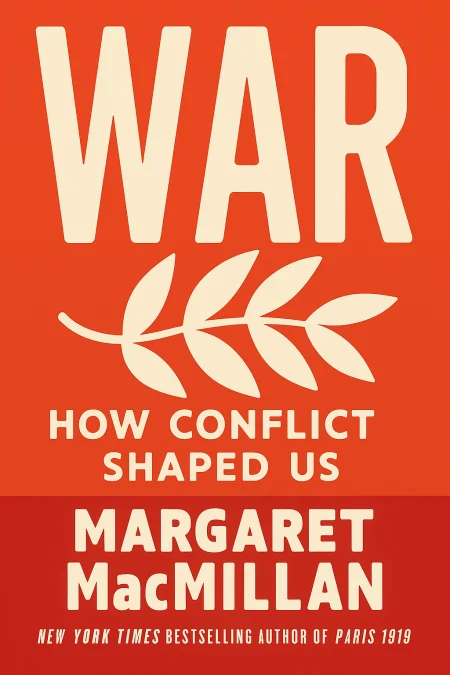
War
How Conflict Shaped Us
Book Edition Details
Summary
In the grand theater of human history, war stands as both a ruthless choreographer and an indomitable muse. Margaret MacMillan, renowned for her incisive historical insights, unravels this paradox in her compelling exploration of conflict's pervasive grip on civilization. With a piercing gaze, she examines war's dual nature—its capacity to birth both darkness and heroism—and how it has woven itself into the very fabric of our societies, ideologies, and identities. Why does this ancient dance of destruction continue to captivate us? Through a tapestry of historical reflections, from the dawn of organized combat to modern confrontations, MacMillan challenges us to confront the unsettling reality: Is warfare an immutable human condition, or can we, at last, rewrite the script? War: How Conflict Shaped Us invites readers to ponder profound questions about the essence of human nature and the enigmatic allure of conflict.
Introduction
Imagine standing on the blood-soaked plains of Gettysburg in 1863, where over 50,000 men fell in three days of fighting, or witnessing the moment when gunpowder first thundered across medieval battlefields, forever changing the balance of power between knight and commoner. These pivotal moments reveal a profound paradox that has shaped human civilization for millennia: war, despite its terrible cost in human suffering, has served as one of the most powerful engines of social transformation, technological innovation, and political evolution in our species' history. This exploration traces the intricate relationship between organized violence and human progress, examining how conflicts have repeatedly catalyzed developments that peaceful societies might never have achieved. Why did the citizen armies of revolutionary France prove so devastatingly effective against the professional forces of Europe's old regimes? How did the Industrial Revolution transform warfare from limited conflicts between professional armies into total wars that consumed entire societies? What explains the curious fact that periods of intense military competition have often coincided with remarkable advances in medicine, technology, and social organization? These questions will captivate anyone seeking to understand the forces that have shaped our modern world, from students of history fascinated by the unexpected consequences of human conflict to policy makers grappling with contemporary security challenges. The journey reveals uncomfortable truths about human nature while illuminating how the very struggles that have caused immense destruction have also forged the institutions, technologies, and social bonds that define civilization itself.
Ancient Foundations: Violence and the Rise of Early States
The story of organized warfare begins not with the clash of bronze swords or the thunder of cavalry charges, but in the quiet revolution that occurred when our ancestors abandoned their nomadic existence for the settled life of agriculture. Around 10,000 years ago, the development of farming created the first great paradox of human civilization: the very settlements that allowed culture and technology to flourish also made systematic violence inevitable. Farmers, unlike nomadic hunters, possessed valuable assets that could be stolen and defended, stored grain and livestock that represented concentrated wealth worth fighting over. Archaeological evidence from across the ancient world tells a consistent story of escalating violence as human societies grew more complex. The discovery of mass graves filled with arrow-pierced skeletons at sites like Talheim in Germany and Crow Creek in South Dakota reveals that prehistoric warfare was neither rare nor small-scale. These early conflicts weren't random brutality but organized campaigns that required planning, leadership, and sophisticated understanding of tactics and terrain. The fortified settlements that began appearing across Europe and the Middle East around 7,000 years ago demonstrate that our ancestors quickly learned to organize their communities around the twin necessities of production and protection. From these violent crucibles emerged the world's first states, political entities that existed primarily to organize and direct collective violence more effectively than their neighbors. The Assyrian Empire, stretching from the Persian Gulf to the Nile Delta, functioned essentially as a military machine designed to extract tribute from conquered peoples while defending against rival powers. Assyrian kings derived their legitimacy not from divine bloodlines or popular consent but from their success in war, creating administrative systems and military innovations that would influence statecraft for centuries. Their development of iron weapons, siege engines, and professional officer corps established patterns that would be refined by subsequent empires from Rome to China. The Roman legions represented the culmination of ancient military organization, creating not just an army but an entire system of governance based on disciplined violence. Roman success stemmed not from superior individual warriors but from their ability to create institutions that could sustain military effort across generations and vast distances. Their roads, originally built for moving troops, became the arteries of commerce and communication that bound the empire together. Their legal systems, developed to govern conquered territories, provided frameworks for justice that persist in modern law. The Roman example demonstrates how military necessity could drive innovations in engineering, administration, and law that far outlasted the empire itself.
Industrial Revolution: Mass Mobilization and Total War (1800-1945)
The French Revolution's levée en masse in 1793 announced a terrifying new reality to the crowned heads of Europe: entire populations could now be mobilized for war. When revolutionary France declared that all citizens must contribute to national defense, it unleashed forces that would transform warfare from the limited conflicts of the 18th century into the total wars that would define the modern era. The sight of citizen-soldiers singing revolutionary songs as they marched to battle represented something unprecedented in European history, a fusion of popular enthusiasm with military power that professional armies struggled to comprehend or counter. The Industrial Revolution provided the technological foundation that made mass warfare devastatingly effective. Steam-powered factories could produce weapons and ammunition on scales never before imagined, while railways could transport entire armies across continents in days rather than months. The telegraph allowed commanders to coordinate operations across vast distances, fundamentally altering the pace and scope of military campaigns. The American Civil War offered a preview of industrial warfare's potential, as Union factories outproduced their Confederate counterparts while railroad networks determined strategic mobility. The conflict's casualty figures, dwarfing previous American wars, foreshadowed the human cost of mechanized violence. By the time Europe erupted into the Great War in 1914, the marriage of industrial capacity with national mobilization had created an entirely new form of conflict that consumed entire societies. Nearly 70 million men were mobilized into the armed forces of the major powers, while civilian populations found their daily lives transformed by rationing, factory work, and government control over previously private activities. The Western Front became a laboratory for military innovation, spawning new weapons from poison gas to tanks, while the home fronts were reorganized as vast production centers dedicated to feeding the insatiable appetite of modern warfare. The Second World War pushed these trends to their logical extreme, as strategic bombing campaigns deliberately targeted civilian populations and entire ethnic groups were marked for systematic extermination. The Holocaust represented the horrifying application of industrial efficiency to mass murder, while the atomic bombs dropped on Japan demonstrated that humanity had acquired the power to destroy civilization itself. These developments forced a fundamental reconsideration of warfare's role in human affairs, leading to new international institutions and legal frameworks designed to prevent such catastrophes from recurring. The terrible irony of total war was becoming clear: the same organizational capabilities and technological innovations that made conflict more destructive also drove remarkable advances in medicine, communications, and social organization.
Modern Era: Nuclear Age to Cyber Warfare (1945-Present)
The mushroom clouds over Hiroshima and Nagasaki ushered in a paradoxical era in which the most powerful weapons ever created would serve primarily as deterrents rather than instruments of war. The Cold War between the United States and Soviet Union demonstrated how the threat of mutual annihilation could impose a strange kind of stability on international relations, even as proxy conflicts raged across the developing world. Nuclear weapons fundamentally altered the calculus of great power competition, creating a balance of terror that channeled rivalry into technological races, intelligence operations, and ideological struggles rather than direct military confrontation. This period witnessed the emergence of new forms of warfare that challenged traditional concepts of battlefield and victory. The American experience in Vietnam revealed how technological superiority could prove ineffective against determined opponents fighting on their home territory with popular support. Guerrilla warfare, refined by movements from Algeria to Afghanistan, demonstrated that weaker powers could use asymmetric tactics to neutralize conventional military advantages. These conflicts highlighted the growing importance of public opinion and media coverage in democratic societies, where television images of distant wars could shape domestic politics and military strategy. The digital revolution has opened entirely new domains of conflict that exist beyond traditional geographic boundaries. Cyber warfare allows nations and non-state actors to attack critical infrastructure, steal sensitive information, and manipulate public opinion without firing a shot or crossing a border. The 2007 cyber attacks on Estonia and the Stuxnet virus that damaged Iran's nuclear program demonstrated that future conflicts might be won or lost in cyberspace rather than on conventional battlefields. These developments have forced military planners to reconceptualize fundamental concepts like territory, sovereignty, and the nature of military force itself. Contemporary warfare increasingly involves non-state actors who operate according to different rules and pursue different objectives than traditional nation-states. Terrorist organizations like Al-Qaeda and ISIS have shown how modern communications technology and transportation networks can be exploited to project power across vast distances while recruiting followers through social media platforms. Their willingness to target civilians deliberately and their ability to inspire attacks by individuals with no direct organizational connection represent new challenges for established military and political institutions. Meanwhile, the development of autonomous weapons systems and artificial intelligence raises profound questions about the future role of human decision-making in warfare, as machines become capable of identifying and engaging targets without human intervention.
Summary
The central paradox that emerges from this historical survey is both disturbing and undeniable: war has served simultaneously as humanity's greatest curse and one of its most powerful engines of progress. From the earliest agricultural settlements that required fortification against raiders to the modern nation-states that emerged from centuries of military competition, organized violence has shaped political institutions, driven technological innovation, and forged social bonds that define civilization itself. The Roman roads that connected an empire, the medical advances that emerged from treating battlefield wounds, and the organizational techniques developed to supply armies across vast distances all demonstrate how military necessity has repeatedly catalyzed developments that benefited far beyond their original martial purposes. This historical perspective offers crucial insights for navigating our contemporary challenges. We must recognize that the human capacity for both cooperation and conflict is deeply embedded in our nature and institutions, making attempts to eliminate warfare entirely noble but potentially unrealistic without addressing underlying sources of competition and fear between groups. The most effective path toward peace may lie not in wishful thinking but in creating international institutions strong enough to manage conflicts before they escalate to violence, while developing technologies and social systems that channel competitive energies into constructive rather than destructive directions. Understanding war's role in human development should make us more thoughtful about how we organize societies and conduct international relations in an age of cyber warfare and autonomous weapons. The challenge is to harness the organizational capabilities and innovative energies that military competition has historically unleashed while finding less destructive outlets for human creativity and ambition. Only by honestly confronting our violent past and understanding how it has shaped our present can we hope to build institutions and technologies that serve human flourishing rather than human destruction.
Related Books
Download PDF & EPUB
To save this Black List summary for later, download the free PDF and EPUB. You can print it out, or read offline at your convenience.
By Margaret MacMillan
