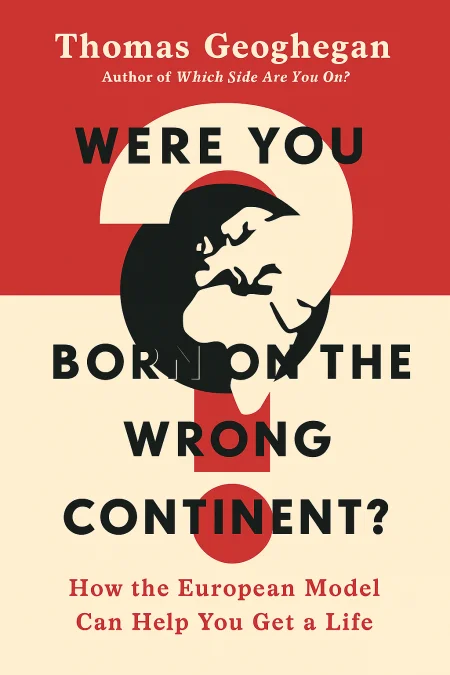
Were You Born on the Wrong Continent?
How the European Model Can Help You Get a Life
Book Edition Details
Summary
In a world where American hustle meets European leisure, Thomas Geoghegan embarks on an insightful quest to unravel a profound cultural conundrum: could a life under Europe’s social democracy eclipse the American dream? With wit and keen observation, this labor lawyer turned author escapes the grind of his homeland for the cobbled streets and convivial cafes of Europe. From France’s romanticized policies to Germany’s understated yet revolutionary worker empowerment, Geoghegan dissects and challenges the economic narratives we've long held dear. By contrasting vacation days, parental leave, and life expectancy, he paints a vivid picture of a continent thriving on collective prosperity. "Were You Born on the Wrong Continent?" isn’t just a travelogue; it's a daring examination of the policies that could redefine well-being and competitiveness in the 21st century. Dive into this captivating exploration and question where true prosperity lies.
Introduction
Picture this: In the winter of 1997, as unemployment soared past four million and economists declared the German model obsolete, few could have predicted that this struggling nation would emerge as Europe's economic powerhouse within a decade. The story that unfolds challenges everything we thought we knew about capitalism, competition, and the relationship between worker welfare and economic success. This journey through Europe's social democratic experiment reveals three profound questions that define our modern economic landscape: Can advanced societies maintain both prosperity and equality in an age of ruthless global competition? What happens when workers gain real power in corporate boardrooms, and does democracy in the workplace actually strengthen or weaken economic performance? Perhaps most intriguingly, can a nation build competitive advantage precisely by refusing to compete on the basis of low wages and weak worker protections? The insights here speak directly to anyone grappling with economic anxiety, work-life balance, or the growing sense that our current system leaves too many behind. Whether you're a policy maker wrestling with globalization's challenges, a business leader seeking sustainable competitive strategies, or simply someone curious about how other societies organize their economies, this exploration offers both hope and hard-won wisdom about what becomes possible when we dare to imagine alternatives to winner-take-all capitalism.
Building the Rhineland Alternative: Post-War Social Democratic Foundations (1945-1997)
In the rubble of post-war Germany, something extraordinary was taking shape that would challenge Anglo-American capitalism for decades to come. As Allied administrators oversaw reconstruction, they didn't simply restore the old economic order. Instead, they helped create what economists would later call "Rhineland capitalism," a system built on three revolutionary pillars: works councils that gave employees real power over workplace decisions, corporate boards where workers held half the seats, and industry-wide wage bargaining that prevented companies from competing by grinding down their workforce. The genius of this system emerged from the most practical of concerns. How do you prevent the kind of economic desperation that had fed fascism? How do you create prosperity that doesn't depend on treating workers as disposable inputs? The answer was radical democracy in the workplace, giving ordinary employees a voice in the decisions that shaped their daily lives and economic futures. By the 1970s and 1980s, this model was producing results that seemed to defy economic orthodoxy. German workers were taking six weeks of vacation, retiring comfortably, and sending their children to university without debt, all while their companies dominated global markets in precision manufacturing and engineering. The secret wasn't just high productivity, but a system that channeled competition away from wage-cutting toward innovation and quality. Yet even as Germany became an export powerhouse, critics regularly predicted its collapse. The business press argued that global competition would inevitably force Germany to abandon its "inflexible" labor markets. By the mid-1990s, with unemployment rising and reunification costs mounting, it seemed the critics might finally be proven right. The stage was set for a test that would determine whether social democracy could survive in a globalized world.
The Globalization Challenge: German Model Under Economic Pressure (1997-2005)
The winter of 1997 found Germany in its darkest hour since reconstruction. Unemployment had soared past 4.7 million, earning comparisons to the Weimar Republic's final days. In Washington and London, economists were proclaiming the triumph of flexible labor markets and financial deregulation. Germany's commitment to worker participation and social protection suddenly looked like expensive luxuries in a world where capital flowed freely to wherever labor was cheapest. Walking through German cities during this period, one could feel the weight of doubt settling over the social democratic experiment. Even committed Europeans wondered whether their model had become obsolete. The costs of integrating East Germany had arrived just as global competition was intensifying, creating a perfect storm of fiscal pressure and economic uncertainty. Yet beneath the surface gloom, something more complex was happening. German companies weren't abandoning their commitment to quality manufacturing; they were doubling down on it. Unable to compete on labor costs, they were forced to compete on innovation, precision, and the kind of sophisticated engineering that only comes from highly skilled, stable workforces. The very "inflexibility" that critics condemned was pushing German industry up the value chain. The period also revealed the deeper cultural foundations of the German model. Even as politicians debated reforms, the basic institutions of worker participation remained intact. Half a million Germans continued to serve on works councils, gaining experience in democratic decision-making that extended far beyond the workplace. This wasn't just an economic system; it was a form of civic education that created citizens capable of thinking collectively about their society's future, preparing Germany for the transformation that lay ahead.
Crisis as Validation: Financial Collapse and Social Democracy's Resilience (2005-2010)
The election of Angela Merkel in 2005 was supposed to mark the end of the German model. Hailed as Germany's Margaret Thatcher, she was expected to dismantle social protections and embrace Anglo-American capitalism. Instead, something unexpected happened. Forced into coalition with Social Democrats, Merkel found herself defending the very system she was meant to reform. More surprisingly, as the global financial crisis unfolded, Germany's supposedly obsolete model began to look remarkably prescient. While American and British banks collapsed under the weight of their own speculation, German banks remained relatively stable, constrained by regulations that had seemed antiquated just years before. While unemployment soared in the flexible labor markets of the United States and United Kingdom, Germany's employment levels held steady, supported by programs that kept workers connected to their employers even during downturns. The crisis revealed the hidden costs of the Anglo-American model's apparent efficiency. Countries that had embraced financial deregulation and labor market flexibility found themselves with hollowed-out manufacturing sectors and workforces ill-equipped for high-skilled competition. Germany, by contrast, had maintained its industrial base precisely because its "inflexible" institutions made it costly for companies to abandon manufacturing for financial speculation. By 2010, the tables had turned completely. Germany was running trade surpluses while America ran deficits. German workers were taking their six weeks of vacation while American workers worried about losing their jobs. The country that was supposed to be the sick man of Europe had become its economic engine. The lesson was unmistakable: in a world of increasing complexity and uncertainty, the patient work of building institutions that balance market forces with human needs wasn't just morally superior, it was economically superior as well.
The American Question: Lessons from Europe's Alternative Capitalism
Germany's journey from crisis to competitiveness offers profound lessons for other advanced economies struggling to balance market efficiency with social cohesion. The German experience demonstrates that worker participation in corporate governance, far from being an obstacle to competitiveness, can actually enhance it by fostering cooperation, skill development, and long-term strategic thinking. Companies with worker representation proved more resilient during the financial crisis and more innovative in their responses to global challenges. The German approach to education and training provides another crucial insight. Rather than simply pushing more students toward university education, Germany maintained its dual system of academic and vocational training, ensuring that workers at all skill levels could contribute to a high-value economy. This approach recognized that not every job requires a college degree, but every job deserves dignity and adequate compensation, creating a workforce capable of producing the high-quality goods that command premium prices in global markets. Perhaps most importantly, Germany's experience shows that economic reform need not mean abandoning social solidarity. The country's leaders recognized that maintaining public support for economic change required ensuring that the benefits of growth were broadly shared. This meant preserving strong safety nets while encouraging work, maintaining collective bargaining while allowing flexibility, and supporting both innovation and stability. The German model faces ongoing challenges, including demographic pressures and the need for continued adaptation to technological change. However, its success in combining economic dynamism with social cohesion offers hope that advanced democracies can chart a middle course between unfettered capitalism and stifling statism. For any nation seeking to build a more inclusive and sustainable form of capitalism, the lessons from Germany's transformation remain profoundly relevant.
Summary
The story of European social democracy, as seen through Germany's remarkable transformation, reveals a fundamental truth about modern capitalism: there is no single path to prosperity, and the most competitive economies are often those that invest most heavily in their people and institutions. The decades-long experiment in Rhineland capitalism demonstrates that societies can choose to organize their economies around human flourishing rather than pure market efficiency, and not only survive but thrive in global competition. The central tension that runs through this history is between two visions of progress. One sees human beings as inputs to be optimized, costs to be minimized, and flexibility as the highest virtue. The other sees human beings as the purpose of economic activity, with stability, dignity, and democratic participation as goals worth pursuing even at the cost of some theoretical efficiency. Germany's experience suggests that this second path may actually be a prerequisite for sustainable prosperity in our complex, interconnected world. For those grappling with today's economic challenges, this history offers three crucial insights. First, alternative forms of capitalism are not only possible but can prove more successful than winner-take-all models. Second, building such alternatives requires patient institutional work and the wisdom to preserve what works while adapting what doesn't. Third, the choice between efficiency and equity may be false; systems designed around human needs often prove more resilient and productive than those designed around abstract market principles. The nations that care most for their people frequently prove most capable of competing with the world.
Related Books
Download PDF & EPUB
To save this Black List summary for later, download the free PDF and EPUB. You can print it out, or read offline at your convenience.
By Thomas Geoghegan
