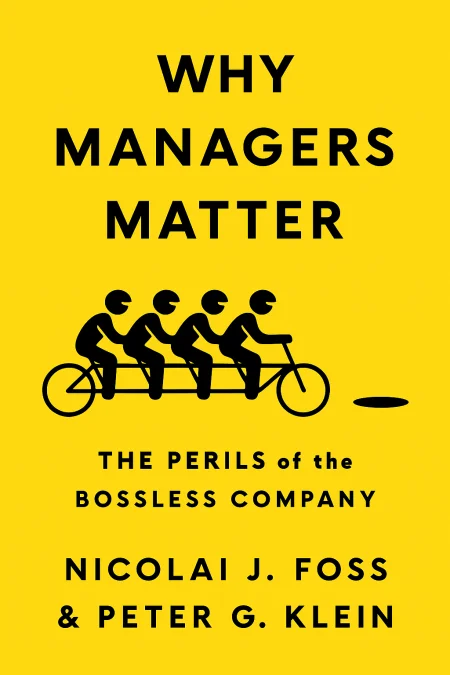
Why Managers Matter
The Perils of the Bossless Company
byNicolai J. Foss, Peter G. Klein
Book Edition Details
Summary
Managers in the modern workplace find themselves at a crossroads, seduced by the allure of trendy, bossless utopias where whimsy reigns supreme. Nicolai J. Foss and Peter G. Klein, however, puncture these illusions with a provocative argument for the enduring necessity of hierarchy. In "Why Managers Matter," they unravel the paradox where too much freedom leads to chaos and micromanagement, while strategic authority fosters creativity and adaptability. Through vivid examples, the authors reveal how an intelligently structured hierarchy doesn't stifle innovation but rather amplifies it, especially amidst the whirlwind of AI advancements and economic upheaval. Foss and Klein’s insights come as a clarion call, underscoring that the artful balance of leadership and order can be the key to thriving in an unpredictable world.
Introduction
The contemporary business landscape has become enchanted with a compelling narrative: organizations can flourish without traditional management structures, liberating employees to self-organize and eliminating hierarchical authority entirely. This vision promises freedom from bureaucratic constraints while unleashing human potential through radical decentralization. Yet beneath these attractive stories lies a fundamental misunderstanding of how complex organizations actually function and create value in practice. The evidence reveals a striking disconnect between the rhetoric of "bossless" companies and the reality of organizational effectiveness. While certain highly publicized examples appear to validate flat structures, deeper examination exposes the selective nature of these cases and the hidden hierarchies that inevitably emerge within supposedly egalitarian systems. The challenge lies not in abandoning organizational structure altogether, but in understanding when and how different forms of authority serve essential coordinating functions that cannot be replicated through informal arrangements. Through systematic analysis of both successful and failed attempts at radical decentralization, clear patterns emerge that illuminate the true relationship between hierarchy and performance. This examination reveals that the most effective organizations are not those that eliminate authority structures, but those that deploy them strategically, adapting hierarchical frameworks to meet the specific demands of their environment, technology, and workforce. The path forward requires moving beyond simplistic narratives toward a nuanced understanding of how organizational design fundamentally shapes human collaboration and innovation in complex environments.
The Myth of Bossless Organizations: Hidden Hierarchies and Selective Evidence
The modern fascination with eliminating management stems from a fundamental misreading of organizational dynamics and human behavior patterns. Companies like Valve Corporation and Zappos have been celebrated as pioneers of self-management, yet their experiences reveal the inherent limitations of radical decentralization. When Valve employees describe their workplace as resembling "high school" with invisible cliques and power struggles, they illuminate the reality that formal hierarchy often gives way to informal dominance structures that lack transparency and accountability mechanisms. The theoretical foundation for bossless organizations rests on several questionable assumptions about human nature and organizational complexity. Proponents argue that educated knowledge workers naturally self-organize toward optimal outcomes, but this perspective ignores the coordination challenges that emerge when multiple individuals pursue different objectives without clear decision-making authority. The absence of formal structure does not eliminate power relationships; it merely obscures them, often creating environments where influence flows to those most skilled at informal political maneuvering rather than those best equipped to make sound decisions. Historical attempts at creating egalitarian organizations consistently demonstrate the emergence of what sociologists term the "iron law of oligarchy." Even movements explicitly committed to democratic principles eventually develop leadership structures, as the practical demands of coordination and decision-making overwhelm idealistic intentions. The pattern repeats across contexts: revolutionary organizations, cooperative enterprises, and technology companies all discover that someone must ultimately bear responsibility for difficult choices and resource allocation decisions. The most revealing aspect of supposedly bossless companies is how they handle crisis situations and rapid market changes. When faced with existential threats or urgent adaptation requirements, these organizations invariably centralize decision-making authority, often in the hands of founders or informal leaders who had been exercising influence throughout the organization all along. This pattern suggests that hierarchical authority serves essential functions that become apparent only when organizations face genuine challenges to their survival and long-term effectiveness.
The Fundamental Functions of Hierarchy: Coordination and Cooperation
Complex organizations face two fundamental challenges that market mechanisms alone cannot effectively resolve: coordination and cooperation. Coordination involves determining what tasks need to be accomplished, by whom, when, and in what sequence to achieve collective objectives. Cooperation requires motivating individuals to execute these tasks effectively, even when doing so may not align perfectly with their immediate self-interest or personal preferences. Hierarchical structures provide proven mechanisms for addressing both challenges simultaneously while maintaining organizational coherence. The coordination function of hierarchy becomes most apparent in situations requiring rapid adaptation to changing external circumstances. When market conditions shift unexpectedly, organizations need mechanisms for quickly realigning resources and priorities across multiple departments or teams without lengthy negotiation processes. Market-based coordination through price signals works well for routine transactions between independent parties, but proves inadequate for the complex interdependencies that characterize modern organizational activities. A hierarchical authority structure enables swift decision-making and implementation when time-sensitive responses are required for competitive survival. The cooperation challenge emerges from the reality that individual optimization does not automatically produce collective optimization outcomes. Even well-intentioned employees may pursue local objectives that undermine broader organizational goals, not from malice but from incomplete information about system-wide effects and interdependencies. Hierarchical monitoring and incentive systems provide mechanisms for aligning individual behavior with organizational objectives, while also creating accountability structures that ensure decisions can be traced, evaluated, and improved over time. Modern technology has certainly reduced some coordination costs, enabling more distributed decision-making in specific operational contexts. However, this technological capability does not eliminate the need for hierarchical oversight; instead, it changes the optimal balance between centralized and decentralized authority within organizational systems. Successful organizations use technology to enhance rather than replace managerial coordination, creating information systems that support better decision-making at multiple organizational levels while maintaining clear lines of accountability and strategic authority that ensure coherent action across diverse activities.
When Flat Structures Work: Specific Conditions and Rare Contingencies
Flat organizational structures can indeed prove effective, but only under specific and relatively rare conditions that most businesses do not encounter in their operational environments. The key contingency factor is modularity: when work can be broken down into independent components that require minimal coordination between different parts of the organization. Companies like Morning Star, the tomato processing firm often cited as a paragon of self-management, succeed with flat structures because their production processes are linear, predictable, and involve standardized activities that can be governed by detailed contracts between employees rather than ongoing managerial oversight. The concept of organizational complementarities reveals why structural design cannot be reduced to simple prescriptions about hierarchy versus flatness. Successful flat organizations require carefully designed systems of incentives, performance measurement, conflict resolution, and cultural norms that work together systematically to substitute for traditional management functions. When companies adopt only surface-level aspects of flat organization—eliminating job titles or management layers—without implementing these complementary elements, the result is often operational chaos rather than employee empowerment and improved performance. Technology plays a crucial role in determining when flat structures remain viable over extended periods. Valve's success with minimal formal hierarchy depends heavily on highly modular software development processes where small teams can work independently on discrete components without constant coordination. The company's digital distribution platform creates natural boundaries between different activities, reducing the need for ongoing managerial coordination while maintaining product coherence. However, even Valve maintains powerful informal hierarchies and relies on sophisticated performance evaluation systems that concentrate significant decision-making power in the hands of senior employees and the founder. The failure of many flat organization experiments can be traced to fundamental misunderstanding of these structural contingencies and complementarities. Zappos's adoption of Holacracy created bureaucratic overhead rather than eliminating it, as employees spent increasing amounts of time in meetings trying to coordinate activities that had previously been managed efficiently through traditional authority relationships. The company's eventual retreat from this model illustrates how organizational structure must fit the specific operational demands of the business rather than conforming to ideological preferences about hierarchy and authority distribution.
Hierarchy as Innovation Driver: Authority Enabling Rather Than Constraining Performance
Contrary to widespread assumptions, hierarchical organizations often demonstrate superior innovative capacity compared to their flatter counterparts when examined over extended time periods. The apparent contradiction dissolves when we recognize that innovation requires not just creative freedom, but also strategic resource allocation, systematic risk management, and long-term direction setting. Large hierarchical organizations possess the financial resources and institutional capabilities necessary to pursue ambitious multi-year research projects that smaller, flatter organizations cannot sustain through market fluctuations and competitive pressures. The innovation process itself benefits from hierarchical structure in several interconnected ways that flat organizations struggle to replicate. Senior managers provide strategic vision and resource allocation decisions that enable research teams to focus on promising directions rather than constantly competing for attention and funding from multiple stakeholders. Middle managers serve crucial bridging functions, translating between technical specialists and strategic leadership while providing the institutional continuity necessary for complex development projects that span multiple years and require sustained commitment despite temporary setbacks. Historical evidence strongly supports the innovative capacity of well-designed hierarchical organizations across multiple industries and time periods. Bell Labs, operating within the highly structured AT&T corporation, produced fundamental technological breakthroughs including the transistor, laser, and photovoltaic cell that transformed entire industries. More recently, companies like Google have created innovative products through structured research divisions that operate within clear hierarchical frameworks while maintaining significant operational autonomy for individual researchers and development teams working on specific projects. The key insight is that successful innovation requires balancing exploration of new possibilities with exploitation of existing capabilities and market positions. Organizations must continue improving existing products and services while simultaneously investigating radically new directions that may not pay off for years. This balance proves difficult to achieve through purely decentralized processes, which tend to favor either short-term optimization or undirected experimentation without strategic coherence. Hierarchical structures provide the governance mechanisms necessary to maintain productive tension between these competing demands, ensuring that innovative efforts serve broader strategic objectives while preserving adequate space for creative exploration and calculated risk-taking.
Summary
The enduring value of hierarchy lies not in its capacity to control human behavior through rigid command structures, but in its ability to coordinate complex activities and align diverse interests toward common objectives that no individual could achieve alone. While the specific forms of hierarchical authority must evolve continuously to meet changing technological and competitive conditions, the fundamental functions of coordination and cooperation that hierarchy serves remain essential for organizational effectiveness in complex environments. The most successful organizations of the future will be those that thoughtfully adapt their hierarchical structures rather than abandoning them entirely, creating sophisticated frameworks that harness human potential while maintaining the strategic direction, resource allocation capabilities, and accountability mechanisms that ambitious collective endeavors require for sustained success.
Related Books
Download PDF & EPUB
To save this Black List summary for later, download the free PDF and EPUB. You can print it out, or read offline at your convenience.
By Nicolai J. Foss
