
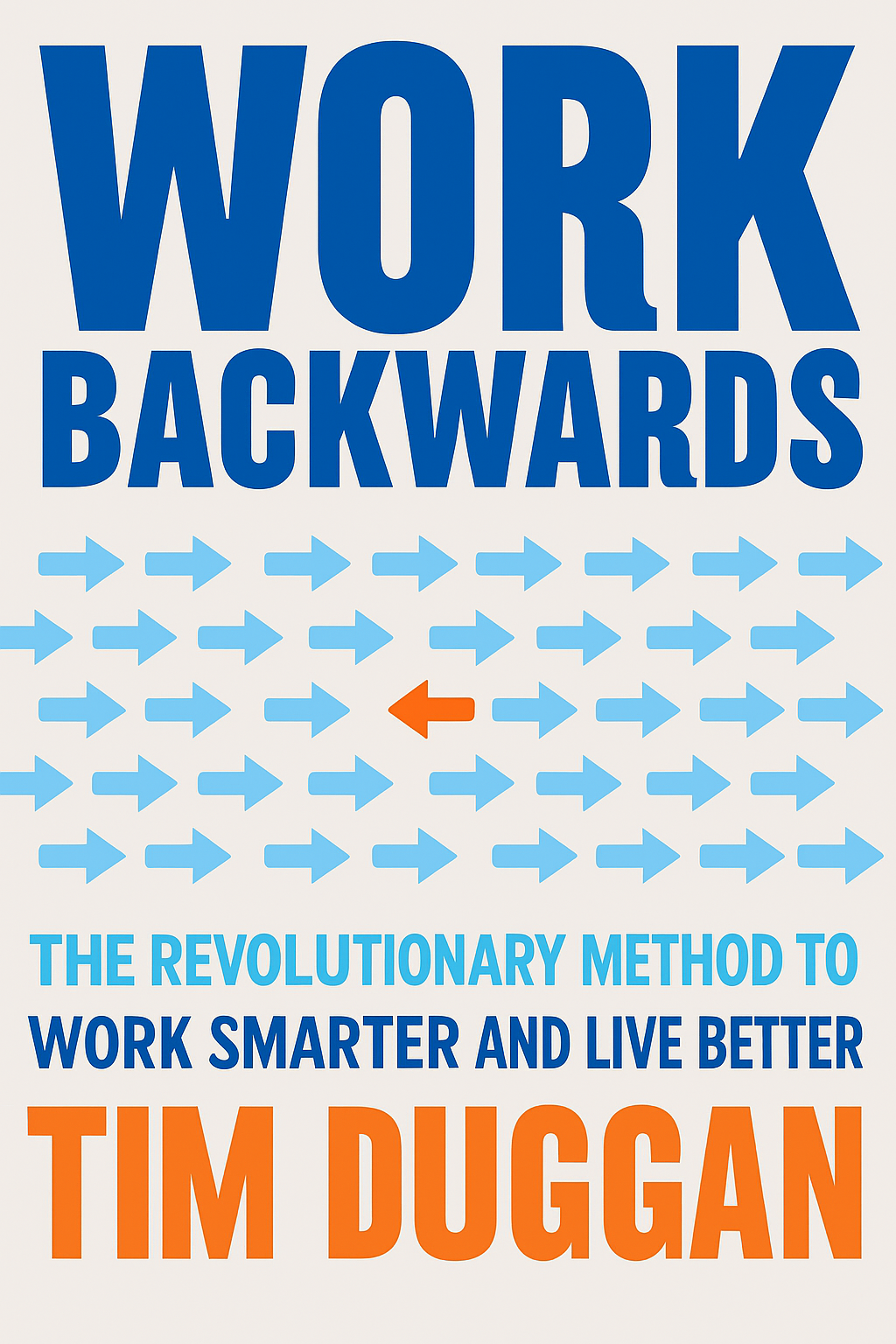
Work Backwards
The Revolutionary Method to Work Smarter and Live Better
Book Edition Details
Summary
In a world where the relentless grind has become the norm, Tim Duggan's "Work Backwards" offers a radical shift in perspective. This transformative guide challenges the status quo, urging readers to flip conventional thinking on its head to rediscover joy and purpose in both work and life. With insights drawn from leading experts on happiness and productivity, Duggan lays out a blueprint for a future where balance isn't just a buzzword but a lived reality. Learn to harness the power of flexible work arrangements, embrace the art of experimentation, and join a burgeoning movement of individuals redefining their relationship with their careers. Seize this unprecedented moment to break free from burnout and reclaim your time, energy, and passion.
Introduction
Tim Duggan stood beside his father's hospital bed, watching the man who had built a successful business over four decades slowly draw his final breaths. In those piercing moments of clarity that come when time stands still, something profound struck him. His father, who had spent years battling cancer while running a company with his name on the front door, wasn't talking about quarterly reports or corner offices. Instead, he spoke of family dinners, adventures on holidays, and time spent on his beloved farm. The business achievements that had dominated so much of his life barely rated a mention. This deathbed revelation became the catalyst for a deeper investigation into our broken relationship with work. Across the globe, millions of people are overworked, disengaged, and increasingly apprehensive about the future. We've built our lives around jobs that drain our energy, consume our time, and leave little room for what truly matters. The pandemic years offered a glimpse of what might be possible when we're forced to step off the hamster wheel, but most of us quickly returned to old patterns without questioning whether there might be a better way. The answer lies not in working harder or finding the perfect job, but in completely reversing how we think about the relationship between work and life. Instead of letting work dictate how we live, we need to start with how we want to live and work backwards from there. This fundamental shift in perspective opens up possibilities we never imagined, allowing us to reclaim our lives from a system that has convinced us to sacrifice everything on the altar of productivity.
The Deathbed Revelation: Why Life Must Come First
Elizabeth Magie had a vision that would challenge everything we believe about winning and losing. In 1904, this progressive woman created The Landlord's Game, designed to demonstrate the evils of capitalism and the beauty of shared prosperity. Her game featured two sets of rules: one called "Prosperity" where everyone won when someone succeeded, and another called "Monopolist" where players ruthlessly eliminated competitors. She intended the contrast to teach players that cooperation was superior to cutthroat competition. Decades later, Charles Darrow discovered Magie's creation, simplified it to include only the monopolistic rules, and sold it to Parker Brothers as his own invention. The game we know as Monopoly became a celebration of the very values Magie had sought to critique. Her name was forgotten, her true intentions buried, and generations of children learned that success meant accumulating wealth while driving others into bankruptcy. This story reveals how deeply our winner-take-all mentality has been embedded in our culture. We've been taught that life is a zero-sum game where we must choose between being successful and being happy, between earning money and spending time with family, between climbing the corporate ladder and maintaining our health. But Magie's original vision reminds us that there's another way to play the game entirely. When we put life first, we create space for work that serves our deepest values rather than consuming them. The deathbed revelation isn't just about regretting the hours we spent in meetings instead of with loved ones; it's about recognizing that we've been playing by the wrong rules all along.
The Finnish Secret: Knowing Your Enough
Frank Martela sits in his office at Aalto University, surrounded by research that tries to explain an impossible paradox. Finland has been named the happiest country in the world for six consecutive years, yet most Finns would describe themselves as quietly melancholic. They don't bounce through their days with permanent smiles or post endless motivational quotes on social media. Instead, they've discovered something far more valuable: contentment with enough. The Finnish approach to happiness isn't about accumulating more possessions, experiences, or achievements. It's about creating a society where basic needs are met, where everyone has access to quality healthcare and education, and where taking the entire month of July off for summer vacation is considered normal rather than luxurious. Their strong social safety net means people feel secure enough to take risks, change jobs, or pursue education without fear of financial ruin. What makes Finland's model so revolutionary is how it challenges our assumptions about what drives satisfaction. In most cultures, we're taught that happiness comes from always wanting more, working harder to earn more money to buy more things. The Finns have discovered that true contentment comes from knowing your enough and being satisfied with it. They've built a society that prioritizes collective wellbeing over individual accumulation, and the result is a population that consistently reports higher life satisfaction despite working fewer hours and owning fewer luxury goods. This Finnish secret suggests that the path to fulfillment isn't about maximizing our income or achievements, but about understanding what we truly need to live well and having the courage to stop there.
The Upside-Down Swan: Tools for Working Better
David Abraham and Andy Law locked themselves in a room in 1995 with a radical vision: to create the workplace of the future. Their advertising agency, St. Luke's, would be owned equally by every employee, decisions would be made democratically, and people would work flexibly from wherever they felt most creative. They called themselves the "upside-down swan" because while most companies tried to appear graceful on the surface while chaos reigned underneath, they chose to let their passionate energy show while maintaining steady progress toward their goals. For five brilliant years, St. Luke's became the most talked-about workplace in the world. Harvard Business Review called it "the most frightening company on Earth" because it challenged every assumption about how businesses should operate. Revenue soared, creative work flourished, and employees reported unprecedented levels of job satisfaction. Fast Company proclaimed it "the ad agency to end all ad agencies," and business leaders from around the globe visited to learn their secrets. But the fairy tale couldn't last. The very idealism that made St. Luke's revolutionary eventually became its downfall. When David wanted to adapt their model to changing circumstances, other employees insisted on maintaining their original principles unchanged. The company that had been founded to break all the rules became enslaved by its own rigid interpretation of those rules. Key founders left, revenue plummeted, and by the mid-2000s, St. Luke's had returned to a traditional corporate structure. The rise and fall of St. Luke's offers crucial lessons about implementing change in our working lives. The tools for creating better work arrangements are available to us now in ways they never were before: remote work, flexible schedules, four-day weeks, career breaks, and technology that can automate routine tasks. But tools are only as effective as our ability to use them wisely. St. Luke's tried to implement every progressive workplace practice simultaneously, without considering how human nature and practical constraints might affect their grand experiment. The key is to choose the right tools for our specific circumstances and implement them gradually, with clear communication and realistic expectations about what they can and cannot achieve.
Summary
The journey from deathbed revelation to workplace revolution reveals a fundamental truth: we've been approaching work and life in completely the wrong order. Instead of starting with what jobs are available and building our lives around whatever salary we can earn, we need to begin with a clear vision of how we want to live and work backwards from there. This reversal isn't just a philosophical shift; it's a practical framework that can transform how we spend our days and ultimately, how we feel about our lives. The stories of Elizabeth Magie's forgotten game, Finland's quiet contentment, and St. Luke's spectacular rise and fall all point to the same conclusion: the rules we've been taught about success and happiness are not only wrong, they're actively harmful to our wellbeing. When we prioritize life over work, define our own version of enough rather than always wanting more, and thoughtfully implement tools that serve our values rather than chasing every new trend, we create space for the kind of existence that won't leave us with regrets on our deathbed. The future of work isn't about finding the perfect job or achieving some mythical work-life balance. It's about having the courage to live deliberately, to question the default path, and to design a life so compelling that work becomes just one part of a much richer whole.
Related Books
Download PDF & EPUB
To save this Black List summary for later, download the free PDF and EPUB. You can print it out, or read offline at your convenience.
By Tim Duggan
