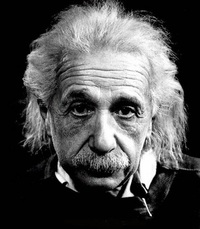
Albert Einstein
Albert Einstein, the German-born theoretical physicist who later became a luminary in the United States, fundamentally reshaped our understanding of the universe. Born in Ulm in 1879 and educated in Switzerland, Einstein's early academic pursuits culminated in a doctoral degree from the University of Zurich. His profound insights during the early 20th century, particularly his special and general theories of relativity, revolutionized the scientific community's conception of space and time, laying the groundwork for modern physics and the eventual harnessing of atomic energy. A pacifist during World War I and a steadfast advocate for social justice, Einstein's ethical convictions were as influential as his scientific contributions. Among Einstein's most significant works is "Relativity: The Special and the General Theory," a text that distilled his groundbreaking theories for a broader audience. His 1905 papers, often referred to as the annus mirabilis papers, introduced concepts that would become foundational in physics, including the photoelectric effect, for which he was awarded the Nobel Prize in Physics in 1921. This particular discovery played a pivotal role in the development of quantum theory. His iconic mass-energy equivalence formula, E=mc², has become synonymous with his name and remains one of the most famous equations in history. Throughout his career, Einstein's research extended into statistical mechanics and quantum theory, where he explored the thermal properties of light and the motion of molecules. Einstein's literary style, characterized by clarity and precision, was matched by his intellectual audacity. He was a visionary who continually pushed the boundaries of theoretical physics, challenging and expanding the prevailing Newtonian mechanics of his time. Beyond his scientific endeavors, Einstein's philosophical musings on religion and ethics revealed a deep commitment to the pursuit of knowledge and humanistic values. His legacy endures not only through his contributions to science but also in his advocacy for peace, as exemplified by the Russell-Einstein Manifesto, which warned against the peril of nuclear weapons. Settling in Princeton, New Jersey, Einstein spent his later years at the Institute for Advanced Study, where his name remains a byword for genius and intellectual curiosity.


by Paul J. Zak
by Rory Vaden
by Robert C. Solomon, Fernando Flores
by Brett Gardner
by Dennis S. Reina
by Julian Baggini
by Larry Downes, Omar Abbosh, Paul Nunes
by Jacqueline Woodson
by Kevin Oakes
by Lindsey Pollak, Kimberly B. Cummings, Kimberly Brown
