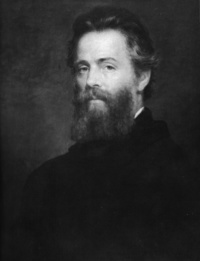
Herman Melville
Herman Melville, an eminent figure of the American Renaissance, was born in New York City in 1819, the third child of a once-affluent merchant family. The early demise of his father plunged the family into financial turmoil, a catalytic event that would later echo through the themes of loss and survival in his literary oeuvre. Melville's seafaring adventures began in 1839, when he embarked as a common sailor, a journey that would profoundly shape his narrative voice and thematic preoccupations. The rich tapestry of his experiences in the South Seas, including his desertion of the whaler Acushnet in the Marquesas Islands, laid the groundwork for his early success as an author of travel-adventures. Among Melville's corpus, "Moby-Dick; or, The Whale" stands as a monumental work, initially met with critical indifference but later heralded as one of the great American novels. This tale of obsession and the human condition encapsulates the existential struggle that defines much of Melville's writing. His earlier works, "Typee" and "Omoo," garnered immediate acclaim for their romanticized yet vivid depiction of Polynesian life, securing Melville's reputation and financial stability. Despite the initial lukewarm reception of "Mardi" and the respectable yet unprofitable "Redburn" and "White-Jacket," Melville's ambition remained undeterred. His short stories, including the enigmatic "Bartleby, the Scrivener," further showcased his ability to delve into the psychological depths of his characters. Melville's literary style is distinguished by its rich symbolism and profound exploration of the human psyche, often interwoven with elements of adventure and philosophical inquiry. His work consistently probes the themes of identity, isolation, and the relentless pursuit of meaning, contributing significantly to the canon of American literature. Later in life, Melville turned his formidable talents to poetry, reflecting on the moral complexities of the American Civil War in "Battle-Pieces and Aspects of the War." Though his final years were marked by personal tragedy and relative obscurity, the posthumous publication of "Billy Budd, Sailor" confirmed Melville's enduring legacy as a master of narrative and a profound commentator on the human spirit.


by Paul J. Zak
by Rory Vaden
by Robert C. Solomon, Fernando Flores
by Brett Gardner
by Dennis S. Reina
by Julian Baggini
by Larry Downes, Omar Abbosh, Paul Nunes
by Jacqueline Woodson
by Kevin Oakes
by Lindsey Pollak, Kimberly B. Cummings, Kimberly Brown
