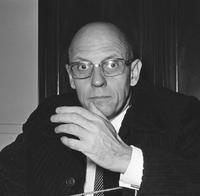
Michel Foucault
Michel Foucault, a luminary in the realm of French philosophy, left an indelible mark on 20th-century thought through his profound exploration of the interplay between power and knowledge. Born in the historic town of Poitiers, France, Foucault's intellectual journey commenced in the hallowed halls of the Lycée Henri-IV and the École Normale Supérieure. There, his philosophical inclinations were nurtured under the guidance of eminent thinkers like Jean Hyppolite and Louis Althusser. His academic pursuits continued at the University of Paris (Sorbonne), where he delved into philosophy and psychology, disciplines that would become the bedrock of his critical inquiries. Foucault's career was characterized by a robust engagement with cultural diplomacy and academia, ultimately leading him to a prestigious position at the Collège de France, where he cemented his reputation as a formidable scholar and activist. Among Foucault's oeuvre, several works stand out for their groundbreaking analysis and enduring influence. "Madness and Civilization: A History of Insanity in the Age of Reason" offers a riveting examination of the societal constructs surrounding mental illness, while "Discipline and Punish: The Birth of the Prison" unveils the mechanisms of social control embedded within penal institutions. "The Order of Things: An Archaeology of the Human Sciences" further exemplifies his methodological innovation, revealing the epistemic shifts that underpin human sciences. These texts, celebrated for their intellectual rigor and depth, have garnered critical acclaim and are now cornerstone readings in disciplines ranging from sociology to cultural studies. Foucault's innovative approach, often described as 'archaeological,' challenged conventional historical narratives and provided a new lens through which to view the structures of society. Foucault's writing, characterized by its analytical precision and theoretical audacity, traversed the intricate landscapes of power dynamics and their manifestations in societal institutions. His works are imbued with a relentless interrogation of historical and cultural paradigms, revealing the subtle yet pervasive mechanisms of control that shape human experience. Renowned for his rejection of labels like structuralism and postmodernism, Foucault nonetheless influenced these movements with his critical methodologies. His legacy extends beyond academia, impacting fields such as feminism, critical theory, and human rights advocacy. Foucault's untimely death in Paris from complications of HIV/AIDS marked the loss of a visionary thinker whose contributions continue to resonate deeply across the intellectual spectrum.
New From Michel Foucault
More Books by Michel Foucault


by Paul J. Zak
by Rory Vaden
by Robert C. Solomon, Fernando Flores
by Brett Gardner
by Dennis S. Reina
by Julian Baggini
by Larry Downes, Omar Abbosh, Paul Nunes
by Jacqueline Woodson
by Kevin Oakes
by Lindsey Pollak, Kimberly B. Cummings, Kimberly Brown
