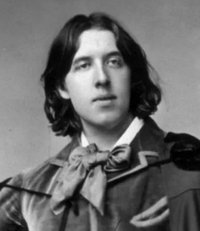
Oscar Wilde
Oscar Fingal O'Fflahertie Wills Wilde, an illustrious figure in the world of letters, emerged from the intellectually vibrant milieu of Dublin, Ireland, where he was born to Anglo-Irish intellectuals. His formative years were marked by an immersion in classical studies at Trinity College Dublin and later at Magdalen College, Oxford, where he honed his linguistic prowess in French and German. Wilde's academic journey was profoundly influenced by the aesthetic philosophy espoused by mentors such as Walter Pater and John Ruskin, which later became the cornerstone of his literary ethos. Settling in London, Wilde quickly became a dazzling presence in its cultural and social circles, captivating audiences with his sartorial flair and scintillating wit. Wilde's literary oeuvre is perhaps best encapsulated by his only novel, "The Picture of Dorian Gray," a work that delves into the sinister allure of eternal youth and beauty, underscored by themes of decadence and moral duplicity. This novel stands alongside his triumphant contributions to the stage, where plays like "An Ideal Husband" and "The Importance of Being Earnest" garnered critical acclaim and cemented his status as a luminary of the late-Victorian theater. Despite the controversial reception of "Salomé," written in French and subsequently banned from the English stage, Wilde's society comedies resonated with audiences and critics alike, securing his reputation as a playwright of exceptional prowess. Wilde's literary style is distinguished by its incisive wit and a masterful command of the epigram, which he wielded to satirize the hypocrisies and foibles of society. His works, characterized by their exploration of aesthetic beauty, moral ambiguity, and social critique, have left an indelible mark on the literary landscape, influencing generations of writers and thinkers. However, Wilde's illustrious career was abruptly marred by his legal battles and subsequent imprisonment for gross indecency, an ordeal that profoundly influenced his later writings, including the poignant "De Profundis" and "The Ballad of Reading Gaol." Exiled to France following his release, Wilde's legacy endures as a testament to his brilliance and the tragic vicissitudes of his life.


by Paul J. Zak
by Rory Vaden
by Robert C. Solomon, Fernando Flores
by Brett Gardner
by Dennis S. Reina
by Julian Baggini
by Larry Downes, Omar Abbosh, Paul Nunes
by Jacqueline Woodson
by Kevin Oakes
by Lindsey Pollak, Kimberly B. Cummings, Kimberly Brown
