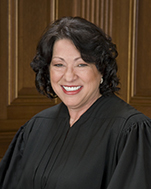
Sonia Sotomayor
Sonia Sotomayor, a distinguished figure in American jurisprudence, has left an indelible mark as the 99th Associate Justice of the U.S. Supreme Court. Born in the Bronx to Puerto Rican parents, her journey from modest beginnings to the nation's highest court is a testament to her tenacity and intellect. A graduate of Princeton University in 1976, where she earned her Bachelor of Arts, and Yale Law School in 1979, where she honed her legal prowess as an editor of the Yale Law Review, Sotomayor's early career was characterized by her unwavering commitment to justice. She began her illustrious legal journey as an Assistant District Attorney in New York County, a role she held with distinction from 1979 to 1984, before transitioning to private practice at Pavia & Harcourt, where she litigated complex international commercial matters until 1992. Her judicial acumen was recognized by President George H.W. Bush, who appointed her to the U.S. District Court for the Southern District of New York in 1992, a position she held until her elevation to the United States Court of Appeals for the Second Circuit in 1998. It was from this esteemed position that President Barack Obama nominated her as a Supreme Court Justice in 2009. In the realm of literature, Sotomayor has captivated readers with her memoir, "My Beloved World," a profound narrative that offers an intimate glimpse into her life and the experiences that have shaped her worldview. The memoir, lauded for its candid and heartfelt exploration of her personal and professional trials, has received critical acclaim for its eloquence and authenticity. This seminal work not only chronicles her rise through the legal ranks but also underscores her enduring commitment to advocacy and education, resonating with readers across the globe as a testament to perseverance and hope. Sotomayor's writing is marked by its clarity and emotional depth, deftly weaving personal anecdotes with broader social themes. Her prose is both engaging and enlightening, offering insights into the complexities of identity and resilience. Through her literary contributions, she has emerged as a leading voice in discussions surrounding justice, equality, and the immigrant experience in America. Her work continues to inspire and challenge readers, reinforcing her legacy as not only a formidable jurist but also a compelling storyteller whose impact transcends the courtroom.


by Paul J. Zak
by Rory Vaden
by Robert C. Solomon, Fernando Flores
by Brett Gardner
by Dennis S. Reina
by Julian Baggini
by Larry Downes, Omar Abbosh, Paul Nunes
by Jacqueline Woodson
by Kevin Oakes
by Lindsey Pollak, Kimberly B. Cummings, Kimberly Brown
