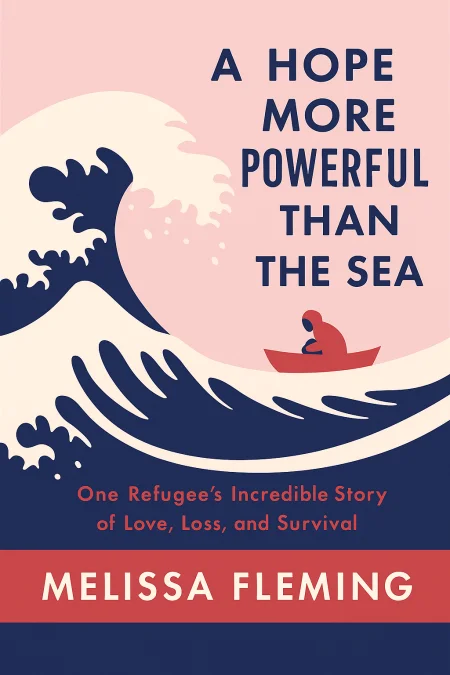
A Hope More Powerful Than the Sea
One Refugee's Incredible Story of Love, Loss, and Survival
Book Edition Details
Summary
In the shadow of Syria's relentless conflict, Doaa Al Zamel's life becomes a harrowing testament to resilience. As political unrest engulfs Egypt, she and her beloved, Bassem, a defiant ex-fighter, dare to dream of a sanctuary across the sea. Their love propels them onto a perilous vessel, joining countless others in a desperate bid for European shores. Yet, amid the Mediterranean's unforgiving waves, disaster strikes, leaving Doaa adrift in a brutal tableau of survival. With only a child's inflatable ring and the weight of two young lives clinging to her, she battles the abyss of despair. "A Hope More Powerful Than the Sea" captures the raw courage of a young Syrian girl navigating the tempest of war, love, and the unyielding quest for hope.
Introduction
In the pre-dawn darkness of a September morning in 2014, hundreds of desperate souls huddled on a Mediterranean beach, their dreams of safety hanging in the balance. Among them was a nineteen-year-old Syrian woman whose journey from revolution to refugee would illuminate one of our era's most devastating human crises. This remarkable story reveals three profound truths about our interconnected world: how ordinary people become swept up in the currents of history beyond their control, how the collapse of one nation can trigger waves of displacement across continents, and how individual acts of courage emerge from humanity's darkest moments. Through one woman's extraordinary ordeal, we witness the brutal arithmetic of survival that millions face daily. Her experience exposes the impossible choices confronting refugees worldwide, the criminal networks that prey on desperation, and the international failures that force people to risk everything for a chance at life. This narrative serves as both a testament to human resilience and an urgent call for understanding the forces that drive people from their homes. Anyone seeking to comprehend the refugee crisis, the Syrian conflict's human cost, or the moral complexities of our globalized world will find essential insights in this deeply personal yet universally significant journey.
From Revolution to War: The Collapse of Syrian Dreams (2011-2012)
The Arab Spring arrived in Syria not with grand pronouncements, but with teenage graffiti scrawled on a school wall in Daraa. In February 2011, fifteen boys spray-painted "Your turn, Doctor," referring to President Bashar al-Assad's medical background. This seemingly minor act of defiance would ignite a revolution that transformed a nation and sent millions fleeing across borders. The boys' subsequent arrest and torture revealed the regime's brutality and sparked the first protests in a country where dissent had been silenced for decades. Doaa Al Zamel watched from her rooftop as peaceful demonstrators filled Daraa's streets, their chants of "We want freedom" echoing through neighborhoods where such words had never been spoken aloud. The seventeen-year-old joined the protests, making revolutionary bracelets and dodging tear gas, embodying the hope of a generation that believed change was finally possible. The demonstrations felt like a festival of possibility, with families gathering to demand dignity and an end to emergency law that had stifled Syrian voices for nearly fifty years. But Assad's response crushed these dreams with systematic violence. The government's crackdown escalated from arrests to sieges, transforming Daraa into a militarized zone where tanks patrolled streets and snipers targeted civilians. The siege of Daraa in April 2011 became a blueprint for the regime's strategy of collective punishment, trapping families in their homes without food, water, or electricity. What began as peaceful protests for reform mutated into armed resistance as the Free Syrian Army emerged from the wreckage of nonviolent opposition. This transformation from hope to horror established the pattern that would devastate Syria for years to come. The regime's unwillingness to accommodate even modest reforms, combined with its willingness to use overwhelming force against civilians, created the conditions for civil war. The dreams of 2011 died in the rubble of Daraa's neighborhoods, replaced by a conflict that would eventually force half of Syria's population from their homes and create the largest refugee crisis since World War II.
Exile and Love: Refugee Life in Egypt Under Morsi's Fall (2012-2014)
Leaving Syria felt like death to Doaa, but staying meant certain destruction. In November 2012, her family joined the growing exodus of Syrians seeking refuge in neighboring countries. Egypt under President Mohamed Morsi welcomed them with open arms and generous policies, offering automatic six-month residency and a chance to rebuild their shattered lives. The family found temporary stability in the coastal city of Gamasa, where hotel owners provided free accommodation and Egyptian neighbors brought food and comfort to traumatized refugees. The warmth of Egyptian hospitality couldn't heal the wounds of displacement. Doaa struggled with depression and the loss of her dreams of becoming a policewoman and attending university. She worked in factories to support her family, her small frame bent over sewing machines and burlap bags, earning barely enough to pay rent. The psychological toll of exile manifested in physical symptoms as she lost weight, developed anemia, and fainted regularly from exhaustion and despair. Into this darkness came Bassem, a fellow Syrian refugee whose persistent courtship slowly melted Doaa's resistance to love. Their engagement in August 2013 brought joy to both families and offered hope for the future. Bassem represented stability and protection in a world that had become unpredictable and dangerous. Their love story unfolded against the backdrop of displacement, with picnics on beaches far from home and dreams of reuniting in Sweden once the Syrian conflict ended. But Egypt's political upheaval in July 2013 shattered this fragile sanctuary. The military coup that ousted Morsi transformed Syrians from welcome guests into suspected threats overnight. Anti-Syrian sentiment exploded across Egyptian society, fueled by propaganda that blamed refugees for the country's problems. Doaa and her sisters faced harassment and attempted kidnappings, while her father lost customers who no longer trusted Syrian barbers. The family that had once symbolized hospitality toward refugees now found themselves trapped between a war-torn homeland and an increasingly hostile host country, setting the stage for their desperate decision to seek safety across the Mediterranean.
The Mediterranean Crossing: Tragedy at Sea and Miraculous Survival (2014)
By September 2014, Doaa and Bassem saw no future in Egypt and no possibility of return to Syria. Europe beckoned as the only escape from their dead-end existence, despite Doaa's terror of water and premonitions of disaster. The couple paid smugglers $2,500 for passage on what they were promised would be a safe journey to Italy, joining the hundreds of thousands attempting the Mediterranean crossing. Their departure on September 6 began a nightmare that would expose the deadly reality behind smugglers' promises and the international community's failure to protect refugees. The fishing boat carrying 500 souls became a floating hell within days. Passengers were crammed together without adequate food, water, or sanitation, transferred repeatedly between unseaworthy vessels to maximize profits and avoid detection. Children cried from thirst while adults prayed for deliverance, their life jackets revealed as fakes that barely provided buoyancy. The smugglers' cruelty became apparent as they struck passengers with sticks and threatened violence against anyone who complained. On September 10, the unthinkable happened. A boat filled with Egyptian men approached at high speed, screaming insults and ramming the refugee vessel deliberately. "Let the fish eat your flesh," they yelled as they watched 500 people plunge into the Mediterranean. The attack was methodical and merciless, designed to murder every man, woman, and child aboard. Most passengers drowned immediately, trapped in the hull or pulled under by the sinking vessel's propeller. Doaa found herself floating on a children's inflatable ring, one of only about 100 initial survivors in a sea littered with corpses. Over four days, she watched fellow refugees die from cold, thirst, and despair while she cradled two toddlers entrusted to her care by dying parents. Bassem, weakened by exposure, slipped from her grasp and drowned after declaring his love one final time. When rescue finally came on September 14, only eleven people remained alive from the original 500. Doaa had kept baby Masa alive through sheer determination, though little Malak died shortly after rescue, breaking Doaa's heart even as she celebrated survival.
Aftermath and Resettlement: Finding New Hope in Europe (2014-2016)
The CPO Japan's crew pulled three survivors from the Mediterranean that day, but Doaa's rescue marked just the beginning of another difficult journey. Greek doctors worked around the clock to save her life and that of baby Masa, whose survival became front-page news across Europe. Doaa's physical recovery took weeks, but the psychological wounds ran far deeper. Nightmares haunted her sleep, and survivor's guilt tormented her waking hours as she struggled to comprehend why she had lived while 500 others, including her beloved Bassem, had perished. Media attention transformed Doaa into an unlikely heroine and symbol of refugee resilience. The Greek Academy of Athens honored her courage with their prestigious annual award, recognizing not just her survival but her determination to save the two children entrusted to her care. Yet fame couldn't heal her trauma or reunite her with the family she desperately missed. Worse, her testimony about the smugglers' crimes triggered death threats against her parents and siblings still trapped in Egypt, forcing them to move repeatedly and live in fear. Doaa's fight for her family's safety became her new mission, replacing her personal grief with fierce determination. Working with UNHCR officials, she navigated the complex bureaucracy of refugee resettlement, using her story's power to advocate for her loved ones' protection. The process took over a year, filled with paperwork, interviews, and waiting that tested everyone's patience. But Doaa refused to give up, knowing that Bassem would have wanted her to protect their family and build the life they had dreamed of together. In January 2016, Doaa's perseverance paid off when Sweden accepted her family for resettlement. The reunion at their new home in the snowy village of Hammerdal was emotional beyond words, as mother and daughter embraced after eighteen months of separation marked by tragedy and triumph. Sweden offered not just safety but opportunity—language classes, education, and the chance to contribute to society. Doaa enrolled in Swedish lessons while dreaming of studying law, determined to fight for justice and ensure that no one else would suffer as her fellow passengers had.
Summary
Doaa's journey illuminates the central tragedy of our time: the transformation of ordinary people into refugees through forces beyond their control. Her story reveals how quickly stability can collapse, turning peaceful neighbors into enemies and forcing families to choose between certain persecution and uncertain death. The Syrian conflict represents more than civil war; it demonstrates how international failures to prevent conflict and protect civilians create cascading humanitarian disasters that span continents and generations. The Mediterranean has become a liquid graveyard where desperation meets indifference, exposing the moral bankruptcy of policies that force people to risk everything for basic human rights. Doaa's survival carries profound lessons for our interconnected world: we must create legal pathways for refugees to seek safety, support countries hosting displaced populations, and address the root causes of forced migration through conflict prevention and resolution. Most importantly, we must remember that behind every statistic lies a human story of loss, courage, and hope. Only by recognizing refugees as individuals with dreams and dignity, rather than as burdens or threats, can we build a world where no one must choose between dying at home and dying at sea in search of safety.
Related Books
Download PDF & EPUB
To save this Black List summary for later, download the free PDF and EPUB. You can print it out, or read offline at your convenience.
By Melissa Fleming
