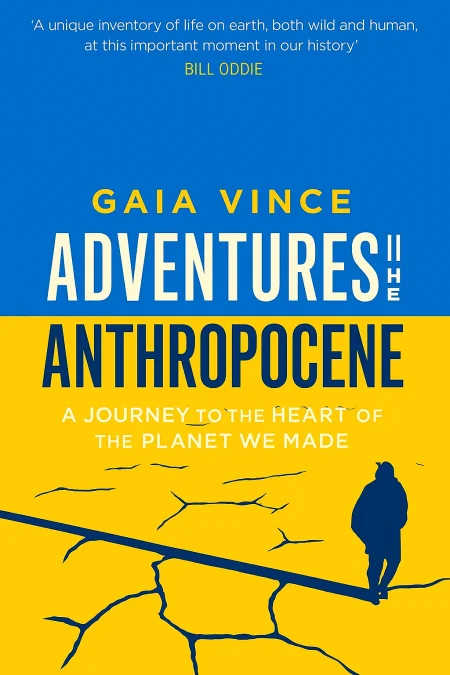
Adventures in the Anthropocene
A Journey to the Heart of the Planet We Made
Book Edition Details
Summary
Gaia Vince, a daring explorer in the realm of science journalism, sets off on a global odyssey that redefines our understanding of survival and ingenuity. In "Adventures in the Anthropocene," she introduces us to everyday heroes wielding extraordinary solutions in the face of an environmental cataclysm of our own making. From Nepal's ice-making innovator to a Caribbean visionary crafting islands from discarded refuse, Vince paints a vivid tableau of resilience and hope. Each story is a testament to human creativity under pressure, underscored by Vince's profound scientific insights. As humanity stands on the brink of the Anthropocene epoch, these narratives illuminate a path through the chaos, offering a beacon of hope amid the looming shadows.
Introduction
Standing at the edge of a retreating Himalayan glacier or watching Pacific islands slowly disappear beneath rising seas, we witness something unprecedented in Earth's 4.5-billion-year history. For the first time, a single species has become powerful enough to rival volcanoes, earthquakes, and ice ages in reshaping our planet's fundamental systems. We have entered what scientists call the Anthropocene - the Age of Humans - where our influence on Earth's atmosphere, oceans, and landscapes has become the dominant force shaping planetary change. This remarkable journey takes us across continents to witness how ordinary people are adapting to extraordinary environmental transformations. From Nepalese farmers creating artificial glaciers to combat disappearing water sources, to Maldivian communities pioneering renewable energy as their nation faces extinction from rising seas, we discover humanity's remarkable capacity for innovation under pressure. These stories reveal both the breathtaking scope of our planetary impact and the ingenious ways communities are engineering solutions that blur the boundaries between natural and artificial systems. Whether you're concerned about climate change, fascinated by human ingenuity, or simply curious about how our species became a geological force, this exploration offers both sobering realities and inspiring hope. It shows us that while we may have inadvertently broken many of Earth's systems, we also possess the creativity and determination to consciously repair and redesign them for a sustainable future.
Industrial Origins and the Great Acceleration (1760-1950)
The transformation began quietly in the English countryside of the 1760s, where coal-powered steam engines first started pumping water from flooded mines. This modest beginning would unleash forces that fundamentally altered humanity's relationship with Earth's energy systems. The Industrial Revolution marked our species' transition from living within natural cycles to harnessing and redirecting planetary energy flows on an unprecedented scale. Within a century, this industrial awakening had spread across Europe and North America, creating the first truly global human impact on Earth's atmosphere. Coal-fired factories belched smoke into previously pristine skies, while steam-powered transportation compressed time and distance in ways that seemed magical to earlier generations. The population explosion that followed was extraordinary - from 1 billion people in 1800 to 1.6 billion by 1900, each person increasingly dependent on fossil fuels for daily existence. The period after 1950 marked what scientists now call the "Great Acceleration" - when human impact on Earth's systems entered an entirely new phase. In just sixty years, global population tripled, economic activity increased twelvefold, and energy consumption surged sixteenfold. Humanity began moving more sediment and rock than all natural processes combined, while pumping enough greenhouse gases into the atmosphere to alter the planet's energy balance for millennia. This acceleration represented more than quantitative change - it was a qualitative shift in humanity's planetary role. We had become a geological force comparable to volcanoes and glaciers, capable of altering Earth's fundamental operating systems. The question was no longer whether humans could influence planetary processes, but whether we could learn to manage our newfound power responsibly as we entered this unprecedented age of human dominance.
Planetary Systems Under Human Dominance (1950-2000)
By the late twentieth century, human influence had penetrated every corner of Earth's natural systems, from the deepest ocean trenches to the highest mountain peaks. The atmosphere itself had become a human artifact, with carbon dioxide levels reaching heights not seen for over 3 million years. The great ice sheets of Greenland and Antarctica, stable throughout human civilization, began their inexorable retreat as global temperatures climbed beyond natural variability. The transformation of Earth's water cycle proved equally dramatic. Massive dams redirected mighty rivers, while groundwater aquifers accumulated over millennia were drained within decades. The Aral Sea simply vanished, leaving salt-crusted wastelands where fishing boats sat stranded like monuments to ecological collapse. Meanwhile, the oceans themselves were changing, becoming more acidic as they absorbed excess carbon dioxide from human emissions. Perhaps nowhere was this transformation more visible than in Earth's living systems. Forests that had stood for thousands of years fell to chainsaws in hours, while species that had evolved over millions of years vanished forever. The great migrations that had defined natural rhythms for eons found their ancient pathways blocked by roads, cities, and agricultural fields. Humanity had inadvertently triggered what biologists recognized as the sixth mass extinction in Earth's history. Yet this period also revealed humanity's growing awareness of its planetary impact. Scientists developed new ways of monitoring Earth's vital signs from space, while environmental movements emerged to challenge assumptions about endless growth on a finite planet. The stage was set for a fundamental reckoning between human ambitions and planetary boundaries, as communities worldwide began experiencing the direct consequences of our transformed Earth systems.
Crisis and Innovation in Earth's New Age (2000-Present)
The early decades of the twenty-first century brought humanity face-to-face with the consequences of its planetary dominance. Climate change manifested in devastating floods, unprecedented droughts, and extreme weather events that disrupted food systems and displaced millions. The stable climate that had nurtured human civilization for 10,000 years was giving way to a new, more volatile planetary state that demanded unprecedented adaptation. Resource depletion accelerated as a growing global middle class demanded material comforts long enjoyed by wealthy nations. Rare earth metals essential for smartphones and solar panels became geopolitical flashpoints, while competition for fresh water intensified in regions already stressed by population growth and changing precipitation patterns. Ecosystems providing essential services - from pollination to water purification - began collapsing under combined pressures of habitat destruction, pollution, and climate disruption. Yet within this crisis emerged remarkable innovations as communities developed solutions that worked with natural systems rather than against them. In Ladakh's high deserts, engineers mastered artificial glacier creation, using stone channels and gravity to freeze winter runoff into ice fields that melted precisely when needed for spring planting. In Gujarat, village leaders used satellite imagery to map underground water channels, then mobilized communities to build check-dams and plant trees that captured every drop of monsoon rain. These innovations succeeded because they combined traditional wisdom with modern technology while involving entire communities in implementation. Mobile phones allowed farmers to access weather forecasts and market prices, while solar panels provided clean energy to villages never connected to electrical grids. The most effective solutions honored both human ingenuity and natural intelligence, suggesting pathways forward that could sustain both human prosperity and planetary health.
Engineering Earth's Future: From Breakdown to Breakthrough
As environmental challenges became undeniable, human creativity and technological innovation began offering glimpses of transformative solutions. Engineers developed artificial trees that could scrub carbon dioxide from the atmosphere more efficiently than natural forests, while scientists experimented with reflecting sunlight back to space to cool an overheating planet. Cities reimagined themselves as living ecosystems, with green roofs, vertical farms, and circular waste systems that mimicked natural cycles. The energy revolution accelerated as renewable technologies achieved cost parity with fossil fuels. Solar panels and wind turbines sprouted across landscapes from the Sahara to the North Sea, while engineers worked to solve intermittent energy storage challenges. Some of the world's poorest communities leapfrogged directly to clean energy, installing solar systems in villages that had never been connected to electrical grids, demonstrating how sustainable development could bypass environmentally destructive industrial phases. Perhaps most importantly, a new generation of leaders emerged who understood that environmental protection and economic development were complementary rather than competing forces. Small island nations threatened by sea-level rise became laboratories for carbon-neutral development, while cities from Copenhagen to Curitiba demonstrated that quality of life could improve even as resource consumption declined. Indigenous communities found their traditional knowledge at the forefront of efforts to develop sustainable relationships with natural systems. The Anthropocene had begun with humanity inadvertently altering planetary systems through industrial activity. But it was evolving into something unprecedented - a geological epoch where a single species consciously took responsibility for managing Earth's life-support systems. Whether this grand experiment in planetary stewardship would succeed remained the defining question of our time, with implications resonating through deep geological time and determining the fate of countless species.
Summary
The central narrative of the Anthropocene reveals a species that became so successful it now threatens the very systems sustaining it. This paradox - that human ingenuity could simultaneously create unprecedented prosperity and existential risk - runs through every aspect of our planetary transformation. From climate disruption to biodiversity collapse, from resource depletion to environmental justice, the challenges we face are fundamentally interconnected, requiring solutions that transcend traditional boundaries between disciplines, nations, and ways of thinking. The historical trajectory from industrial origins through planetary dominance to conscious stewardship offers profound lessons for navigating our future. The pace of change in human-Earth relationships has accelerated exponentially, meaning solutions must be implemented at unprecedented speed and scale. Technological innovation alone proves insufficient without corresponding changes in social values, economic systems, and political structures. Most critically, communities most vulnerable to environmental change often bear least responsibility for creating these problems, demanding approaches rooted in justice and equity. Moving forward, three principles emerge as essential for thriving in the Anthropocene. We must embrace our role as planetary stewards while remaining humble about the limits of our knowledge and control. We need economic systems operating within ecological boundaries rather than treating environmental degradation as acceptable externalities. And we must foster global cooperation on unprecedented scales, recognizing that in an interconnected Earth system, local actions have planetary consequences. The Age of Humans has only just begun, and how we navigate its challenges will determine both our species' fate and the trajectory of Earth's future evolution.
Related Books
Download PDF & EPUB
To save this Black List summary for later, download the free PDF and EPUB. You can print it out, or read offline at your convenience.
By Gaia Vince
