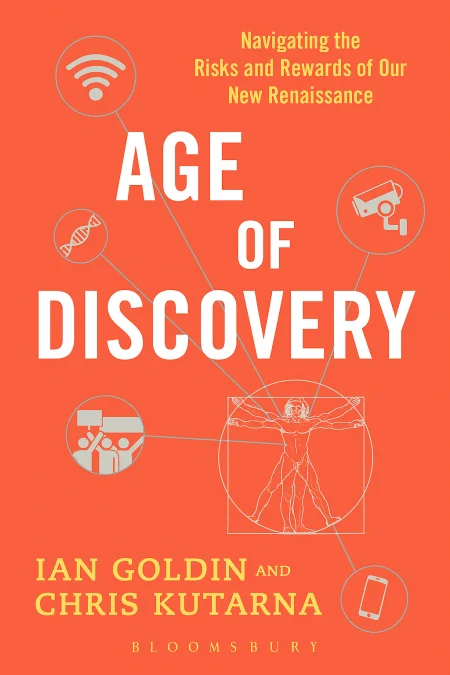
Age of Discovery
Navigating the Risks and Rewards of Our New Renaissance
Book Edition Details
Summary
In an electrifying fusion of past and present, "Age of Discovery" by Ian Goldin and Chris Kutarna paints a vivid tableau of our modern era as a New Renaissance. Five centuries past, titans like Da Vinci and Columbus shattered the confines of their world, igniting a cascade of change and enlightenment. Today, as the echoes of their upheavals reverberate, we stand at a similar crossroads—where technology, global trade, and scientific strides promise to reshape humanity's path. With gripping insight, this book draws daring parallels, urging us to glean wisdom from history's greatest minds. As we navigate a landscape of both wonder and peril, Goldin and Kutarna challenge us to craft a legacy that will echo through time, a testament to our potential in these extraordinary days.
Introduction
In 1543, a Portuguese merchant ship arrived at the Japanese island of Tanegashima carrying an invention that would forever change warfare: the arquebus, an early firearm. Within months, Japanese craftsmen had reverse-engineered the weapon and begun mass production. This moment captures the essence of our Renaissance ancestors' world—a time when revolutionary technologies spread across continents with breathtaking speed, when ancient barriers crumbled overnight, and when humanity's greatest achievements walked hand-in-hand with its most dangerous innovations. Today, we inhabit a strikingly similar epoch. Like those Renaissance Europeans who watched printing presses multiply knowledge while religious wars tore communities apart, we witness artificial intelligence promising miraculous breakthroughs while cyber warfare threatens our digital infrastructure. The same global networks that enable unprecedented collaboration also amplify financial contagion and pandemic spread. Understanding how previous generations navigated these tensions between progress and peril offers crucial wisdom for our current challenges. This exploration reveals how ages of discovery consistently generate both extraordinary human achievements and systemic risks that can spiral beyond our control. Whether you're a leader grappling with technological disruption, an educator preparing students for an uncertain future, or simply someone seeking to understand our turbulent times, these historical parallels illuminate the choices that will determine whether our new renaissance becomes humanity's greatest triumph or its most dangerous gamble.
Renaissance Revolution: Connection, Innovation, and Transformation (1450-1650)
The Renaissance began not with artistic inspiration but with practical necessity. By 1450, Europe faced converging crises that shattered medieval certainties. The Ottoman Empire had severed traditional trade routes to Asia, forcing merchants to seek new paths to prosperity. The printing press, invented around 1440, was democratizing knowledge at unprecedented speed. Meanwhile, navigational innovations enabled explorers like Columbus and Vasco da Gama to connect distant continents for the first time in human history. These pressures catalyzed an explosion of human potential. Leonardo da Vinci embodied the era's spirit by combining artistic genius with scientific observation, designing flying machines while painting the Mona Lisa. Nicolaus Copernicus revolutionized humanity's cosmic worldview through careful mathematical analysis. Niccolò Machiavelli founded political science by studying how power actually worked rather than how it should work. Each breakthrough built upon others, creating cascades of innovation that transformed European civilization within decades. The deeper forces driving this transformation were connection and development. New trade networks linked societies across vast distances, facilitating exchanges of goods, ideas, and technologies. Growing wealth supported larger populations and more complex institutions. Rising literacy rates expanded the pool of minds capable of contributing to intellectual progress. Cities became crucibles of creativity where diverse talents intersected and collaborated in ways previously impossible. Yet this same period witnessed profound instability. Religious wars consumed Europe as new ideas challenged established authorities. Economic disruptions created winners and losers on unprecedented scales. The very networks that enabled progress also spread diseases like syphilis across continents with devastating speed. The Renaissance demonstrated that ages of discovery inevitably generate both extraordinary achievements and extraordinary risks, establishing patterns that continue to shape our world today.
Modern Parallels: Digital Networks and Global Integration Today
Our contemporary moment exhibits the same fundamental forces that shaped the Renaissance, but amplified to planetary scale. Where fifteenth-century Europe saw the emergence of continental trade networks, we witness truly global integration. International commerce has expanded twentyfold since 1950, while digital communications now connect billions of people instantaneously, creating a global nervous system that would have seemed miraculous to Renaissance observers. The developmental forces prove equally striking. Global population has tripled since 1950, while literacy rates have soared from roughly 50 percent to over 85 percent worldwide. Life expectancy has increased by more than twenty years in most regions. Perhaps most remarkably, extreme poverty has declined precipitously even as population exploded, lifting billions from subsistence to middle-class living standards within a single generation. These twin forces create the same conditions that fostered Renaissance genius. Today's global cities serve as modern Florences, concentrating diverse talents and resources in ways that spark innovation. The internet functions as a vastly more powerful printing press, enabling rapid knowledge sharing and collaborative problem-solving on unprecedented scales. Scientific research has become genuinely international, with breakthrough discoveries emerging from teams spanning multiple continents. The parallels extend to systemic vulnerabilities as well. The 2008 financial crisis demonstrated how problems in American housing markets could trigger global economic collapse, much as sixteenth-century banking failures rippled across European trade networks. Modern pandemic threats follow similar dynamics to diseases that swept through Renaissance Europe, exploiting our transportation networks to spread with unprecedented speed. The same digital technologies that democratize knowledge also enable the rapid propagation of misinformation and extremist ideologies, creating modern equivalents of the religious conflicts that plagued Renaissance societies.
Social Upheaval: From Religious Wars to Contemporary Divisions
The Renaissance's greatest achievements coincided with its most devastating social conflicts. The same printing presses that spread humanist learning also amplified religious divisions, culminating in the Protestant Reformation and over a century of warfare. Martin Luther's 95 Theses, posted in 1517, sparked not merely theological debate but social revolution that tore Europe apart. Peasants who had accepted their station for generations suddenly questioned why they should remain poor while church officials lived in luxury. The underlying dynamic was brutally familiar: rapid change created winners and losers, challenging established hierarchies and traditional sources of meaning. New ideas about individual dignity and divine grace undermined the medieval social order but offered no clear replacement. The result was chaos that claimed hundreds of thousands of lives across religious wars, peasant revolts, and witch trials. Communities that had coexisted peacefully for centuries turned violently against each other as competing worldviews became irreconcilable. Today's social fractures follow remarkably similar patterns. The same digital technologies that enable unprecedented global collaboration also amplify division and extremism. Social media platforms that connect diverse communities also create echo chambers that reinforce prejudice and conspiracy theories. Economic globalization that has lifted millions from poverty has simultaneously created new forms of inequality that fuel populist resentment and nationalist backlash. The Renaissance experience reveals how social cohesion depends not just on shared prosperity, but on shared meaning and purpose. When traditional sources of authority lose credibility, societies become vulnerable to extremist movements that promise simple answers to complex problems. Understanding this pattern doesn't make current divisions inevitable, but it does suggest that technological and economic progress alone cannot ensure social stability. Societies must actively cultivate the institutions and values that hold diverse communities together, learning from both the successes and failures of their predecessors.
Future Navigation: Balancing Genius with Risk Management
The Renaissance ultimately teaches us that human societies face a perpetual contest between flourishing genius and flourishing risk. The same forces that enable extraordinary achievements also create new vulnerabilities that can threaten civilization itself. The key insight is that this tension cannot be resolved through simple choices between progress and safety—it can only be managed through conscious wisdom and collective action. Renaissance figures like Niccolò Machiavelli understood that fortune favors the bold, but also that prudence requires preparation for misfortune. The most successful Renaissance cities and states were those that embraced innovation while building robust institutions to manage its consequences. Venice thrived for centuries by combining commercial daring with careful risk management, while other city-states that chose either excessive caution or reckless expansion ultimately failed. Today's challenges require similar balance and wisdom. We must welcome technological genius while mitigating its risks, embrace global connection while building resilience against systemic shocks, and foster individual achievement while maintaining social cohesion. This means investing in education and research while also strengthening public health systems, encouraging entrepreneurship while updating social safety nets, and promoting free expression while combating misinformation and extremism. The Renaissance also demonstrates the crucial importance of virtue—not in a narrow moral sense, but as the cultivation of human excellence in all its forms. Renaissance humanists believed that individuals and societies could consciously develop better versions of themselves through education, practice, and mutual support. This remains our greatest opportunity and responsibility: to shape the future through deliberate choices rather than simply reacting to forces beyond our control. The contest between genius and risk continues, and its outcome depends entirely on the wisdom of our collective response.
Summary
The Renaissance reveals a fundamental truth about human progress: every age of discovery presents both unprecedented opportunities and existential risks. The same innovations that can elevate human civilization can also threaten its survival. This isn't a design flaw in human development—it's an inherent feature of how complex societies evolve and adapt to changing circumstances. The central lesson is that progress isn't automatic or inevitable. It requires conscious effort to nurture genius while managing risk, to embrace beneficial change while preserving essential stability, and to connect globally while maintaining local resilience. The Renaissance succeeded not because it avoided these tensions, but because it ultimately developed institutions and values capable of navigating them skillfully. When those institutions failed, as they did during the religious wars, the consequences proved catastrophic for entire generations. For our own age, this historical parallel suggests three essential priorities. First, we must invest simultaneously in the foundations of human flourishing—education, health, and scientific research—while building robust defenses against systemic risks like pandemics, cyber attacks, and climate change. Second, we must strengthen the social bonds that hold diverse communities together, recognizing that technological connection alone cannot replace the deeper work of building trust and shared purpose. Finally, we must cultivate what Renaissance thinkers called virtue: the habit of acting for long-term collective benefit even when short-term costs seem high. The future belongs to those who can balance boldness with wisdom, innovation with responsibility, and individual achievement with collective wellbeing.
Related Books
Download PDF & EPUB
To save this Black List summary for later, download the free PDF and EPUB. You can print it out, or read offline at your convenience.
By Ian Goldin
