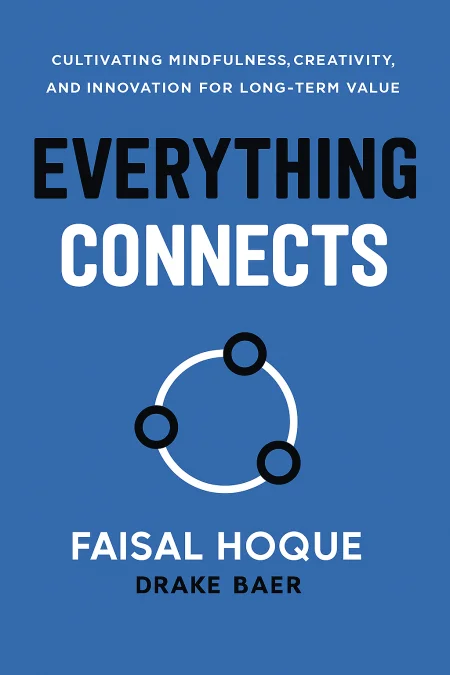
Everything Connects
How to Transform and Lead in the Age of Creativity, Innovation and Sustainability
Book Edition Details
Summary
In an era where the only constant is change, "Everything Connects" by Faisal Hoque offers a vibrant tapestry of wisdom woven from the threads of ancient philosophies and cutting-edge business practices. Hoque, a visionary thinker and serial entrepreneur, guides you through the intricate dance of connecting your inner purpose with external actions to foster innovation and leadership. By drawing lessons from the timeless teachings of Eastern thought and the creative genius of Leonardo da Vinci, this book serves as a compass for navigating the complexities of modern life. Whether you’re a CEO meditating on your next move or a team member navigating the politics of a corporate world, you'll discover how each element of life interrelates, creating a powerful synergy that fuels long-term success. Updated for the challenges of the Fourth Industrial Revolution and a post-pandemic landscape, this edition underscores the essential interconnectedness of work, play, and existence. Embrace this holistic blueprint and transform your professional and personal landscapes into realms of boundless creativity and innovation.
Introduction
Picture a young entrepreneur, barely 17, stepping off a plane in a foreign country with nothing but determination and a dream. This isn't just another success story—it's a journey that reveals something profound about how we work, lead, and create value in our rapidly changing world. What if the greatest innovations don't come from brilliant individuals working in isolation, but from the delicate web of connections between people, ideas, and purpose? In our hyperconnected yet often fragmented business landscape, we're witnessing a fundamental shift. The old rules of rigid hierarchies and efficiency-above-all-else are crumbling. In their place, something more human, more sustainable, and ultimately more powerful is emerging. This transformation isn't just about new technologies or business models—it's about rediscovering the ancient wisdom that everything truly is connected. This book explores how the integration of mindfulness, authenticity, and genuine human relationships creates the foundation for sustained innovation and long-term value creation. Through real stories of entrepreneurs, leaders, and organizations who've learned to thrive in uncertainty, we'll discover how embracing our interconnectedness isn't just good for business—it's essential for creating work that matters and organizations that endure.
From Buddhist Meditation to Silicon Valley Success
Paul Slakey seemed to have it all figured out. A Berkeley engineering graduate working for the prestigious McKinsey & Company at age 34, living the California dream with a beautiful family and promising career. Yet beneath the surface of success, something was deeply wrong. Twelve-hour days, grueling commutes through Los Angeles traffic, and constant pressure to deliver insights to high-paying clients left him increasingly stressed and disconnected from what truly mattered. When a book on mindfulness meditation found its way into his hands, Paul discovered something unexpected. Those first tentative moments sitting in his backyard, eyes closed, simply focusing on his breath, offered relief from the relentless mental chatter. But fear crept in—what if meditation made him lose his competitive edge? What if finding peace meant losing his drive to succeed? So he stopped. For years, Paul convinced himself that spiritual practices were incompatible with ambitious professional life. It wasn't until the dot-com crash left him unemployed and questioning his identity that he returned to meditation, this time out of necessity rather than curiosity. What Paul discovered through this journey mirrors a broader truth emerging in our innovation economy. The very qualities that make us most human—our ability to be present, to connect authentically with others, to find meaning beyond immediate rewards—are precisely what organizations need most to thrive in uncertain times. His story reveals that true leadership isn't about having all the answers, but about cultivating the inner clarity and resilience that allows us to navigate complexity with wisdom and compassion.
Building Human-Centered Organizations That Actually Work
At Yammer, the enterprise social networking company, something remarkable was happening in their Seattle offices. Instead of traditional org charts and fixed hierarchies, employees found themselves working on a "Big Board" where teams formed and disbanded weekly. Engineers might find themselves leading projects one week, then contributing as individual contributors the next. This wasn't chaos—it was intentional organizational fluidity designed to match the rapid pace of innovation. Adam Pisoni, Yammer's Chief Technology Officer, recognized something profound about organizational structure: companies that built themselves around the products they made, rather than the value they created, were destined for disruption. Blockbuster had perfected the art of running video rental stores just as the world was moving toward streaming. Nokia had mastered traditional cell phones as smartphones were emerging. Their expertise became their prison. But Yammer took a different approach. By treating their organizational structure as something to be continuously iterated and improved, they created what Pisoni called "organizational iteration." Nothing was permanent, anyone could suggest changes, and everyone was responsible for thinking about the system, not just their jobs. This rotational structure naturally broke down silos, shared knowledge across teams, and prevented anyone from becoming too attached to old ways of working. The deeper insight here challenges everything we've been taught about management and efficiency. When we prioritize human connections and collective learning over rigid processes and individual heroics, we don't sacrifice performance—we unleash it. The most innovative organizations aren't just collections of talented individuals; they're living systems where relationships become the infrastructure for rapid adaptation and continuous growth.
Creating Sustainable Value Through Authentic Leadership
The story of Orchestra and Mailbox reveals something essential about how breakthrough innovations actually emerge. Gentry Underwood and Scott Cannon had identified a real problem—people were using email as a terrible to-do list—and built an elegant solution. Orchestra To-Do was beautiful, well-designed, and earned recognition as the best productivity app of its year. Yet it failed. The turning point came during a walk through Palo Alto when Underwood watched his wife, one of their most enthusiastic supporters, email him an eBay listing instead of using their app. The realization hit hard: they were asking people to manage two inboxes instead of solving the fundamental problem. Their solution, while technically superior, ignored the messy reality of how people actually work. This failure became their breakthrough. Instead of building a to-do list that worked like email, they reimagined email itself as a gesture-based interface that matched how people naturally triaged messages on mobile devices. Mailbox wasn't just another app—it became what Underwood called "a euphoric inbox," transforming something people dreaded into something they enjoyed using. The journey from Orchestra to Mailbox illustrates a crucial principle of sustainable value creation: authentic innovation emerges from deep empathy for human experience, not just technical sophistication. When we truly understand the contexts people live and work in, when we honor the complexity of their actual needs rather than our assumptions about what they should want, we create solutions that integrate seamlessly into their lives. This is how $100 million acquisitions are born—not from brilliant individual insights, but from persistent, humble attention to how everything connects.
Summary
The transformation from traditional business thinking to genuinely connected, mindful organizations isn't just about adopting new practices—it's about remembering something fundamental about human nature that we've forgotten in our rush toward efficiency and scale. The entrepreneurs and leaders whose stories illuminate this book discovered that their greatest breakthroughs came not from working harder or thinking smarter in isolation, but from cultivating deeper awareness of themselves, genuine care for the people around them, and patient attention to how all the pieces of their work fit together. Whether it's a stressed consultant finding peace through meditation, a tech company embracing organizational fluidity, or entrepreneurs learning from failure to create transformative products, the pattern remains consistent: sustainable success emerges from the quality of our relationships and the authenticity of our engagement with the world. In an age of disruption and uncertainty, our capacity for connection becomes our greatest competitive advantage. The future belongs not to those who can optimize individual performance, but to those who can weave together human potential into something larger, more resilient, and more meaningful than any of us could create alone.
Related Books
Download PDF & EPUB
To save this Black List summary for later, download the free PDF and EPUB. You can print it out, or read offline at your convenience.
By Faisal Hoque
