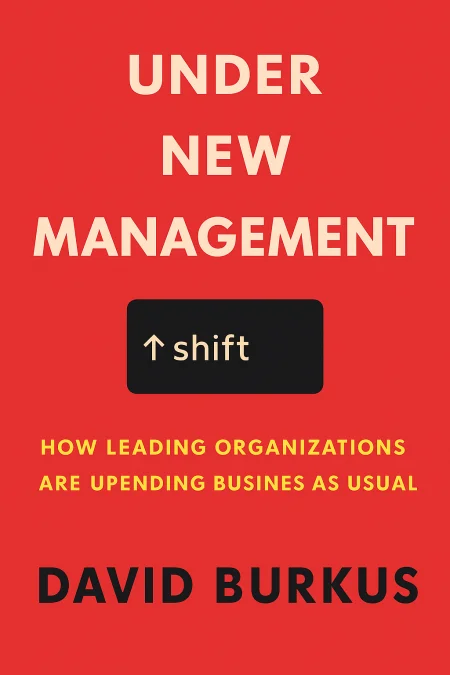
Under New Management
How Leading Organizations Are Upending Business as Usual
Book Edition Details
Summary
In a world where traditional management styles crumble under the weight of modern demands, Dr. David Burkus offers a daring manifesto that will make you rethink everything you thought you knew about leadership. "Under New Management" is not just a book; it's a revolution in print, revealing the radical shifts that are redefining how businesses succeed today. From companies banishing email outside work hours to workplaces where vacations are unlimited and hierarchies nonexistent, Burkus presents a compelling argument for embracing unconventional practices. This groundbreaking narrative urges businesses to dismantle outdated norms, champion employee welfare, and fuel innovation with fresh thinking. It's a wake-up call for leaders ready to shed the shackles of the past and forge a new path forward.
Introduction
Sarah stared at her inbox showing 247 unread emails at 6:30 AM, feeling the familiar knot in her stomach tighten. As a marketing director at a Fortune 500 company, she spent more time managing messages than creating meaningful work. Down the hall, her colleague Mike prepared for another performance review that would rank him against teammates rather than recognize his contributions. Meanwhile, across town, employees at a growing tech company were starting their day differently—no mandatory emails, no rigid vacation policies, no fear of authentic collaboration. The contrast isn't coincidental. While most organizations cling to management practices designed for the industrial age, a quiet revolution is transforming how the world's most innovative companies operate. These pioneers have discovered something profound: the very systems we've trusted to drive success are often the barriers preventing us from achieving it. This exploration reveals thirteen counterintuitive practices that challenge everything we thought we knew about effective leadership. From companies that pay employees to quit, to organizations that eliminate all managers, to workplaces where salaries are completely transparent, these stories illuminate a new path forward. Each practice might seem radical at first glance, but the results speak volumes—higher engagement, increased productivity, and workplaces where people genuinely thrive. The journey ahead will challenge assumptions and inspire possibility. More importantly, it will show you that the future of work isn't about perfecting old systems, but about having the courage to reimagine them entirely.
Disrupting Traditional Communication: From Email Bans to Transparent Salaries
Thierry Breton stood at the crossroads of a radical decision. As CEO of Atos, a global technology company employing 70,000 people, he watched his organization drown in digital communication. Managers were spending up to 20 hours per week reading and writing emails, yet productivity was declining. Employee surveys revealed that most felt overwhelmed by their inboxes and distracted from meaningful work. In February 2011, Breton announced something unprecedented: Atos would become a "zero email" company within three years. The transformation wasn't about eliminating communication—it was about revolutionizing how it happened. Instead of the constant interruption of email notifications, Atos built an internal social network organized around project-based communities. Employees could choose when to engage in conversations rather than having their focus fractured by incoming messages. Training programs helped 5,000 managers learn to lead in this new environment, while 3,500 ambassadors supported their peers through the transition. The results were remarkable. Email volume dropped 60 percent, employee satisfaction soared, and the company's operating margin increased significantly. But Breton wasn't alone in this revolution. From Netflix eliminating traditional vacation policies to companies like SumAll making all salaries completely transparent, forward-thinking leaders are discovering that many communication and transparency practices we consider essential are actually obstacles to authentic connection and trust. These pioneering organizations reveal a fundamental truth: when we eliminate the noise that drowns out genuine dialogue, we create space for the conversations that truly matter. The courage to challenge established communication norms isn't just changing how people work—it's transforming how they connect with purpose and each other.
Reimagining Employee Experience: Unlimited Vacations and Quitting Bonuses
When Reed Hastings announced Netflix's unlimited vacation policy, skeptics predicted chaos. How could a company function without tracking time off? Yet the policy emerged from a simple observation: Netflix didn't monitor when employees worked, so why monitor when they didn't? The company's culture slide deck, viewed over 11 million times, introduced a radical concept—treating employees as responsible adults rather than potential rule-breakers. The transformation went beyond vacation days. Netflix eliminated expense policies in favor of a simple directive: "Act in Netflix's best interest." Instead of bureaucratic controls, the company built a foundation of trust and mutual respect. Employees responded by taking appropriate time off and making thoughtful spending decisions, often saving the company money while feeling more valued and autonomous. Meanwhile, at Zappos, every new employee receives an unexpected offer during their third week of training: $4,000 to quit immediately, no questions asked. CEO Tony Hsieh explains that this "offer" serves a deeper purpose than simply weeding out uncommitted workers. When employees reject the money and choose to stay, they're making a powerful psychological commitment to the company's culture and values. This principle of cognitive dissonance creates something beautiful—employees who stay don't just work for Zappos, they believe in it. The morning after rejecting thousands of dollars to leave, they wake up knowing they chose the company over easy money. That choice transforms their relationship with their work from transactional to transformational. These practices illuminate a profound shift in how we think about employee experience. Rather than assuming people need constant oversight and external motivation, these companies prove that trust and authentic choice create the conditions for extraordinary commitment and performance.
Transforming Organizational Structure: Team Hiring and Flexible Hierarchies
When Boris Groysberg studied Wall Street analysts—professionals seemingly defined by individual brilliance—he discovered something that shattered conventional wisdom. Star performers who switched companies experienced an average 20 percent drop in performance during their first year, and many never fully recovered their previous success. The research revealed a hidden truth: individual excellence is deeply intertwined with team quality and organizational context. The implications were profound. At Whole Foods Market, this understanding led to a revolutionary approach—teams vote on whether new hires become permanent members. After a 60-day trial period, existing team members must give a two-thirds majority approval for someone to stay. This isn't just about cultural fit; it's about recognizing that team performance affects everyone's success, from daily collaboration to profit-sharing bonuses. Matt Mullenweg took this insight even further at Automattic, the company behind WordPress. Instead of traditional interviews, candidates complete real projects with actual teams for several weeks. They write code for live systems, interact with customers, and collaborate on meaningful work while being paid fairly for their contributions. This "trial" process reveals far more than any interview could about how someone actually performs in the role. The wisdom extends beyond hiring to organizational design itself. At companies like Eden McCallum, traditional hierarchies give way to fluid networks that form around projects and dissolve when work is complete. Rather than climbing corporate ladders, people flow to where their skills are most needed and their contributions most valued. These approaches recognize a fundamental truth about human collaboration: the magic happens not in individual genius but in the chemistry between people working toward shared goals. When we design organizations around these connections rather than rigid structures, we unlock potential that traditional hierarchies can never access.
Empowering Human Potential: Open Offices to Managerless Companies
The irony was striking: companies implemented open offices to spark collaboration, but research consistently showed they increased stress, reduced productivity, and made people less creative. At Gerson Lehrman Group, leaders learned that the answer wasn't choosing between open or closed spaces, but giving employees the freedom to choose what worked best for their tasks and temperament. Their redesigned office featured everything from quiet phone booths for private calls to collaborative cafes for team meetings. Employees could start their day in one environment and move to another as their needs changed. The key insight wasn't about office design—it was about control. When people have autonomy over their physical environment, they feel more engaged with their work and more committed to their organization. This principle of autonomy reaches its ultimate expression in companies that eliminate managers entirely. At Valve Software, a billion-dollar gaming company, employees have no bosses, no job descriptions, and no assigned projects. Instead, people rotate among initiatives, contribute where they can add the most value, and organize their own work. New hires spend six months learning to accept that no one will tell them what to do—because they're trusted to figure out what needs doing. Chris Rufer took this approach to an unexpected industry when he built Morning Star, the world's largest tomato processor, as a completely managerless organization. Every employee writes their own mission statement and negotiates agreements with colleagues about how they'll work together. There are no purchasing departments or HR managers—if someone needs equipment or help, they simply buy it or hire it, making their case to affected colleagues. These radical experiments in human autonomy reveal something powerful about human nature: when we trust people to control their own destiny, they rise to meet that trust with responsibility, creativity, and extraordinary commitment. The future of work isn't about managing people better—it's about creating conditions where people can manage themselves brilliantly.
Summary
Throughout history, the most significant breakthroughs have come from those brave enough to question what everyone else accepted as truth. The leaders and organizations in these stories didn't set out to be radical—they simply refused to accept that frustrated employees, bureaucratic inefficiency, and disengaged teams were inevitable costs of doing business. Their experiments reveal a profound insight: many of our most trusted management practices were designed for a world that no longer exists. Email systems that fragment attention, vacation policies that assume distrust, performance reviews that pit colleagues against each other, and hierarchies that stifle innovation—these aren't solutions to modern challenges, they're relics of an industrial age that prioritized compliance over creativity. The path forward requires courage to embrace what initially feels counterintuitive. When we trust employees with unlimited vacation, they take appropriate time off and return refreshed. When we share salary information transparently, people feel more fairly treated and work more collaboratively. When we eliminate rigid hierarchies, teams form naturally around the work that matters most. These aren't just better business practices—they're affirmations of human dignity and potential. The revolution isn't waiting for permission from consultants or approval from boards of directors. It's happening in organizations where leaders choose trust over control, transparency over secrecy, and human flourishing over mechanical efficiency. The question isn't whether these practices will spread, but whether you'll have the wisdom and courage to join the pioneers who are already transforming the future of work, one relationship at a time.
Related Books
Download PDF & EPUB
To save this Black List summary for later, download the free PDF and EPUB. You can print it out, or read offline at your convenience.
By David Burkus
