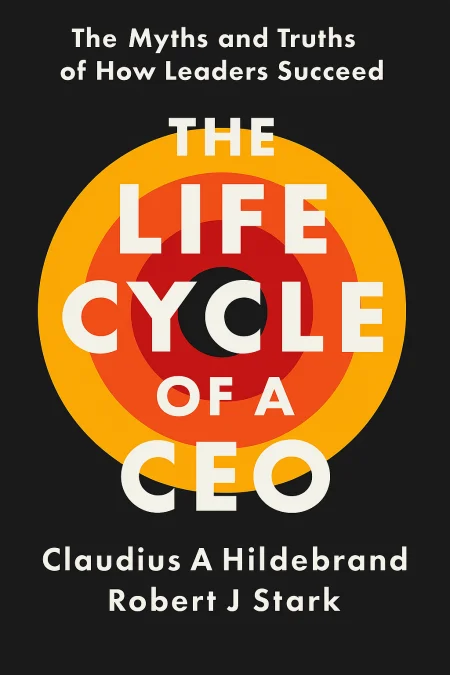
The Life Cycle of a CEO
The Myths and Truths of How Leaders Succeed
byClaudius A Hildebrand, Robert J Stark
Book Edition Details
Summary
In the fast-paced world of corporate giants, becoming a CEO is less a coronation and more a call to continuous evolution. "The Life Cycle of a CEO" is a vivid tapestry woven from the stories of the S&P 500's leaders, revealing an odyssey through five pivotal stages: launch, calibration, reinvention, the complacency trap, and legacy. Authors Claudius A. Hildebrand and Robert J. Stark dismantle the myth of the infallible leader, offering a raw, unfiltered look at the resilience and reinvention required at the helm of modern enterprise. For those aspiring to scale the heights of corporate leadership, this book is a compass, guiding through the turbulent seas of executive life with insights borne from unprecedented research and candid CEO dialogues. Prepare to challenge assumptions and redefine what it means to lead with purpose.
Introduction
Why do some CEOs thrive while others stumble, even when they possess similar qualifications and experience? The conventional wisdom about executive leadership focuses on traits and characteristics, yet fails to explain the dramatic performance variations that occur throughout a CEO's tenure. The reality is far more nuanced: leadership effectiveness follows predictable patterns tied not just to individual capabilities, but to the distinct challenges that emerge at different stages of executive tenure. This framework introduces the CEO Life Cycle model, a systematic approach to understanding how leadership demands evolve over time. Based on comprehensive analysis of over 2,000 CEO tenures, this model reveals five distinct stages that executives navigate, each presenting unique opportunities and pitfalls. The theory challenges the myth of the omnipotent leader who arrives fully formed, instead demonstrating that sustained success requires continuous adaptation and growth. Understanding these stages enables leaders to anticipate challenges, develop appropriate skills, and optimize their performance throughout their journey. This systematic approach transforms executive development from reactive problem-solving to proactive strategic preparation.
The Launch and Calibration Phases: Early CEO Challenges
The Launch phase represents the critical first twelve months when new CEOs must simultaneously master the fundamentals while proving their worth. This stage introduces the hourglass effect, where all organizational components flow through the CEO position, creating unprecedented pressure from multiple stakeholder groups. Unlike previous leadership roles with defined boundaries, the CEO position demands constant navigation between internal operations and external relationships with boards, investors, analysts, and media. The honeymoon period often accompanies this stage, providing initial market optimism and stakeholder support. However, this tailwind can quickly transform into turbulence as reality sets in and early moves are scrutinized. The key challenge lies in balancing decisive action with thorough discovery, requiring both confident leadership and humble learning. CEOs must resist the temptation to rely solely on past experiences, instead adapting their approach to the unique demands of their new environment. The Calibration phase typically emerges in the second year as the initial excitement fades and performance expectations intensify. This stage often features the sophomore slump, where share prices correct from honeymoon highs and analysts apply more rigorous scrutiny to results. The phenomenon reflects market recalibration rather than fundamental performance issues, yet creates significant pressure for CEOs to demonstrate tangible progress. During this phase, informed intuition becomes crucial as leaders must make complex decisions with incomplete information. The challenge involves combining data-driven analysis with experiential wisdom while avoiding the trap of overreacting to market volatility. Successful navigation requires transparent communication with stakeholders, continued board relationship building, and the courage to stay focused on longer-term value creation despite short-term pressures. This stage tests not just strategic acumen but emotional resilience and stakeholder management skills.
Reinvention and Growth: Mid-Tenure Strategic Transformation
The Reinvention stage typically begins around year three when early initiatives start producing measurable results and CEO credibility reaches new heights. This phase represents the strategic inflection point where leaders leverage their established position to pursue transformational initiatives. Having proven their basic competence, CEOs gain latitude to make bolder moves that might have faced resistance during their early tenure. The accumulated trust becomes a powerful resource for driving organizational change and pursuing ambitious growth strategies. This stage demands a fundamental shift from reactive problem-solving to proactive vision-setting. Leaders must expand beyond operational excellence to become architects of organizational transformation. The challenge involves articulating compelling future visions while maintaining current performance levels. Many CEOs discover they must reinvent themselves personally to lead organizational reinvention effectively, developing new competencies in areas like innovation management, cultural transformation, or digital strategy. The great divergence occurs during this period, where high-performing CEOs significantly outpace their peers across multiple metrics. Top performers increase capital expenditure, research and development spending, and revenue growth rates while their lower-performing counterparts often stagnate or decline. This divergence reflects the compound effect of strategic choices made during this critical window. Leaders who successfully navigate this stage often pursue programmatic approaches to innovation and acquisition while building organizational capabilities for sustained competitive advantage. Consider the transformation challenge as analogous to upgrading an aircraft engine while maintaining flight altitude. The complexity requires exceptional coordination between maintaining current operations and building future capabilities. CEOs must balance the promotion focus of pursuing growth opportunities with the prevention focus of protecting existing assets, all while managing increased external expectations and internal resistance to change.
Complacency Trap and Legacy: Late-Stage Leadership Dynamics
The Complacency Trap emerges during years six through ten, presenting a paradoxical challenge where success breeds the seeds of stagnation. Like sailors entering the maritime doldrums, CEOs may find themselves in deceptively calm waters that mask underlying performance deterioration. The status quo bias becomes particularly dangerous during this phase, as leaders become overly satisfied with existing strategies and organizational arrangements rather than driving continuous improvement. This stage is characterized by the revenge effects of success, where previous achievements create overconfidence and reduce vigilance. Leaders may rely too heavily on proven formulas without recognizing changed market conditions or emerging threats. The challenge involves maintaining paranoid vigilance while preserving team morale and organizational energy. External monitoring becomes crucial, yet boards often become more deferential to long-serving CEOs, reducing the natural tension that drives performance improvement. Combat strategies include implementing formal challenge mechanisms, seeking diverse external perspectives, and maintaining disciplined processes for strategic recalibration. The most successful leaders treat this stage as an opportunity for renewal rather than consolidation, pursuing new learning and embracing discomfort as signs of continued growth. They understand that entropy affects organizations just as it does physical systems, requiring constant energy input to maintain order and momentum. The Legacy stage, beginning around year ten, presents the dual mandate of driving continued performance while preparing for succession. This phase demonstrates that the conventional wisdom about optimal CEO tenure length is fundamentally flawed. Data shows that leaders who remain engaged and energized often achieve their strongest performance during these later years, benefiting from accumulated wisdom and established stakeholder relationships. The challenge involves simultaneous acceleration and preparation for departure, similar to a Formula One driver who must brake and accelerate through complex turns. CEOs must avoid the trap of letting their identity become too intertwined with the role while still maintaining the passion necessary for effective leadership. The most successful legacy builders adopt a generativity mindset, focusing on what they can leave behind rather than what they might lose by departing.
Succession Planning and PE Models: Alternative Leadership Frameworks
The succession planning challenge reveals fundamental flaws in how organizations prepare for leadership transitions. Despite succession being widely considered a board's most important responsibility, nearly half of large companies lack meaningful succession plans. The human factors involved create emotional complexity that often derails rational processes, from CEO anxiety about departure to board paralysis in the face of high-stakes decisions. Understanding these dynamics is crucial for creating systematic approaches to leadership development and transition management. Effective succession planning requires treating the process as continuous organizational capability building rather than periodic crisis management. The most successful approaches integrate succession planning with broader talent development systems, creating robust pipelines of prepared leaders while providing development opportunities throughout the organization. This systematic approach addresses diversity challenges, reduces transition risks, and creates competitive advantages through superior leadership development. The private equity CEO model offers an alternative framework that compresses the traditional life cycle into three distinct phases: Proof of Performance, Pivoting to Growth, and Executing the Exit. This accelerated timeline creates intense pressure for rapid results while providing exceptional support through dedicated operating teams and involved boards. The model demonstrates how different governance structures and time horizons fundamentally alter the leadership experience and required skill sets. Private equity CEOs benefit from clearer performance metrics, more engaged boards, and substantial operational support, yet face reduced autonomy and compressed development timelines. The trade-offs illuminate important lessons about governance effectiveness, stakeholder engagement, and the relationship between leadership authority and organizational performance. Understanding these differences helps leaders evaluate career paths and organizational contexts while providing insights for improving traditional corporate governance approaches.
Summary
The CEO journey is not a destination but a continuous cycle of adaptation, growth, and renewal that challenges leaders to evolve constantly while driving organizational transformation. This systematic understanding of leadership stages provides a roadmap for anticipating challenges, developing capabilities, and optimizing performance throughout executive tenure. The framework reveals that sustainable success depends not on heroic individual traits but on the disciplined pursuit of learning, stakeholder engagement, and organizational development across predictable yet challenging phases of leadership evolution.
Related Books
Download PDF & EPUB
To save this Black List summary for later, download the free PDF and EPUB. You can print it out, or read offline at your convenience.
By Claudius A Hildebrand
