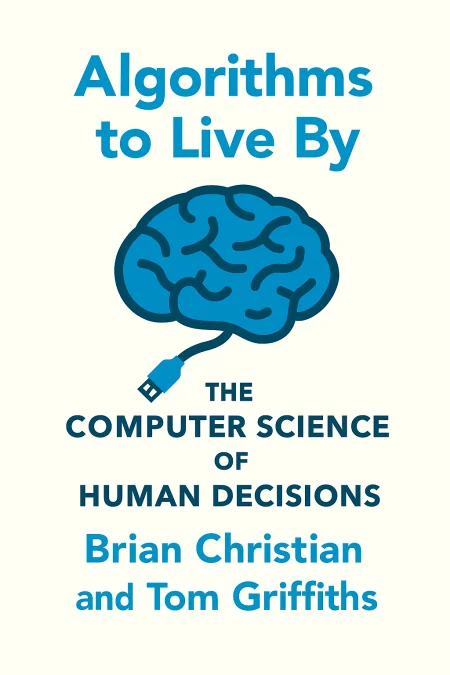
Algorithms to Live By
The Computer Science of Human Decisions
byBrian Christian, Tom Griffiths
Book Edition Details
Summary
Imagine the mind of a computer scientist fused with the soul of a philosopher, and you'll begin to glimpse the brilliance within "Algorithms to Live By." Authors Brian Christian and Tom Griffiths unravel the enigmatic relationship between cold, calculating algorithms and the warm, chaotic world of human decision-making. Our lives brim with choices—some mundane, others monumental. But what if the solutions lie not in our hearts, but in the algorithms that power our technology? This captivating work reveals how the mathematical musings of computer science can illuminate our everyday dilemmas, from choosing a partner to perfecting your daily routine. It’s a guide not just for tech enthusiasts but for anyone eager to decode the algorithm of life itself, transforming the abstract into actionable insights for a more harmonious existence.
Introduction
Every morning, you wake up to a cascade of decisions that seem uniquely human yet mirror the exact challenges that computer scientists have been solving for decades. Should you spend another week searching for the perfect apartment, or settle for the good one you saw yesterday? How do you balance trying that intriguing new restaurant against returning to your reliable favorite? When is the right moment to commit to a relationship, a job, or even just a parking spot? These everyday dilemmas have puzzled humans for millennia, but the solutions have been hiding in plain sight, encoded in the elegant algorithms that power our digital world. The mathematical principles that help computers optimize searches, balance resources, and make efficient decisions offer profound wisdom for navigating life's most perplexing choices. When we understand the computational logic behind good decision-making, we discover frameworks that can transform overwhelming complexity into manageable clarity, helping us live with greater confidence and less regret.
Know When to Stop and Commit
The art of optimal stopping represents one of life's most crucial skills, determining when you've gathered enough information to make the best possible choice. This principle emerges from the mathematical elegance of the secretary problem, where you must choose the best candidate from a sequence of applicants without the ability to return to previous options. The story of astronomer Johannes Kepler perfectly illustrates this challenge in the most human of contexts. After his first wife died in 1611, leaving him with young children to raise, Kepler faced the daunting task of finding a new partner. Rather than rushing into remarriage or endlessly deliberating, Kepler approached this deeply personal decision with systematic precision. He courted eleven different women over the course of two years, carefully evaluating each potential match while learning about his own preferences and the available options. What makes Kepler's approach remarkable is how closely it followed what mathematicians now call the 37% Rule, though he couldn't have known the mathematical foundation. Kepler spent significant time in the exploration phase, gathering information about potential partners and refining his understanding of what would make a successful marriage. When he encountered his eleventh prospect, Susanna Reuttinger, who clearly surpassed all his previous options, he acted decisively. Their marriage proved deeply fulfilling, producing seven children and providing the stable foundation that supported his revolutionary astronomical discoveries. To apply this wisdom in your own life, first estimate the total time or number of options you plan to consider for any major decision. Dedicate the first 37% of that timeframe to pure exploration, observing what's available and calibrating your standards without making commitments. Then, as soon as you encounter an option that exceeds the best you've seen during your exploration phase, choose it confidently. This approach maximizes your probability of finding an excellent outcome while protecting you from both premature settling and paralytic indecision. Remember that the goal isn't perfection but optimization, and the cost of endless searching often exceeds the benefit of marginally better options.
Balance Exploration with Exploitation
The fundamental tension between discovering new possibilities and capitalizing on known successes defines countless decisions throughout our lives. This explore-exploit dilemma appears everywhere from career choices to weekend plans, and computer science offers sophisticated insights into finding the optimal balance through understanding when curiosity serves us and when consistency delivers better results. The story of data scientist Dan Siroker during Barack Obama's 2008 presidential campaign demonstrates this principle with extraordinary stakes. Faced with designing the campaign's main website, Siroker could have relied on conventional wisdom or committee preferences, but instead he implemented a systematic exploration strategy. He tested different combinations of headlines, images, and call-to-action buttons, treating each variation as a hypothesis to be validated through real user behavior rather than assumption. Through methodical A/B testing, Siroker's team discovered that a simple family photo of the Obamas paired with a "Learn More" button dramatically outperformed their initial design featuring a video and "Sign Up Now" text. This finding contradicted the team's intuitions but proved remarkably powerful in practice. The willingness to explore alternatives systematically, measure results objectively, and then exploit the winning combination generated an additional $60 million in campaign donations, demonstrating how strategic exploration can yield transformative results. The key to mastering this balance lies in recognizing that your optimal strategy should shift based on your time horizon and life stage. When you're young or new to any domain, prioritize exploration aggressively. Try different career paths, travel to unfamiliar places, experiment with various approaches to relationships and creativity. The information you gather has enormous long-term value because you have decades to benefit from what you learn. As you age or as deadlines approach, gradually shift toward exploiting your best-discovered options, deepening existing relationships and refining proven strategies. Use the Upper Confidence Bound principle when choosing between alternatives: favor options that either have demonstrated success or haven't been tried enough to judge fairly. This ensures you don't abandon potentially excellent choices due to limited sampling while still capitalizing on proven winners. Remember that the most successful people aren't those who always make perfect choices, but those who explore wisely when they have time and exploit effectively when they need results.
Embrace Optimal Imperfection
The relentless pursuit of perfect solutions often becomes the greatest obstacle to achieving good outcomes, and computer science reveals why embracing optimal imperfection frequently delivers superior results. This principle recognizes that the cost of additional optimization often exceeds its benefits, and that timely good decisions outperform delayed perfect ones. Computer scientist Brian Christian faced this reality when helping plan his friend's wedding reception. The couple wanted to create the perfect seating arrangement for their 120 guests, considering personality compatibility, relationship dynamics, dietary restrictions, and conversation potential. The mathematical complexity was staggering: with 12 tables of 10 people each, there were more possible arrangements than atoms in the observable universe, making exhaustive optimization literally impossible within human timescales. Rather than pursuing impossible perfection, Christian applied computational relaxation techniques to the problem. He identified the most critical constraints—keeping feuding relatives separated, grouping people with shared interests, ensuring each table had engaging conversational dynamics—and focused optimization efforts there. For less crucial considerations, he accepted satisfactory rather than optimal solutions, recognizing that guests would hardly notice whether the third-best seating arrangement differed from the absolute best. The wedding reception was a tremendous success, with guests commenting enthusiastically about how comfortable and engaged they felt at their assigned tables. Christian's willingness to embrace optimal imperfection allowed him to solve the problem well rather than perfectly, delivering excellent results while avoiding the paralysis of endless optimization. More importantly, it freed mental energy for what truly mattered: celebrating meaningful relationships rather than agonizing over minute details. When facing complex decisions in your own life, start by identifying your core constraints and non-negotiable requirements. Focus your optimization efforts on these critical factors, then systematically relax less important criteria, accepting good-enough solutions for secondary concerns. Set explicit time limits for decision-making processes and honor them religiously, recognizing that perfect solutions arriving too late are inferior to good solutions delivered promptly. Apply the 80/20 principle ruthlessly: acknowledge that 80% of your satisfaction typically comes from getting 20% of the details exactly right, and resist the temptation to perfect elements that contribute minimally to your overall outcome.
Summary
The convergence of computer science and human decision-making reveals a profound truth that can transform how we navigate life's complexities: the same mathematical principles that enable machines to process information efficiently offer remarkable guidance for our most challenging personal choices. From knowing when to stop searching and commit, to balancing exploration with exploitation, to embracing optimal imperfection, these algorithmic insights provide frameworks that convert overwhelming decisions into manageable processes. As the research demonstrates, "the best algorithms are all about doing what makes the most sense in the least amount of time," recognizing that wisdom lies not in perfect solutions but in timely, well-reasoned actions that move us forward. Start today by applying the 37% Rule to your next significant decision—whether you're job hunting, apartment searching, or choosing a life partner—spend the first third of your available time learning what's possible, then commit confidently to the first option that exceeds your established standards, trusting that optimal action beats perfect hesitation every time.
Related Books
Download PDF & EPUB
To save this Black List summary for later, download the free PDF and EPUB. You can print it out, or read offline at your convenience.
By Brian Christian
