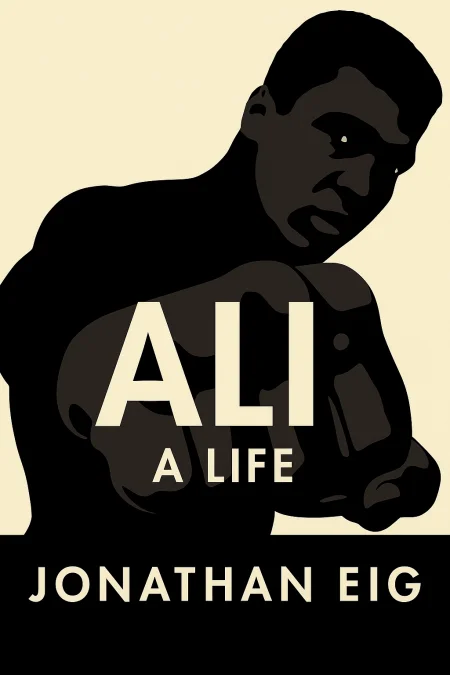
Ali
A Life
Book Edition Details
Summary
In the heart of a divided America, a young Cassius Clay emerges not just as a boxer but as a whirlwind of charisma, defiance, and strength. Jonathan Eig's masterful biography, "Ali," peels back the layers of an icon whose name transcends the sport itself. From the poignant struggles of his Louisville roots to the seismic impact of his conversion to Islam and refusal to fight in Vietnam, Ali’s life is a battleground of ideals and identity. Eig had unparalleled access to Ali’s closest confidants and unearthed forgotten tapes and files that paint a vivid portrait of the man who declared, “I am America.” Here lies a story of courage, race, and a relentless quest for personal truth, revealing the untold complexities of a legend who redefined what it means to be great.
Introduction
On a sweltering February night in 1964, a brash twenty-two-year-old boxer named Cassius Clay shocked the world by defeating the seemingly invincible Sonny Liston to become heavyweight champion. Few could have predicted that this moment would mark the emergence of one of the most transformative figures of the twentieth century. The young man who danced around the ring proclaiming he had "shook up the world" would soon undergo his own profound transformation, evolving from Cassius Clay into Muhammad Ali, a name that would become synonymous with courage, conviction, and the willingness to sacrifice everything for one's principles. Ali's journey unfolded against the turbulent backdrop of the 1960s and 1970s, when America grappled with civil rights, the Vietnam War, and fundamental questions about identity and justice. His story transcends sports, revealing how one individual's unwavering commitment to his beliefs could challenge an entire nation's assumptions about race, religion, and patriotism. Through his remarkable life, we discover the anatomy of authentic leadership, the true cost of standing alone against popular opinion, and the transformative power of using one's platform to advocate for justice. His evolution from Olympic hero to controversial convert to global icon offers profound insights into the nature of courage, the price of fame, and the enduring impact of choosing principle over profit in the face of overwhelming opposition.
The Making of a Champion: From Louisville to Olympic Gold
The foundation of Muhammad Ali's greatness was laid in the segregated streets of Louisville, Kentucky, where Cassius Marcellus Clay Jr. was born in 1942. His early years were shaped by the contradictions of growing up black in America, experiencing both the warmth of a close-knit community and the harsh realities of racial discrimination. The pivotal moment came when twelve-year-old Cassius discovered boxing after his bicycle was stolen, leading him to police officer Joe Martin's gym in search of revenge. What began as a quest for retribution evolved into something far more profound as the young Clay discovered his extraordinary physical gifts and an almost mystical confidence in his own destiny. Clay's amateur career was nothing short of spectacular, marked by an unusual combination of blazing speed, unorthodox technique, and theatrical flair that would later revolutionize professional boxing. Unlike traditional heavyweights who relied on brute force, Clay fought with the grace of a dancer and the speed of a welterweight, keeping his hands low and relying on lightning reflexes to avoid punishment. His style confounded critics who dismissed it as flashy and ineffective, but his results spoke louder than their doubts. He compiled an impressive amateur record while developing the psychological warfare tactics that would become his trademark, learning early that boxing was as much about mental domination as physical prowess. The pinnacle of his amateur career came at the 1960 Olympics in Rome, where eighteen-year-old Clay captured the light-heavyweight gold medal in dramatic fashion. His victory over the experienced Polish fighter Zbigniew Pietrzykowski showcased not only his boxing skills but also his remarkable ability to adapt under pressure and overcome adversity when it mattered most. The triumph in Rome transformed Clay from a promising local fighter into an international celebrity, complete with endorsement deals and a professional contract backed by a syndicate of Louisville businessmen who recognized his commercial potential. Upon returning to America, Clay began his professional career with characteristic confidence and showmanship that had never been seen in heavyweight boxing. He predicted the exact rounds in which his opponents would fall, composed memorable poetry about his fights, and proclaimed himself "The Greatest" long before his record justified such bold claims. While some dismissed his behavior as juvenile braggadocio, Clay understood intuitively that boxing was as much entertainment as sport, and his ability to generate publicity and sell tickets quickly made him one of the most sought-after fighters in the division, setting the stage for his eventual shot at the heavyweight championship.
Conviction Over Career: The Price of Standing for Principle
The transformation from Cassius Clay to Muhammad Ali represented far more than a simple name change; it was a revolutionary act of self-determination that would define the rest of his life. His conversion to Islam and alignment with the Nation of Islam in 1964 shocked a nation unprepared for a black athlete who refused to conform to established expectations. The young champion had chosen spiritual authenticity over commercial appeal, embracing a faith that taught black pride and self-reliance while rejecting what he called his "slave name." This decision immediately made him a lightning rod for controversy, as many Americans viewed the Nation of Islam as a dangerous radical organization that threatened the social order. The true test of Ali's convictions came with his refusal to be inducted into the U.S. Army in 1967, when he declared, "I ain't got no quarrel with them Viet Cong." This stance was rooted in his genuine religious beliefs as a Muslim minister, but it also reflected his growing political consciousness and his understanding of the connection between American racism at home and imperialism abroad. The consequences were swift and devastating: stripped of his boxing license, banned from competition in every state, and facing five years in federal prison. At the peak of his athletic powers, earning millions per fight, Ali was forced into exile, sacrificing what should have been the prime years of his career for his principles. During his three-and-a-half-year banishment from boxing, Ali reinvented himself as a speaker and activist, touring college campuses and spreading his message of resistance to unjust authority. These were years of financial struggle and legal uncertainty, as his case wound through the courts while he survived on lecture fees and the support of those who admired his courage. The mainstream press vilified him as unpatriotic, death threats poured in, and former fans burned his photographs in the streets. Yet Ali never wavered, using his platform to articulate a powerful critique of American foreign policy and racial injustice that resonated with a generation questioning traditional values. The Supreme Court's unanimous decision in 1971 to overturn his conviction vindicated Ali's stance and cleared the way for his return to boxing. By then, public opinion had begun to shift as the Vietnam War grew increasingly unpopular and the civil rights movement evolved into a broader struggle for black power and self-determination. The man who emerged from exile was different from the one who had entered it, aged by years of stress and uncertainty but also transformed into a symbol of moral courage whose influence extended far beyond the boxing ring.
Rope-a-Dope and Redemption: Reclaiming Greatness in the Ring
Ali's return to boxing in 1970 marked the beginning of the most dramatic and legendary chapter in heavyweight history, as he fought to reclaim not only his title but his place in American culture. The years away from competition had cost him speed and reflexes, forcing him to develop new strategies and rely more heavily on his intelligence, endurance, and psychological warfare. This evolution culminated in the development of his famous "rope-a-dope" tactic, a revolutionary approach that turned apparent weakness into devastating strength and would be most memorably displayed in his stunning victory over George Foreman in Zaire in 1974. The "Rumble in the Jungle" represented the pinnacle of Ali's strategic genius and perhaps his last, best chance to reclaim the championship that had been taken from him seven years earlier. At thirty-two, he was considered past his prime, facing a younger, stronger opponent who had demolished Joe Frazier and Ken Norton in devastating fashion. Yet Ali understood something about Foreman that others missed: the champion's awesome power came at the cost of stamina and conditioning. By leaning against the ropes and allowing Foreman to punch himself out while absorbing tremendous punishment, Ali demonstrated a kind of courage that transcended mere physical bravery, enduring apparent defeat in service of a larger strategy. The trilogy of fights with Joe Frazier showcased both Ali's tactical evolution and his capacity for psychological cruelty, as their rivalry became deeply personal and bitter. Their first encounter in 1971, billed as the "Fight of the Century," resulted in Ali's first professional defeat after a brutal fifteen-round war that left both men hospitalized. The psychological warfare surrounding these fights was as intense as the physical combat, with Ali mercilessly taunting Frazier and questioning his intelligence and dignity in ways that deeply wounded a man who had supported him during his exile. The final Frazier fight in Manila in 1975 pushed both warriors to the brink of destruction in what Ali later called "the closest thing to dying that I know of." The "Thrilla in Manila" was conducted in oppressive heat and humidity, with both fighters absorbing tremendous punishment before Frazier's corner stopped the fight after fourteen rounds. This victory cemented Ali's claim to being the greatest heavyweight of all time, but it also marked the beginning of his physical decline, as the accumulated damage from these epic battles would have lasting consequences that extended far beyond his boxing career.
Beyond Boxing: Legacy of an Athlete-Activist
Muhammad Ali's impact extended far beyond the boxing ring, transforming him into a global symbol of resistance, authenticity, and the power of individual conscience to challenge institutional authority. His willingness to sacrifice his career for his beliefs inspired countless others to stand up for their convictions, while his charismatic personality and poetic wit made him one of the most quotable and recognizable figures of his era. From his early boast "I am the greatest" to his principled stand against the Vietnam War, Ali consistently challenged conventional wisdom and refused to be confined by others' expectations of how a black athlete should behave. His influence on the civil rights movement was profound, even if sometimes complicated by his association with the Nation of Islam, which put him at odds with mainstream civil rights leaders like Martin Luther King Jr. Nevertheless, his example of black pride and self-determination resonated with a generation of African Americans seeking their own path to equality and dignity. Ali showed that success didn't require accommodation to white expectations, that a black man could be unapologetically himself and still achieve greatness, paving the way for future generations of athlete-activists who would use their platforms to advocate for social change. The later years of Ali's career were marked by both triumph and tragedy, as his inability to recognize his own limitations led him to fight long past his prime. His speech began to slur noticeably, his reflexes slowed, yet he continued absorbing punishment in increasingly one-sided contests that diminished his legend even as they demonstrated his incredible heart. The brutal defeat to Larry Holmes in 1980 marked the effective end of his career, though by then the signs of Parkinson's syndrome were becoming apparent, gradually silencing the voice that had once commanded the world's attention. Ali's diagnosis with Parkinson's disease added a poignant final chapter to his story, as he faced his illness with the same grace and dignity he had shown throughout his career. His lighting of the Olympic torch in Atlanta in 1996, his hands trembling but his spirit unbroken, provided one of the most moving moments in sports history and reminded the world of his enduring significance. Even in decline, Ali remained a figure of inspiration, showing that true greatness transcends any single arena of achievement and encompasses the courage to remain authentic in the face of overwhelming pressure to conform.
Summary
Muhammad Ali's life stands as a testament to the transformative power of unwavering conviction and the courage to be authentically oneself, regardless of the cost or consequences. His journey from Olympic champion to cultural revolutionary illustrates how true greatness transcends any single field of achievement, encompassing moral courage, social impact, and the willingness to sacrifice personal gain for principle. Ali demonstrated that an athlete could be more than an entertainer, that sports figures could use their platforms to challenge injustice and inspire meaningful social change, establishing a template for athlete-activism that continues to influence public discourse today. The lessons from his extraordinary life remain profoundly relevant: the importance of standing up for one's beliefs even when it's unpopular, the value of authenticity over conformity, and the recognition that true legacy is measured not just in victories but in the positive impact one has on others. For anyone seeking inspiration to pursue their convictions despite opposition, or struggling to balance personal ambition with social responsibility, Muhammad Ali's story provides a powerful blueprint for turning personal struggle into universal triumph, reminding us that the courage to be different can ultimately change the world.
Related Books
Download PDF & EPUB
To save this Black List summary for later, download the free PDF and EPUB. You can print it out, or read offline at your convenience.
By Jonathan Eig
