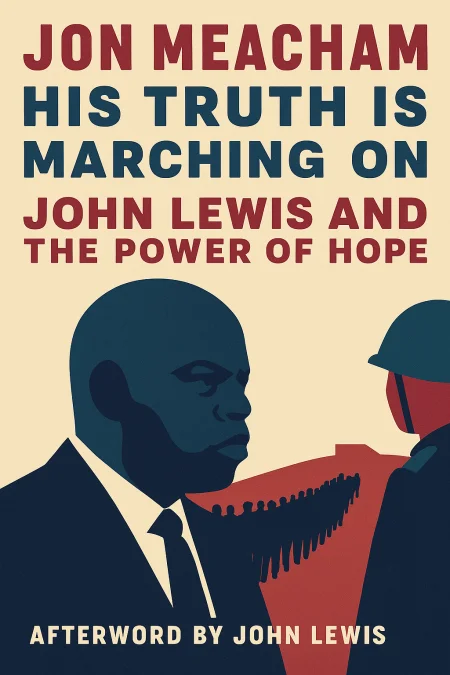
His Truth Is Marching On
John Lewis and the Power of Hope
Book Edition Details
Summary
In the fierce crucible of America's civil rights battleground, where dreams clashed with harsh realities, emerges a tale as poignant as it is powerful. "His Truth Is Marching On" unveils the indomitable spirit of John Lewis, a beacon of hope whose unyielding faith propelled him into history's tumultuous embrace. From the dusty fields of Alabama to the pivotal Selma march, Lewis's journey is a testament to unwavering conviction and moral courage. Jon Meacham's narrative, woven with meticulous research and heartfelt interviews, captures the essence of a man who stood undeterred before adversity, not in defiance of his nation, but out of profound love for its ideals. This masterful chronicle offers readers not just a reflection on past struggles, but a vibrant blueprint for today's quest for justice and equality.
Introduction
On a bridge in Selma, Alabama, in March 1965, a young man named John Lewis stood ready to march into history. As clubs rained down upon his head and tear gas filled the air, Lewis embodied a revolutionary idea: that love could triumph over hate, that nonviolence could defeat brutality, and that ordinary people could transform a nation through extraordinary courage. Born into the sharecropping fields of rural Alabama, Lewis would become one of America's most compelling moral voices, a man who turned the Christian gospel into a blueprint for social change. Lewis's life illuminates three profound dimensions of human possibility. First, his journey from the cotton fields of Pike County to the halls of Congress reveals how individual determination can overcome seemingly insurmountable obstacles. Second, his unwavering commitment to nonviolence in the face of savage brutality demonstrates the transformative power of principled resistance. Finally, his vision of the "Beloved Community" offers timeless wisdom about building a society rooted in justice, compassion, and human dignity. Through Lewis's story, we witness not just the arc of one remarkable life, but the ongoing struggle to fulfill America's founding promise that all people are created equal.
From Alabama Fields to Nashville Awakening
John Robert Lewis entered the world on February 21, 1940, in a shotgun shack in Carter's Quarters, Alabama, where his great-grandfather Frank Carter had been born into slavery. The Lewis family worked as sharecroppers, their lives governed by the brutal rhythms of cotton picking and the harsh realities of Jim Crow. Young Lewis's hands would bleed from the cotton bolls, and he watched his mother's fingers split and harden from years of field work. Even as a child, he possessed an instinctive sense that this system was fundamentally wrong. "Nobody should have to work like this," he would tell his mother, words that revealed an early moral clarity that would define his life. Lewis found his first congregation among the family's chickens, preaching sermons and conducting baptisms for his feathered flock. This childhood ministry was more than mere play; it reflected a deep spiritual calling that would later merge with his passion for justice. When he heard Martin Luther King Jr. on the radio delivering "Paul's Letter to the American Christians," Lewis felt as though "a light turned on in my heart." King's message that Christians must challenge unjust earthly institutions resonated powerfully with the young man who had already begun questioning the segregated world around him. The transformative moment came when Lewis left Alabama for American Baptist Theological Seminary in Nashville in 1957. At this small school known as "the Holy Hill," Lewis encountered professors like John Lewis Powell, who introduced him to Hegelian philosophy and the concept that history moves through thesis, antithesis, and synthesis. More crucially, Lewis discovered the workshops led by James Lawson, a Methodist minister who had studied Gandhi's methods in India. In the basement of Clark Memorial United Methodist Church, Lewis learned the principles of nonviolent resistance that would guide his life. Nashville became Lewis's laboratory for putting Christian love into action. The city's sit-in movement, which began in February 1960, transformed lunch counters into altars of democracy. Lewis and his fellow students, including the brilliant Diane Nash, faced verbal abuse, physical violence, and arrest with remarkable composure. When white thugs beat them and poured detergent on their backs, the students responded with prayers and freedom songs. This wasn't passive submission but active resistance rooted in the radical belief that suffering could be redemptive and that love could overcome hate.
Freedom Rider and March Leader
By 1961, Lewis had emerged as one of the most committed practitioners of nonviolent resistance in the South. When the Congress of Racial Equality announced the Freedom Rides to test interstate transportation desegregation, Lewis immediately volunteered, writing that this was "the most important decision in my life, to decide to give up all if necessary for the Freedom Ride, that Justice and Freedom might come to the Deep South." His willingness to sacrifice everything for the cause reflected a spiritual maturity that belied his twenty-one years. The Freedom Rides revealed both the depths of Southern white resistance and the extraordinary courage of young activists like Lewis. In Rock Hill, South Carolina, he was beaten unconscious by a white mob that included future repentant Klansman Elwin Wilson. In Montgomery, Alabama, Lewis suffered a fractured skull when attacked with a wooden Coca-Cola crate. Each assault only strengthened his resolve. "I was not eager to die, but I was at peace with the prospect of it," he later recalled. This acceptance of potential martyrdom freed Lewis from the fear that paralyzed others and enabled him to act with remarkable boldness. Lewis's leadership qualities became evident during his imprisonment at Mississippi's notorious Parchman Farm, where Freedom Riders were subjected to deliberate humiliation and brutality. Rather than being broken by the experience, Lewis and his fellow prisoners created an informal university, teaching each other and growing stronger in their commitment to nonviolence. The guards tried to silence their freedom songs, but the music continued, a testament to the unbreakable spirit of those who had chosen love over hate. In 1963, Lewis was elected chairman of the Student Nonviolent Coordinating Committee, making him one of the youngest leaders in the civil rights movement. His speech at the March on Washington, though toned down from his original draft, still carried a prophetic urgency that challenged both the Kennedy administration and the American people. Standing at the Lincoln Memorial, Lewis spoke not from the mountaintop like King, but from the valley, representing those whose burdens he knew intimately because they were his own.
Bloody Sunday and the Path to Change
The events of March 7, 1965, began as a peaceful march for voting rights but became a defining moment in American history. Lewis, serving as chairman of the Student Nonviolent Coordinating Committee, led six hundred marchers across the Edmund Pettus Bridge, named ironically for a Confederate general and Ku Klux Klan leader. As they crested the bridge, Lewis saw a sea of blue uniforms blocking their path. When ordered to disperse, he made a fateful decision to kneel in prayer rather than retreat. The violence that followed was swift and merciless. Lewis suffered a fractured skull as mounted police charged into the crowd with clubs and whips, while tear gas filled the air. The images of peaceful protesters being brutally beaten shocked the nation and forced Americans to confront the reality of racial oppression in the South. President Lyndon Johnson, watching the coverage, knew that the moral authority of the federal government was at stake. Within days, Johnson addressed Congress with unprecedented urgency, declaring that "at times history and fate meet at a single time in a single place to shape a turning point in man's unending search for freedom." The president's speech, invoking the movement's anthem "We Shall Overcome," led directly to the passage of the Voting Rights Act. Lewis had literally bled for the right to vote, and his sacrifice helped secure that right for millions of Americans. The years following Bloody Sunday tested Lewis's commitment to nonviolence as never before. The bombing of the Sixteenth Street Baptist Church in Birmingham, which killed four young girls, prompted many to question whether love could truly overcome such evil. The murders of civil rights workers during Freedom Summer in Mississippi seemed to mock the very idea of redemptive suffering. Yet Lewis held fast to his principles, believing that "we truly believed that we were on God's side, and in spite of everything, God's truth would prevail."
Congressional Service and Lasting Legacy
After decades of activism and community organizing, Lewis's election to Congress in 1986 marked a new chapter in his lifelong commitment to justice. Representing Georgia's 5th District, which included much of Atlanta, Lewis brought to Capitol Hill the same moral clarity and unwavering principles that had defined his civil rights work. He quickly established himself as the "conscience of Congress," never hesitating to speak truth to power regardless of political consequences. Lewis's congressional career was marked by his consistent advocacy for voting rights, civil rights, and social justice issues. He played a crucial role in the creation of the National Museum of African American History and Culture and was instrumental in preserving civil rights landmarks and history. His annual pilgrimages back to Selma with congressional colleagues and young people demonstrated his belief that each generation must learn the lessons of the past to protect democracy's future. These journeys became powerful teaching moments, connecting the struggles of the 1960s to contemporary challenges. Perhaps Lewis's greatest contribution to American political life was his embodiment of what he called "good trouble," the willingness to challenge unjust systems through principled civil disobedience. Even as a sitting congressman, Lewis was arrested dozens of times protesting everything from apartheid in South Africa to immigration policies he deemed inhumane. His actions reminded Americans that democracy requires active participation and that elected officials have a moral obligation to stand up for their convictions, even when it's politically inconvenient. Lewis's vision of the "Beloved Community" extended far beyond the immediate goals of desegregation and voting rights to encompass a transformed America where all people could live together in harmony, justice, and mutual respect. His willingness to forgive his attackers and work alongside former enemies demonstrated the practical power of this philosophy. When Elwin Wilson, one of the men who had beaten Lewis during the Freedom Rides, publicly apologized decades later, Lewis embraced him without hesitation, proving that reconciliation was not just an ideal but an achievable reality.
Summary
John Lewis embodied the revolutionary truth that ordinary people, armed with extraordinary love and courage, can bend the arc of history toward justice. His life demonstrated that true strength lies not in the ability to inflict suffering but in the willingness to endure it for a righteous cause, and that the most powerful weapon against hatred is an unshakeable commitment to human dignity and redemption. From Lewis's example, we learn that meaningful change requires both moral clarity and personal sacrifice, that progress often comes through patient persistence rather than dramatic breakthroughs, and that the choice to respond to violence with love is not weakness but the highest form of strength. His vision of the Beloved Community challenges us to see beyond the divisions that separate us and to work toward a society where justice rolls down like waters and righteousness like a mighty stream. For anyone seeking to understand how individual conscience can transform collective consciousness, Lewis's life offers both inspiration and a practical roadmap for turning ideals into reality through sustained moral action.
Related Books
Download PDF & EPUB
To save this Black List summary for later, download the free PDF and EPUB. You can print it out, or read offline at your convenience.
By Jon Meacham
