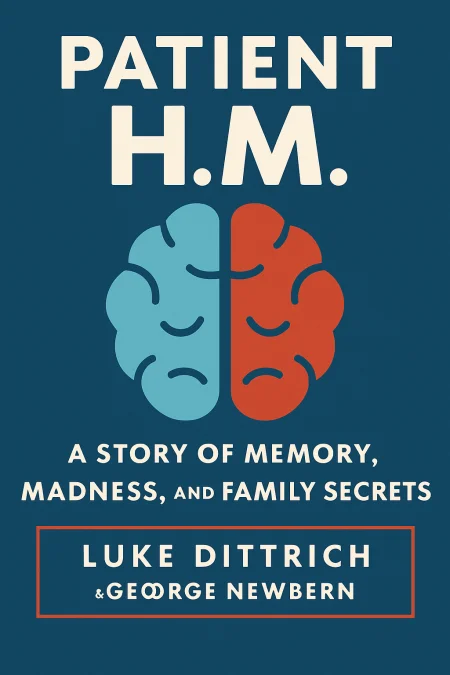
Patient H.M.
A Story of Memory, Madness, and Family Secrets
byLuke Dittrich, George Newbern
Book Edition Details
Summary
In a world where the mind's mysteries beckon the bold and the curious, one man's fate becomes the key to unlocking them. Enter the gripping saga of Henry Molaison, forever known as Patient H.M., whose life-altering surgery in 1953 transformed him into neuroscience's most enigmatic figure. Luke Dittrich takes us on a spellbinding journey through shadowy asylum corridors and gleaming laboratories, revealing a forgotten chapter of American medical history. As pioneering surgeons grapple with ambition and ethics, they tread a perilous path between genius and hubris. Dittrich's personal connection adds a poignant layer, delving into the haunting legacy of his own family. Patient H.M. stands at the crossroads of biography, memoir, and science, offering a mesmerizing exploration of the human psyche's most profound depths and the daring quest to comprehend it. This tale of curiosity, sacrifice, and the boundaries of scientific exploration captivates from the first incision to the last revelation.
Introduction
In the sterile corridors of Hartford Hospital on September 1, 1953, a young man named Henry Molaison underwent what would become the most famous brain surgery in medical history. At twenty-seven, Henry suffered from debilitating epileptic seizures that had stolen his ability to live a normal life. In a desperate attempt to cure him, neurosurgeon William Beecher Scoville removed crucial portions of Henry's brain, including most of his hippocampus. The operation succeeded in reducing Henry's seizures, but it came with an unexpected and devastating cost: Henry could no longer form new memories. What began as a medical tragedy became a scientific revolution that would reshape our understanding of the human mind. Henry, known to researchers as Patient H.M., would spend the next five decades as the most studied individual in the history of neuroscience. His profound amnesia unlocked secrets about how human memory works, leading to groundbreaking discoveries that transformed brain science and helped countless others. Through Henry's extraordinary journey, readers will discover how personal sacrifice can advance medical knowledge, understand the delicate architecture of memory that makes us who we are, and appreciate the complex ethical questions that arise when scientific progress comes at great human cost.
The Making of a Pioneer Neurosurgeon
William Beecher Scoville emerged from a world of privilege and intellectual achievement, born into a family that valued both moral courage and scientific inquiry. Named after his great-grandfather, the famous preacher Henry Ward Beecher, young William grew up surrounded by expectations of greatness. His father, Samuel Scoville Jr., was a successful lawyer and naturalist who instilled in his son a deep curiosity about the natural world and the mechanisms that governed it. This early exposure to scientific thinking would prove formative in shaping William's approach to medicine and his relentless pursuit of innovation. The tragedy that would define much of Scoville's later work struck when he was just fifteen years old. His beloved younger brother Henry died in a bicycle accident, suffering a severe head injury that proved fatal. The loss devastated the family and left an indelible mark on William's psyche. Years later, colleagues would speculate that this early trauma drove his relentless pursuit of treatments for brain disorders, as if he were trying to save the brother he had lost. The shadow of that tragedy would follow him throughout his career, fueling both his brilliance and his willingness to take extraordinary risks. Scoville's path to neurosurgery was marked by exceptional academic achievement and an insatiable appetite for pushing boundaries. After graduating from Yale Medical School, he quickly established himself as one of the most skilled and daring surgeons of his generation. His colleagues nicknamed him "Wild Bill" for his fearless approach both in the operating room and behind the wheel of his collection of sports cars. By the early 1950s, he had become a pioneer in the emerging field of psychosurgery, developing new techniques for treating mental illness through brain operations. His work at Connecticut's state hospitals gave him unprecedented access to patients suffering from severe psychiatric conditions, and he performed hundreds of experimental procedures in his quest to understand how the brain's structure related to its function. It was this combination of surgical skill, scientific curiosity, and willingness to venture into uncharted territory that would lead him to perform the operation that changed Henry Molaison's life forever, creating both a medical tragedy and a scientific breakthrough that would define both their legacies.
The Experimental Surgery That Changed Everything
Henry Molaison's journey to Scoville's operating table began with a childhood bicycle accident that planted seeds of electrical chaos in his developing brain. Born in 1926 to working-class parents in Hartford, Connecticut, Henry had been a normal, healthy child until that fateful day when he was seven years old. Whether the head injury directly caused his later epileptic seizures remains unclear, but by his teenage years, Henry was experiencing increasingly frequent and severe episodes that made normal life nearly impossible. The seizures manifested in devastating ways, with grand mal attacks that left him convulsing on the ground and petit mal episodes during which he would simply absent himself from the world, staring blankly while performing repetitive motions. Despite heavy medication, the seizures continued to worsen throughout his twenties, forcing him to repeat several grades in school and severely limiting his social interactions. By the time his family consulted Scoville in 1953, Henry was having multiple seizures daily, making it impossible for him to hold down a steady job or maintain relationships. On that September morning, Scoville drilled two holes in Henry's skull, just above his eyebrows, and carefully lifted his frontal lobes to access the deeper structures of his brain. With meticulous precision, he removed most of Henry's hippocampus, amygdala, and surrounding tissue from both sides of his brain, areas now known to be crucial for memory formation. The operation proceeded smoothly, with no immediate complications, and by conventional measures, the surgery appeared successful in reducing Henry's seizures. However, within days it became clear that something had gone terribly wrong. Henry emerged from the surgery unable to form new memories, trapped in a condition that would define the rest of his life. Every experience, every conversation, every moment would vanish within minutes. He could remember his childhood and early adulthood with remarkable clarity, but everything after the surgery existed in a perpetual present. What Scoville had intended as a cure had instead created the most profound case of amnesia ever documented, transforming Henry from a patient seeking relief into the most important research subject in the history of neuroscience.
Becoming the Most Studied Patient in History
Following his surgery, Henry became the focus of intensive scientific study that would span more than fifty years, fundamentally altering our understanding of human memory. When neuropsychologist Brenda Milner first tested Henry in 1955, she discovered that while his intelligence remained intact, his ability to form new memories had been almost completely destroyed. Despite his profound amnesia, Henry remained remarkably cooperative and good-natured, greeting each scientist as if meeting them for the first time, regardless of how many previous encounters they had shared. The early studies revealed the extraordinary selectivity of Henry's memory impairment, revolutionizing neuroscience by proving that memory was not distributed equally throughout the brain as scientists had long believed. While he could not form new episodic memories of specific events and experiences, his procedural memory remained intact. Henry could learn new motor skills, such as tracing patterns while looking in a mirror, even though he had no recollection of practicing these tasks. This discovery proved that memory was not a single, unified system but rather comprised multiple, distinct processes controlled by different brain regions. Henry's case became the foundation for modern memory research, inspiring countless studies and theoretical frameworks that mapped the intricate landscape of human memory. Scientists discovered that his hippocampus, the brain region most damaged by surgery, was essential for consolidating new experiences into long-term memory. Without it, Henry lived in a world where the past beyond his early twenties was largely intact, but the present could never become permanent. His condition provided researchers with an unprecedented window into the workings of memory, revealing for the first time how different types of memory were controlled by distinct neural networks. Over the following decades, researchers from around the world traveled to meet Henry, conducting thousands of experiments that would benefit millions of people worldwide. The knowledge gained from studying his unique condition led to breakthrough treatments for memory disorders, influenced the development of new surgical techniques that preserved cognitive function, and deepened our understanding of conditions ranging from Alzheimer's disease to post-traumatic stress disorder. Henry's personal tragedy had become one of the most scientifically productive cases in medical history, though he remained largely unaware of his fame, greeting each day with the same gentle confusion about his circumstances.
Legacy of a Lost Mind
Henry Molaison lived for fifty-five years after his surgery, spending more than half a century in a state of perpetual present, yet his contributions to science extended far beyond his lifetime. When he died in 2008 at age eighty-two, his brain was carefully preserved and studied with cutting-edge technology, continuing to reveal secrets about memory and consciousness. The detailed analysis of his brain tissue confirmed and refined decades of research, providing the most complete picture ever assembled of how surgical damage had affected his remarkable mind. The ethical implications of Henry's case continue to resonate in medical research today, serving as both a catalyst for scientific discovery and a cautionary tale about the responsibilities that come with studying vulnerable populations. As someone who could not remember agreeing to participate in studies, Henry's situation challenged traditional concepts of ongoing consent and raised profound questions about balancing the pursuit of knowledge with the protection of human dignity. His case became instrumental in developing more rigorous ethical guidelines for research involving vulnerable individuals. Henry's influence extends far beyond laboratory walls, making him perhaps the most famous patient in medical history. His story has been featured in countless textbooks, documentaries, and popular science books, inspiring new approaches to caring for patients with dementia and other memory-related conditions. The discoveries made possible by studying his condition have led to targeted treatments for memory disorders and influenced everything from educational techniques to rehabilitation methods for stroke patients. The battle over Henry's brain after his death reflected the intense scientific interest his case had generated, with multiple institutions claiming they could best serve the cause of advancing human knowledge. This controversy highlighted the ongoing tension between scientific ambition and respect for human dignity, even after death. Yet Henry's legacy lives on not only in the scientific knowledge he made possible, but in the countless patients who have benefited from the treatments and understanding that emerged from his extraordinary sacrifice, ensuring that his profound loss contributed something meaningful to humanity's understanding of itself.
Summary
Henry Molaison's transformation from epilepsy patient to the most studied individual in neuroscience history represents one of the most profound contributions to human knowledge in the twentieth century, demonstrating how individual sacrifice can illuminate universal truths about memory, consciousness, and what makes us human. His case revealed that memory is not a single faculty but a complex system of interconnected processes, fundamentally changing how we understand learning and the architecture of the mind while raising enduring questions about the ethics of medical research and the responsibilities we bear toward vulnerable populations. From Henry's extraordinary journey, we learn that scientific progress often comes at great personal cost, and that those who contribute to our understanding deserve both recognition and protection. His story reminds us to approach medical innovation with both courage and humility, recognizing that behind every breakthrough lies a human being whose dignity must be preserved. For anyone interested in neuroscience, medical ethics, or the remarkable resilience of the human spirit, Henry's legacy offers profound insights into how we can use knowledge responsibly to help others while honoring the individuals who make such discoveries possible.
Related Books
Download PDF & EPUB
To save this Black List summary for later, download the free PDF and EPUB. You can print it out, or read offline at your convenience.
By Luke Dittrich
